
Every year on 21 February the world marks International Mother Language Day, and the date belongs to Bengali. On that day in 1952, police in Dhaka opened fire on students demanding that Bengali be recognised as a state language of what was then Pakistan, and several people were killed. UNESCO chose the date in 1999. Few languages carry quite that weight for the people who speak them, which is worth knowing if you're about to learn Bengali: people notice, and warm to you, when an outsider makes the effort. The way in is simple enough: give the script two weeks, then enjoy a grammar with no genders to memorise.
Where Bengali is spoken, and which Bengali to learn
Bengali, or Bangla as its speakers call it, is the national language of Bangladesh and the main language of the Indian state of West Bengal, as well as of Tripura and the Barak Valley in Assam. Roughly a quarter of a billion people speak it, which puts it among the ten most spoken languages in the world. Britain has a large Bengali community, concentrated in London's East End, and there are many more speakers in the Gulf and North America.
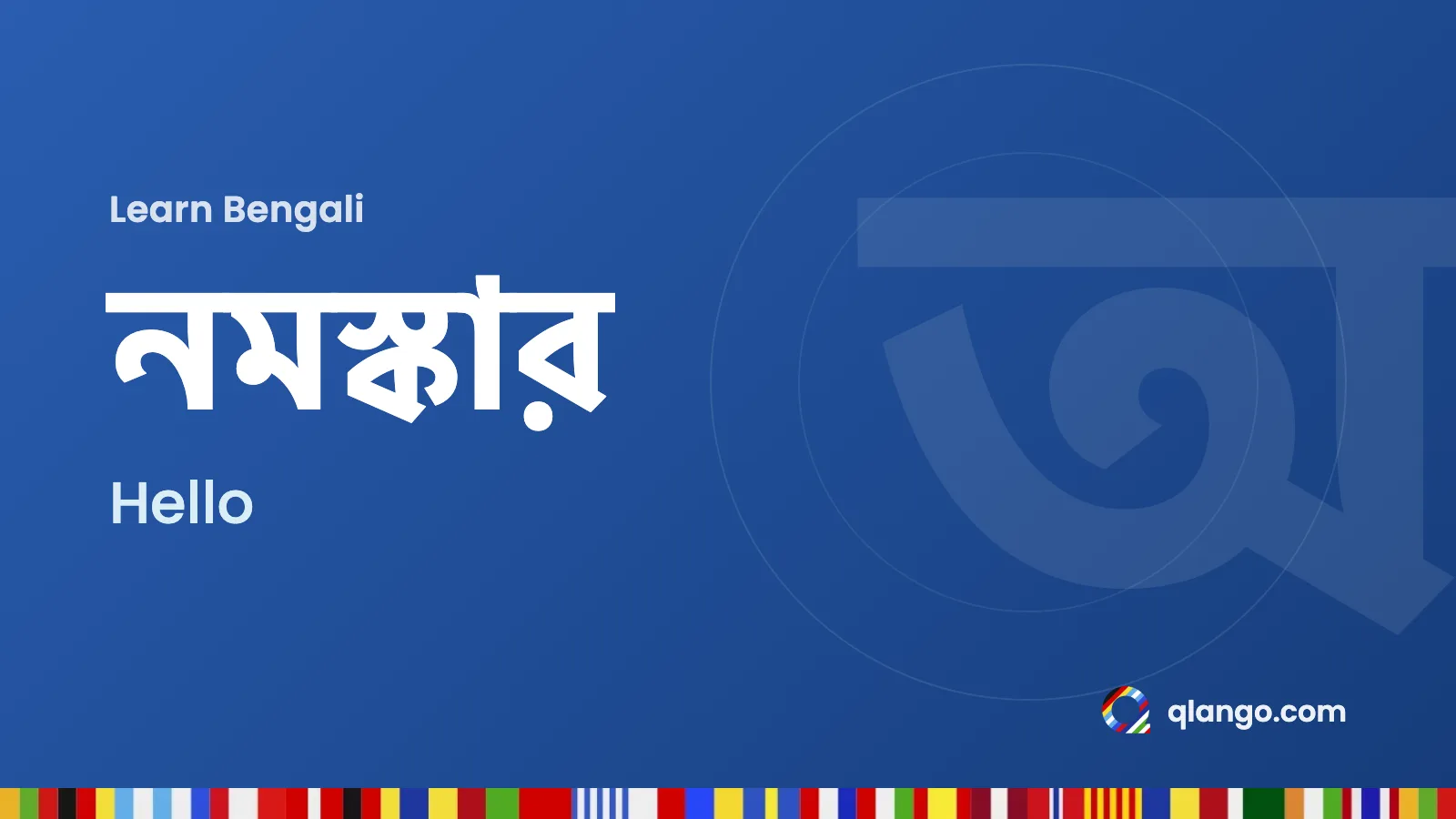
The standard language grew out of the educated speech of the Kolkata region and is understood everywhere, but Dhaka and Kolkata sound different and sometimes choose different words. Water is জল (jol) in West Bengal and পানি (pani) in Bangladesh; "hello" is নমস্কার (nomoskar) among many Hindus and আসসালামু আলাইকুম (assalamu alaikum) among Muslims. Many British Bangladeshi families speak Sylheti at home, which differs a good deal from standard Bengali, so if your reason for learning is a family from Sylhet, expect some surprises at the dinner table.
How to learn Bengali script
Bengali has its own script, written left to right, with most letters hanging from a line along the top. It's a cousin of Hindi's Devanagari rather than a copy. Each consonant carries a built-in vowel, and in Bengali that vowel is an o, not an a: কলম (kolom) is "pen". At the end of a word it usually disappears, so নাম is nam, "name". Other vowels are marks attached to the consonant, and some sit in surprising places: the i in কি (ki) is written before the k, and the o in কো (ko) wraps around both sides of it.
Two more things take time. Conjuncts, called juktakkhor, merge two or three consonants into one shape. Some are easy to decode, like ন্ত (nt) in শান্ত (shanto, calm); others, like ক্ষ in ক্ষমা (khoma, forgiveness), have to be learned as pictures. Then there's spelling: শ, ষ and স are usually all pronounced sh, ন and ণ are the same n, and জ and য are usually both j. Reading is easier than spelling, which suits a beginner nicely.
Two weeks of daily practice will have you reading signs and simple words slowly. The conjuncts will keep turning up for months, one at a time, and that's normal.
What English speakers find easy
No grammatical gender
Bengali doesn't care whether a noun is masculine or feminine, and neither do its verbs. Even the pronoun is neutral: সে (she) means "he" or "she", which English speakers find either confusing or very funny.
No "to be" in simple sentences
আমি ছাত্র (ami chhatro) is "I am a student", word for word "I student".
Regular verbs
Verbs change for person and for politeness, not for gender or number: আমি করি (ami kori, I do), তুমি করো (tumi koro, you do), আপনি করেন (apni koren, you do, politely), সে করে (she kore, he or she does), and আমরা করি (amra kori, we do) uses the same form as "I".
What English speakers find hard
The verb comes at the end, and "in", "at" and "to" are endings on the noun: বাড়িতে (barite) is "at home". Nouns take a small counting word: একটা বই (ekta boi) is "a book", and বইটা (boita), with that word moved to the end, is "the book". "Not" comes after the verb: আমি জানি না (ami jani na), "I don't know". There are three words for "you", তুই (tui), তুমি (tumi) and আপনি (apni), from intimate to polite; use apni with strangers. And Bengali separates plain and aspirated consonants and has a set of sounds made with the tongue curled back, as Hindi does. Both are Indo-Aryan languages, so anyone who knows some Hindi will recognise plenty of words.
First words in Bengali
- নমস্কার (nomoskar) or আসসালামু আলাইকুম (assalamu alaikum): hello, as above
- ধন্যবাদ (dhonnobad): thank you
- হ্যাঁ (hyan) and না (na): yes and no
- আপনি কেমন আছেন? (apni kemon achhen?): how are you?, politely
- ভালো আছি (bhalo achhi): I'm well
- আমার নাম ... (amar nam ...): my name is ..., with no verb at all
- জল (jol) or পানি (pani): water, and a small clue to where someone is from
- আমি বাংলা শিখছি (ami bangla shikhchhi): I'm learning Bengali, the sentence that earns the warmest smiles
A realistic first month
Weeks one and two are for the script: the vowels and their signs, the consonants and a handful of common conjuncts, with ten minutes of reading aloud every day. Learn the greetings above in parallel so you have something to say from day one.
In week three, collect forty everyday nouns, practise them with একটা and টা, and learn the present tense of a few verbs: করা (kora, to do), যাওয়া (jaoa, to go), খাওয়া (khaoa, to eat). Bengali "eats" water and tea as well as rice, so খাওয়া will get plenty of use.
In week four, write five short sentences a day about yourself, swap messages with a Bengali speaker or another learner, and keep a list of every conjunct you meet. Short daily reviews matter more than long sessions; our article on vocabulary learning methods explains why.
How Qlango helps you learn Bengali
Qlango teaches Bengali at A1 and A2. A2 on the CEFR scale means you can manage simple, routine exchanges and describe your background, your surroundings and your immediate needs, which is a solid footing for family visits and travel. While the script is new you can show a Latin transliteration under the words and switch it off when you're ready. Flashcards, find-the-pairs and pick-one-of-four exercises keep the conjunct-heavy words in rotation, spaced repetition brings each one back before it fades, and the weekly learning plan, streaks and statistics keep the twenty minutes a day honest.
You choose the language you learn through, so it can be your native language rather than English. The course is free to start, and Premium brings offline learning and an AI teacher, with no limit on questions, for counting words, verb forms or anything else in the grammar. All courses and levels are on the languages page.
Jol or pani will depend on whose kitchen you end up in. The script is the same in both, and two weeks of it, with Qlango's A1 lessons as the daily practice, is enough to start reading signs slowly in Dhaka and Kolkata alike.


