
The Camino de Santiago finishes in Santiago de Compostela, the capital of Galicia, and somewhere on the last stretch the pilgrims who have been wishing each other buen camino since the Pyrenees start seeing bo camiño instead. Nearly the same words, in a different language. For a good number of walkers, that waymark is where the wish to learn Galician begins.
Galician is a Romance language from the north-west corner of Spain. If you know Spanish or Portuguese it will feel close from the first day, and if you don't, it's still one of the friendlier languages for English speakers. Start with the spelling and the pronoun habits that set Galician apart, then build everyday vocabulary, and, if you speak Spanish, spend your energy keeping the two apart. A month at fifteen to twenty minutes a day gets you through greetings, introductions and simple conversation about yourself.
Where Galician is spoken
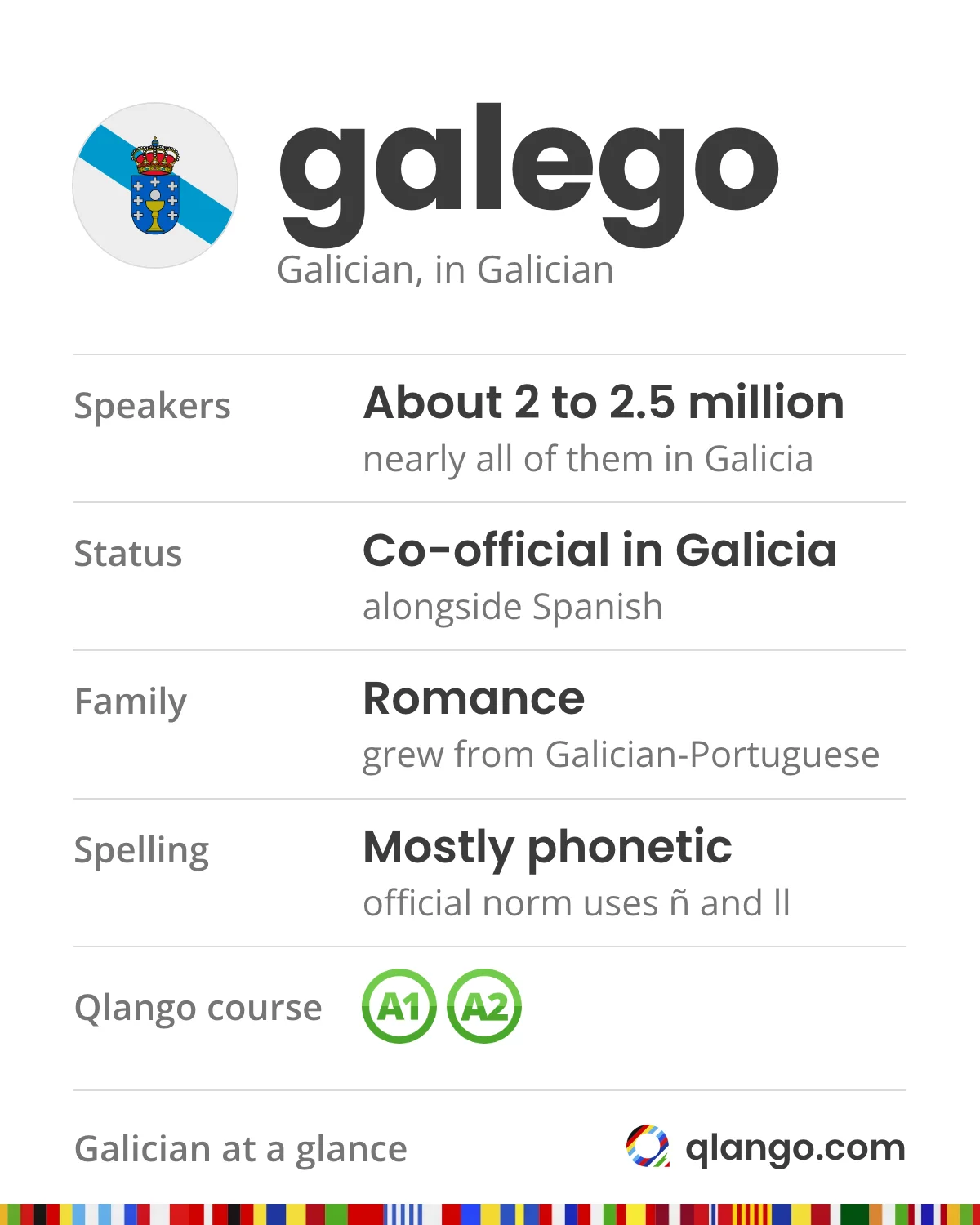
Galician, galego, is co-official with Spanish in Galicia, and it's also spoken in neighboring strips of Asturias, León and Zamora. Somewhere around two to two and a half million people speak it, nearly all of them in Galicia, where it's the language of the regional government, the Xunta, of TVG, the regional television, and of a great deal of everyday life, especially outside the cities. Galicia also sent huge numbers of emigrants to Latin America, so many to Argentina that Argentines still call all Spaniards gallegos.
How Galician relates to Spanish and Portuguese
Galician and Portuguese grew from the same medieval language, Galician-Portuguese, which in the Middle Ages was the language of lyric poetry across much of the Iberian Peninsula. The two drifted apart after Portugal became an independent kingdom, and Galician spent centuries under the influence of Spanish. They are still largely mutually intelligible, especially on paper. The official spelling, set by the Royal Galician Academy, uses Spanish-style conventions such as ñ and ll; a minority movement, reintegrationism, writes Galician in a Portuguese-style spelling instead. Learn the official norm first, since that's what you'll see on signs and in schools.
| English | Galician | Spanish | Portuguese |
|---|---|---|---|
| thank you | grazas | gracias | obrigado |
| good morning | bos días | buenos días | bom dia |
| people | xente | gente | gente |
| water | auga | agua | água |
| milk | leite | leche | leite |
| hand | man | mano | mão |
| Thursday | xoves | jueves | quinta-feira |
The last row is a good reminder that Galician is a language in its own right, not a halfway point between the other two.
What's easy and what's hard
For English speakers
The easy part is the Romance vocabulary, which overlaps with the thousands of words English took from French and Latin, and a spelling system that is mostly phonetic. The US Foreign Service Institute, which rates languages by difficulty for English speakers, puts Spanish and Portuguese in its easiest group. Galician isn't on its list, but it's built from the same material. The hard part is the verbs, with their many tenses and persons, as in any Romance language, and seven vowel sounds where the spelling shows five: e and o each come in an open and a closed version.
For Spanish speakers
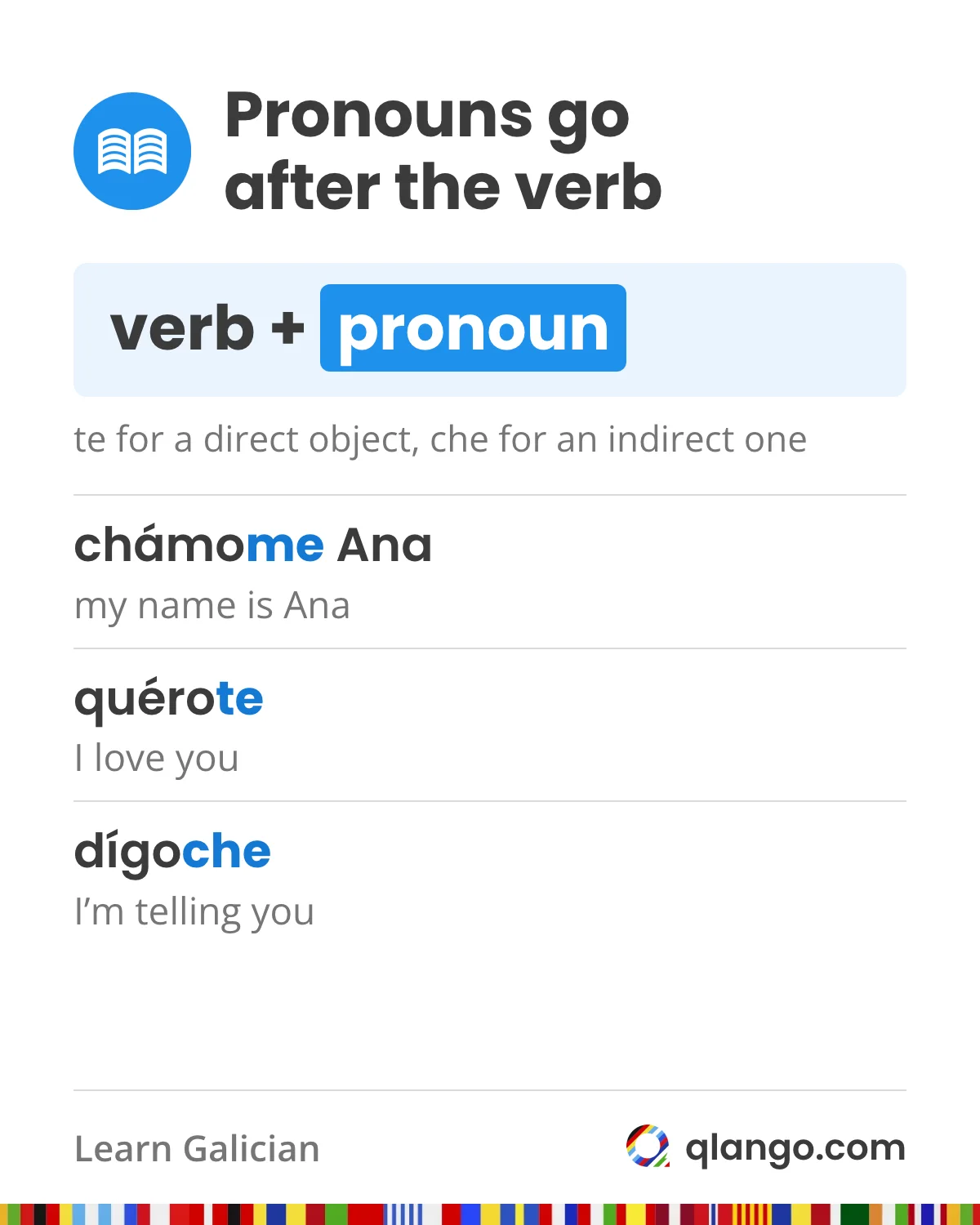
You'll understand a lot from day one, which is exactly the danger. Galician puts object pronouns after the verb where Spanish puts them before, so it's chámome Ana, not me llamo Ana. It distinguishes te for a direct object from che for an indirect one: quérote means I love you, but dígoche means I'm telling you. It has an inflected infinitive, as in antes de saírmos, before we leave. It has false friends, too: a rapaz in Galician is a young man, not a bird of prey. A careless blend of Spanish and Galician even has a name, castrapo, and it isn't a compliment. In parts of the west you'll also hear the gheada, a g pronounced close to an English h.
Galician for your first day
- Ola: hello
- Bos días: good morning; boas tardes, good afternoon; boas noites, good evening or good night
- Que tal?: how are you?
- Chámome Ana: my name is Ana
- Encantado or encantada: pleased to meet you
- Grazas and moitas grazas: thanks, and thank you very much
- Por favor: please
- Si and non: yes and no
- Adeus and ata logo: goodbye, and see you later
- Morriña: a deep longing for home, probably the best-known Galician word of all
Galician courses assume you already speak Spanish
Galicia teaches Galician thoroughly, in schools and in adult courses, and there are official certificates, the Celga, from level 1 to level 5, matched to CEFR levels. But nearly all of it is designed for people who live in Galicia and already speak Spanish, and it's taught through Galician or Spanish. Outside Spain very few language schools teach Galician at all, and material in English for complete beginners is scarce. A beginner who arrives without Spanish soon notices how much of what exists quietly leans on it.
The first month, week by week
In the first week, learn the sounds, especially x, the "sh" in xente and Xunta, and start hearing the open and closed vowels, along with the greetings. In the second, build a stock of everyday nouns and the present tense of ser, estar and ter; like Spanish, Galician has two verbs for "to be", and ter is "to have". In the third, practice pronouns after the verb until chámome stops feeling backwards, and add the te and che pair. In the fourth, write five sentences a day about your life and put on something in Galician: TVG with subtitles, music, or local radio.
New words stick better with a method behind them; our guide to vocabulary learning methods compares the ones that work.
Learn Galician with Qlango
Qlango teaches Galician at A1 and A2, which takes you from Ola to simple, practical conversations about family, work, shopping and your neighborhood. Lessons are short and fit into a daily routine. Spaced repetition brings words back just before you'd forget them, which matters most for the words that are almost Spanish, such as auga and leite, because "almost" is exactly what slips. Building sentences puts the pronouns where Galician wants them, and writing answers yourself makes you type xente rather than gente. When you add the course, you choose the language you learn through, your native language or one you want to strengthen, and you can start free. With Premium you get offline lessons and an AI teacher that will explain the difference between te and che as often as you ask. The table of languages shows every course and level, including Galician's neighbors in Spain, Basque and Catalan.
Pilgrims pick up bo camiño on the final stretch. You can begin further back, with the x in xente and a handful of greetings, which is exactly where Qlango's A1 course starts.


