You already know some Scottish Gaelic. Whisky comes from uisge beatha, water of life. Slogan was sluagh-ghairm, a battle cry. Glen, loch, ben, clan and bog all crossed into English from Gaelic, which was once spoken across much of Scotland and left its mark on the map long after it retreated to the north and west.
To learn Scottish Gaelic from zero, start with the spelling rules, which look forbidding but are systematic. Then learn sentences built on tha, the everyday verb "to be", and get used to lenition, the h that appears after certain consonants and changes their sound. Fifteen to twenty minutes a day for a month gives you greetings, introductions and short sentences about yourself, your family and the weather, which in Scotland is never a wasted topic.
Where Scottish Gaelic is spoken today
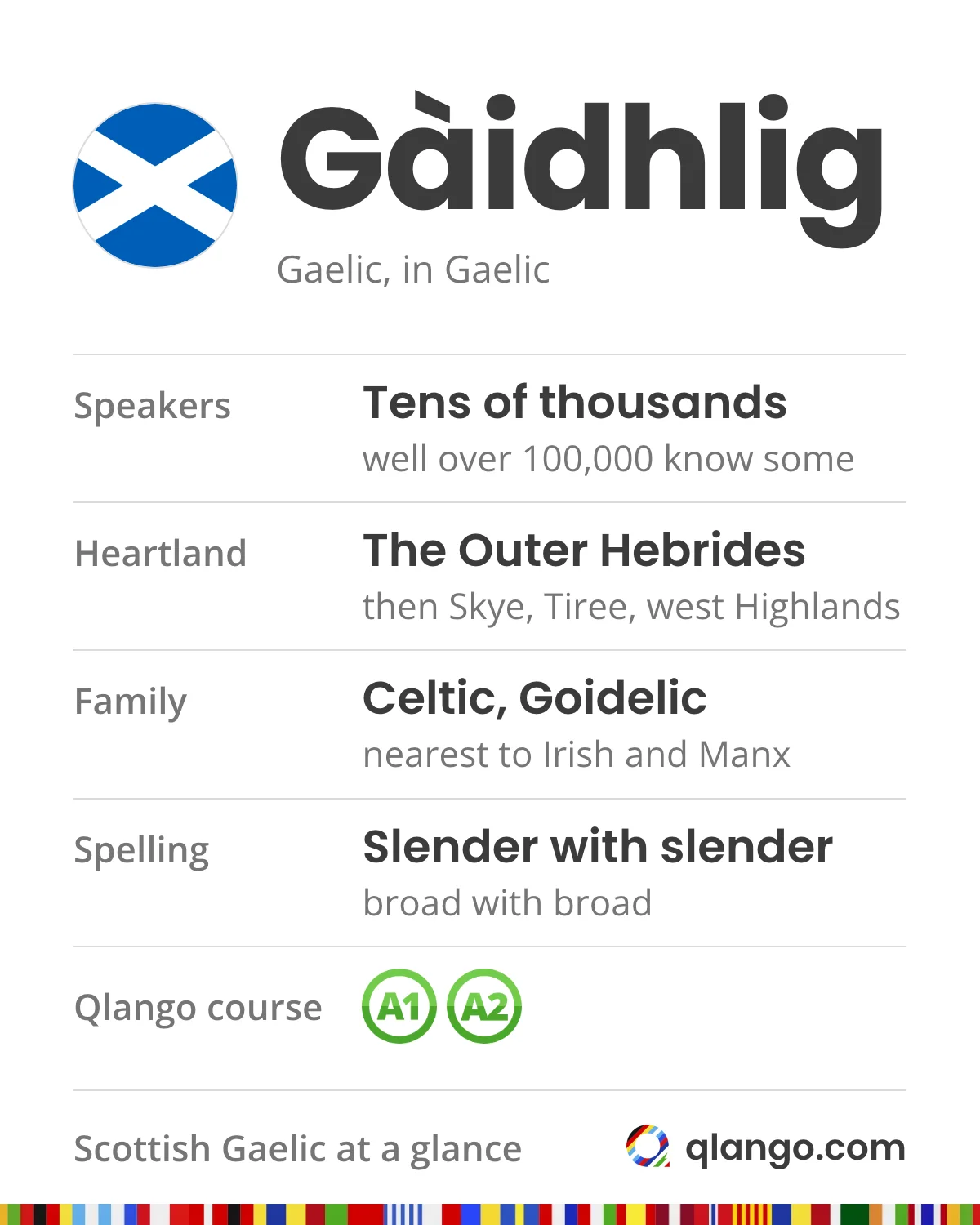
Gaelic, Gàidhlig, is a Celtic language of the Goidelic branch. It descends from the Gaelic of medieval Ireland, so its nearest relatives are Irish and Manx. In Scotland the English name is pronounced roughly "GAL-ick", which is one quick way to tell the Scottish language from the Irish one.
Scotland's 2022 census found well over 100,000 people with some Gaelic skills, while those who can actually speak it number in the tens of thousands. Its heartland is the Outer Hebrides, Na h-Eileanan Siar, where a large share of the population still speaks it, followed by Skye, Tiree and parts of the west Highlands. Glasgow has a sizeable Gaelic community and its own Gaelic school, and in Cape Breton, Nova Scotia, a small community descends from Highland emigrants. The Gaelic Language (Scotland) Act 2005 gave the language official recognition, BBC ALBA broadcasts in Gaelic, and Gaelic-medium education keeps growing.
Questions people ask before they start
Is Scottish Gaelic the same as Irish?
No. The two share a lot of grammar and a good deal of vocabulary, and written texts are often recognizably related, but they are separate languages with their own spelling conventions and pronunciation. Learn one at a time.
Is it hard for English speakers?
It's easier than its reputation. The difficulty comes early: spelling and sounds feel strange for a few weeks, then settle. The grammar has features English lacks, chiefly lenition, verb-first sentences and the absence of a single word for yes or no, but a small set of patterns covers a lot of ground.
Does it cost anything to start?
It doesn't have to, and plenty of people begin without spending a penny. The trap is collecting phrases with no order behind them. Whatever you use, make sure it moves you through levels and brings old words back on a schedule. For realistic expectations about time, see our guide on how long it takes to learn a language.
What will feel strangest?
Probably the way feelings and possessions work. Tha an t-acras orm means I'm hungry, literally "the hunger is on me". Tha cat agam means I have a cat, "a cat is at me". Gaelic has no verb "to have", and once that clicks, a lot of other things do too.
How Gaelic spelling and lenition work
Gaelic spelling follows a rule usually summed up as "slender with slender, broad with broad". The vowels e and i are slender, a, o and u are broad, and a consonant is flanked by vowels of the same type, which tell you how to pronounce it. That's why words seem to have vowels to spare. Modern spelling uses only one accent, the grave (à, è, ì, ò, ù), and it marks a long vowel.
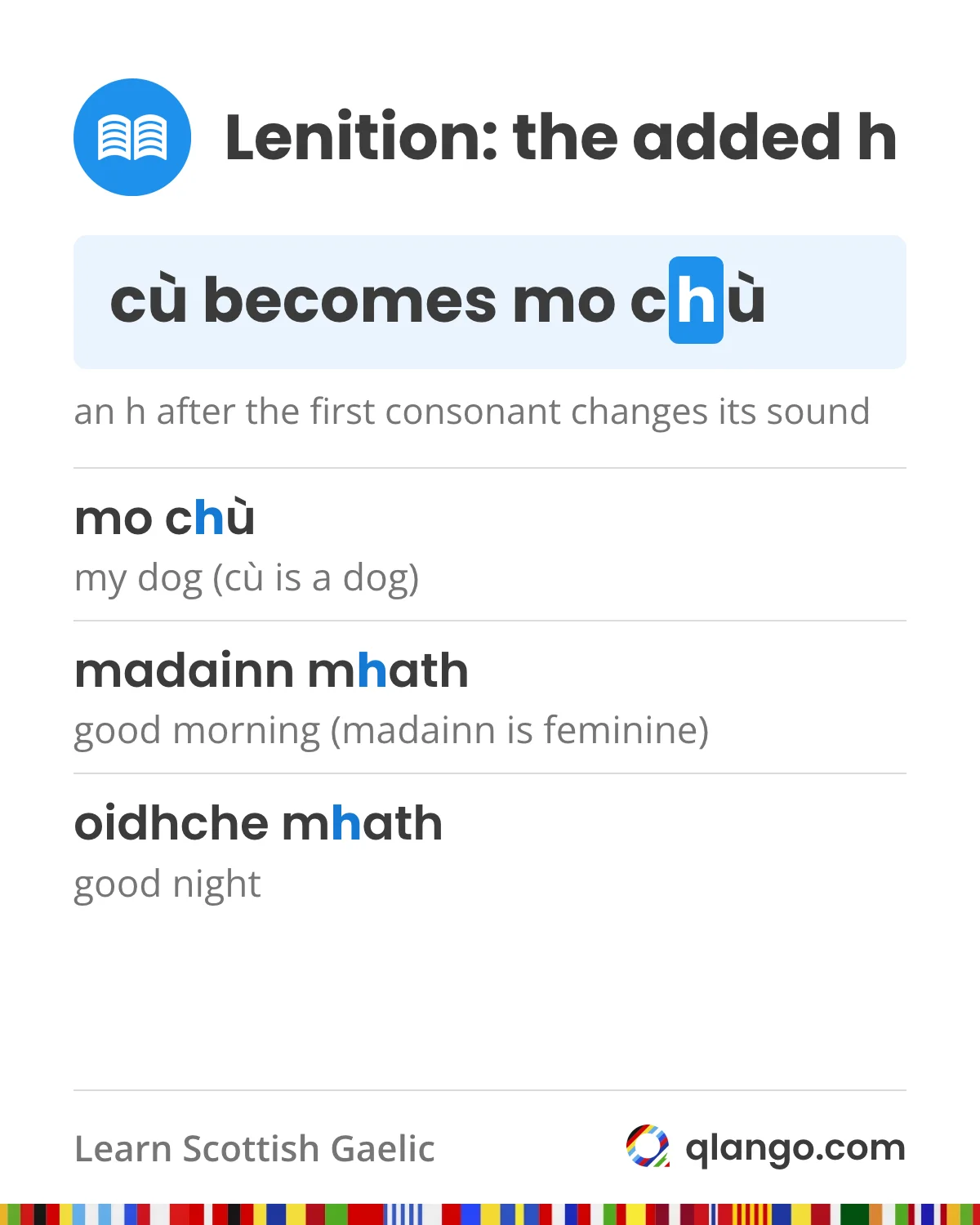
Lenition is the change you'll see most. It's written by adding h after the first consonant, and it changes the sound: cù is a dog, mo chù is my dog. You can watch it work in the greetings. Madainn, morning, is a feminine noun, so good morning is madainn mhath, while feasgar, afternoon or evening, is masculine, so good evening is feasgar math. Same adjective, two forms, decided by the gender of the noun in front. Don't memorize the rules yet. Notice them.
Sentences start with the verb. Tha mi sgìth, I'm tired. Tha i fuar, it's cold. And questions are answered with the verb too: A bheil thu sgìth? Are you tired? Tha, or Chan eil.
A first Gaelic vocabulary
| Gaelic | English |
|---|---|
| Halò | hello |
| Madainn mhath | good morning |
| Feasgar math | good afternoon, good evening |
| Ciamar a tha thu? | how are you? (to a friend) |
| Ciamar a tha sibh? | how are you? (polite or plural) |
| Tha gu math, tapadh leat | fine, thank you |
| Is mise Iain | I'm Iain |
| Dè an t-ainm a th' ort? | what's your name? |
| Slàinte mhath | cheers |
| Oidhche mhath | good night |
| Mar sin leat | goodbye |
Gaelic beyond the Highlands
Gaelic is taught in Scotland, mostly in the Highlands and Islands and in Glasgow and Edinburgh, but very few language schools elsewhere offer it, and most commercial course series skip it. A lot of what exists assumes you can get to a class in Scotland, and much of the rest was made for singers learning one song or visitors learning one toast. Learners abroad, some with Scottish grandparents and some who simply love the music, often end up stitching together a course of their own.
Your first month, in four steps
- Letters before words. Learn the broad and slender rule and the sound of the common letter combinations, then the greetings in the table. Say them aloud every day until the exchange runs by itself.
- Tha sentences. Talk about yourself: tired, well, at home, at work. Add the weather.
- At me, on me. Learn agam and orm with what you have and how you feel, and collect phrases that show lenition, learning each one whole.
- Questions and real Gaelic. Ask and answer with tha and chan eil, write five short sentences a day, and find some Gaelic to listen to: BBC ALBA with subtitles, or Gaelic song, which has kept the language in people's ears for generations.
How Qlango helps you learn Scottish Gaelic
Qlango teaches Scottish Gaelic at A1 and A2, taking you from Halò to simple everyday conversations about your family, your work and the place you live. Lessons are short, and every new word comes back through spaced repetition just before it would slip away, which helps with spellings like oidhche that rarely stick on the first try. Flashcards and the find-the-pair exercise drill vocabulary, building sentences trains the verb-first order, and writing answers yourself fixes the accents in place. You choose the language you learn through, and the course is free to start. Premium adds offline lessons and an AI teacher you can ask, as often as you need, why it's madainn mhath but feasgar math. The FAQ explains how adding a course works, the table of languages lists every level, and the Premium plans are here.
Letters before words is step one of the plan above, and it's where the A1 course in Qlango begins too. Give it fifteen minutes today, and by the weekend Ciamar a tha thu? will run without a glance at the table.