
In Swahili, safari means a trip. Any trip: a week in the Serengeti, a bus ride to visit your aunt, a business trip to Nairobi. The word came from Arabic, like kitabu (book) and habari (news), and it says a lot about the language itself: a Bantu language from the East African coast, shaped by centuries of trade across the Indian Ocean, and used today as a common tongue by tens of millions of people who grew up speaking something else.
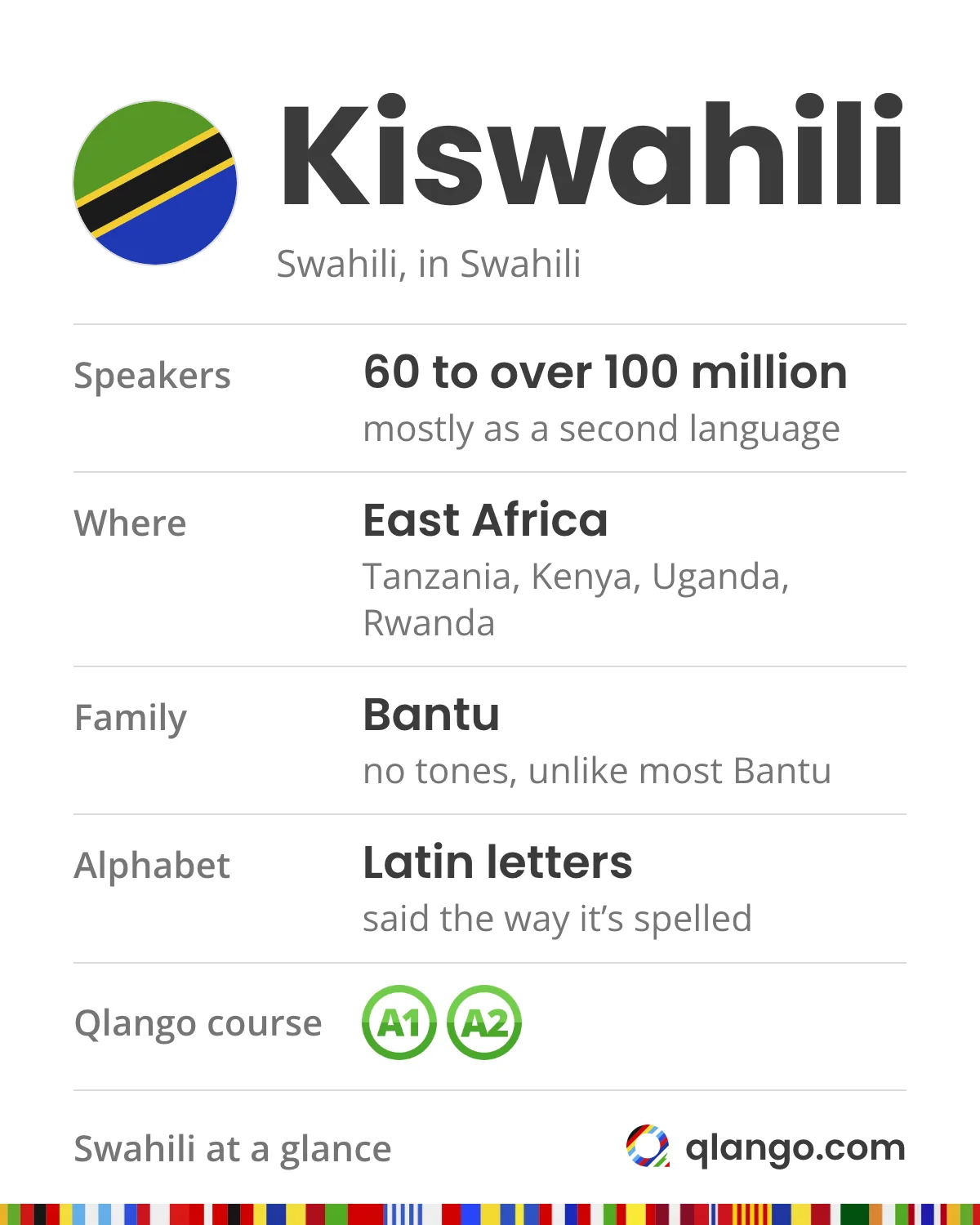
If you want to learn Swahili, you'll find the language makes starting easy. It's written in the Latin alphabet and pronounced the way it's spelled, and, unlike most of its Bantu relatives, it has no tones. The real work is noun classes, a grammar system with no English equivalent, and verbs that pack subject, tense and object into a single word. Give the greetings a week, give noun classes a month, and review vocabulary every day from the start.
Where Swahili is spoken
Swahili, or Kiswahili as its speakers call it, began on the coast and the islands off it, Zanzibar among them, and spread inland along the trade routes. Today it's a national or official language in Tanzania, Kenya, Uganda and Rwanda, one of the four national languages of the Democratic Republic of the Congo, and spoken in Burundi, northern Mozambique and beyond. Only a minority speak it as a first language, mostly along the coast. Most learned it as a second language next to their own, which is why estimates of the total vary so much: from around 60 million to well over 100 million speakers.
The Swahili of Tanzania and the coast is usually treated as the standard. In Nairobi you'll also hear Sheng, a fast-moving slang that mixes Swahili and English, which textbooks don't teach and teenagers never stop reinventing.
A Bantu language with a long memory of trade
Swahili is a Bantu language, a relative of Zulu, Xhosa and Shona, and its grammar is thoroughly Bantu. Its vocabulary is more cosmopolitan. Besides kitabu and habari, Arabic gave it saa (hour, clock), dakika (minute) and rafiki (friend). Portuguese left meza (table), colonial German left shule (school), and English left baisikeli (bicycle). Older Swahili poetry was written in Arabic script, but the language has used the Latin alphabet since the colonial era.
The easy part: sounds and spelling
Five vowels, a, e, i, o, u, pronounced roughly as in Spanish or Italian. Every letter is sounded, and stress almost always falls on the second-to-last syllable: ki-TA-bu, ha-BA-ri. A few sounds need attention, like ng' at the start of ng'ombe (cow), which is the ng of "singer", or the th of thelathini (thirty), which is the th of "think". The US Foreign Service Institute, measuring for English speakers, puts Swahili in its Category II, with Indonesian and German: about 36 weeks of full-time study to professional level.
How to learn Swahili noun classes
Every Swahili noun belongs to a class, marked by a prefix that usually changes in the plural. Those same prefixes then echo through adjectives and verbs. Here are five of the most common pairs, each with -zuri, "good":
| Pair | Singular | Plural |
|---|---|---|
| m- / wa- | mtu mzuri, a good person | watu wazuri, good people |
| m- / mi- | mti mzuri, a good tree | miti mizuri, good trees |
| ki- / vi- | kitabu kizuri, a good book | vitabu vizuri, good books |
| ji- / ma- | jicho zuri, a good eye | macho mazuri, good eyes |
| n- / n- | ndizi nzuri, a good banana | ndizi nzuri, good bananas |
Verbs agree too. Mtoto amelala: the child is asleep. Watoto wamelala: the children are asleep. Kitabu kimeanguka: the book has fallen. Vitabu vimeanguka: the books have fallen. Even the names of languages follow the pattern: Kiswahili, Kiingereza (English), Kifaransa (French).
Learn every noun with its plural, and learn agreement from sentences. The table is for checking your work, not for reciting.
Verbs in one word
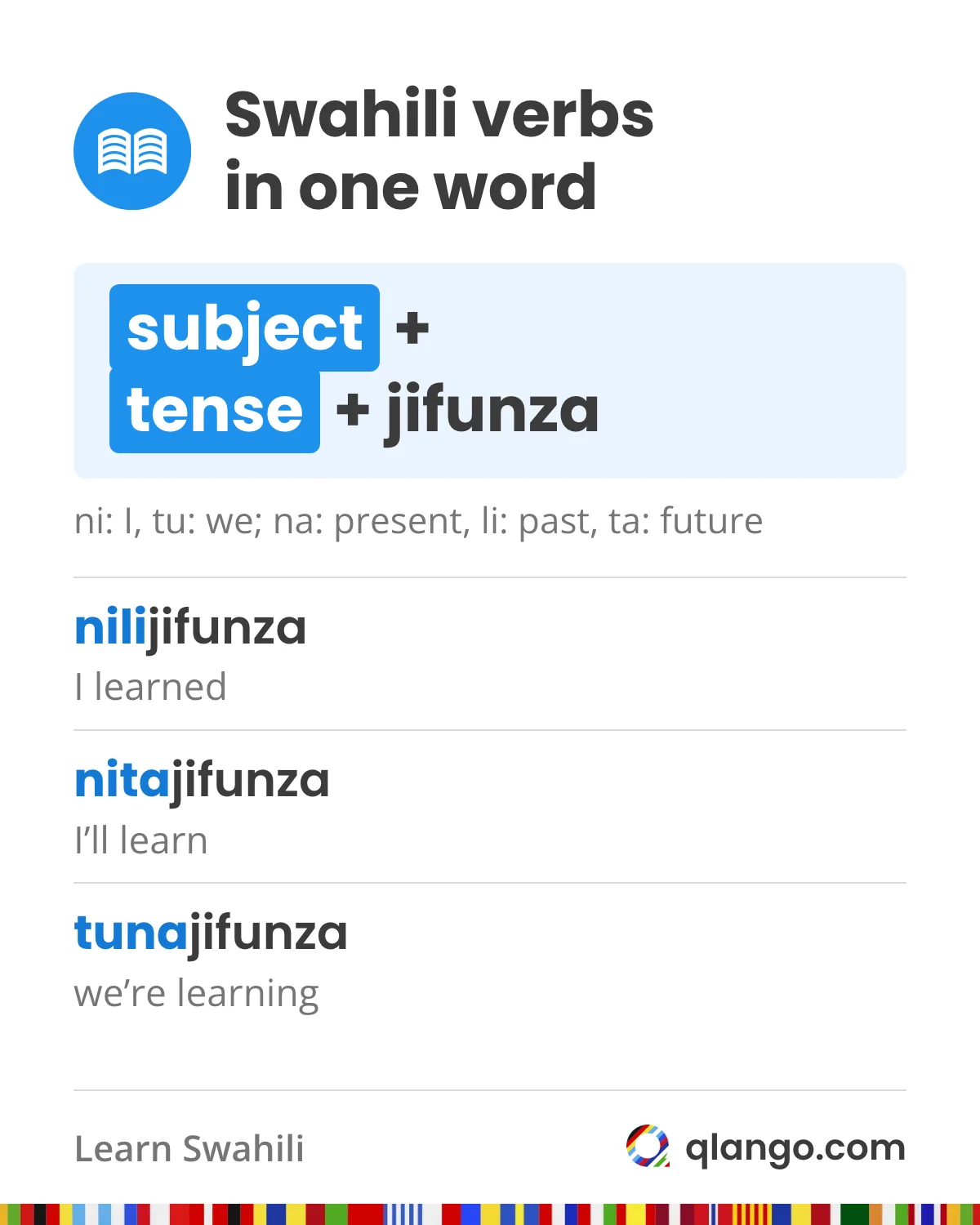
Ninajifunza Kiswahili means "I'm learning Swahili". Ni- is "I", -na- marks the present, and jifunza is "learn". Swap one piece and the meaning moves: nilijifunza, I learned; nitajifunza, I'll learn; tunajifunza, we're learning. Once you can see the pieces, long Swahili verbs stop looking like walls of letters.
First words: greet properly
Greetings in East Africa are taken seriously, and a stranger who greets properly gets a warmer reception than one who opens with a question.
- Habari? or Habari gani?: how are things? The answer is nzuri, good, almost whatever is going on.
- Hujambo? Sijambo: how are you? I'm fine. To a group: Hamjambo? Hatujambo.
- Shikamoo: a respectful greeting to an elder, who replies marahaba. Expected in Tanzania especially.
- Mambo? Poa: what's up? Cool. Between friends your own age.
- Asante, asante sana: thank you, thank you very much.
- Karibu: welcome. You'll hear it constantly.
- Tafadhali: please. Samahani: excuse me, sorry.
- Ndiyo, hapana: yes, no.
- Sielewi: I don't understand.
- Pole pole: slowly, gently.
- Kwa heri: goodbye.
Jambo, the word in every guidebook, is mostly what people say to tourists. Hujambo and habari will get you further.
Grammars for the semester, phrases for the safari
Swahili has more teaching material than most African languages: universities in East Africa, Europe and North America teach it, and good grammars exist. Most of it, though, is either academic, built around a semester and a classroom, or touristy, phrase lists that stop at jambo. The middle ground is thinner: something for an adult with half an hour a day that starts at hujambo and carries on, step by step, into noun classes.
A realistic first month
Half an hour a day is enough. Keep a daily vocabulary review going throughout; our guide to vocabulary learning methods explains why the timing of reviews matters more than their length.
Week 1: greetings and sounds
Learn the greetings above and practise both sides of each exchange aloud. Read a little Swahili aloud every day, leaning on the second-to-last syllable.
Week 2: people and things
The m-/wa- and ki-/vi- classes: twenty nouns from each, with their plurals, and adjectives like -zuri, -kubwa (big) and -dogo (small).
Week 3: verbs
Present, past and future with -na-, -li- and -ta-, across all the subject prefixes. Write short sentences about today, yesterday and tomorrow.
Week 4: the other classes
Add m-/mi-, ji-/ma- and n- nouns, and start writing short messages. If you've met noun classes before in Zulu, you'll recognise the idea, and Swahili's version comes without clicks or tones.
Learning Swahili in Qlango
Qlango teaches Swahili at A1 and A2, from the first habari to the level where you can handle everyday exchanges, describe your family and your work, and read short, simple texts. Noun classes are where it helps most. Spaced repetition brings words like mtoto and watoto back right before they fade, and when you write answers yourself, the prefix on the verb has to match the noun or the answer doesn't work. With Premium, an AI teacher explains why it's kitabu kizuri but jicho zuri, and then the next thing you wonder about. Lessons are short enough for a bus ride, and Premium lets you take them offline.
When you add the course, you choose the language you learn through, English or your own. The full table of languages and levels is here. The course is free to start, and Premium is available monthly, yearly or as a one-time Forever plan.
Pole pole, slowly and gently, is how Swahili speakers tell you not to rush, and it suits a first month well. Half an hour a day in Qlango, beginning with the A1 greetings, is pace enough.


