
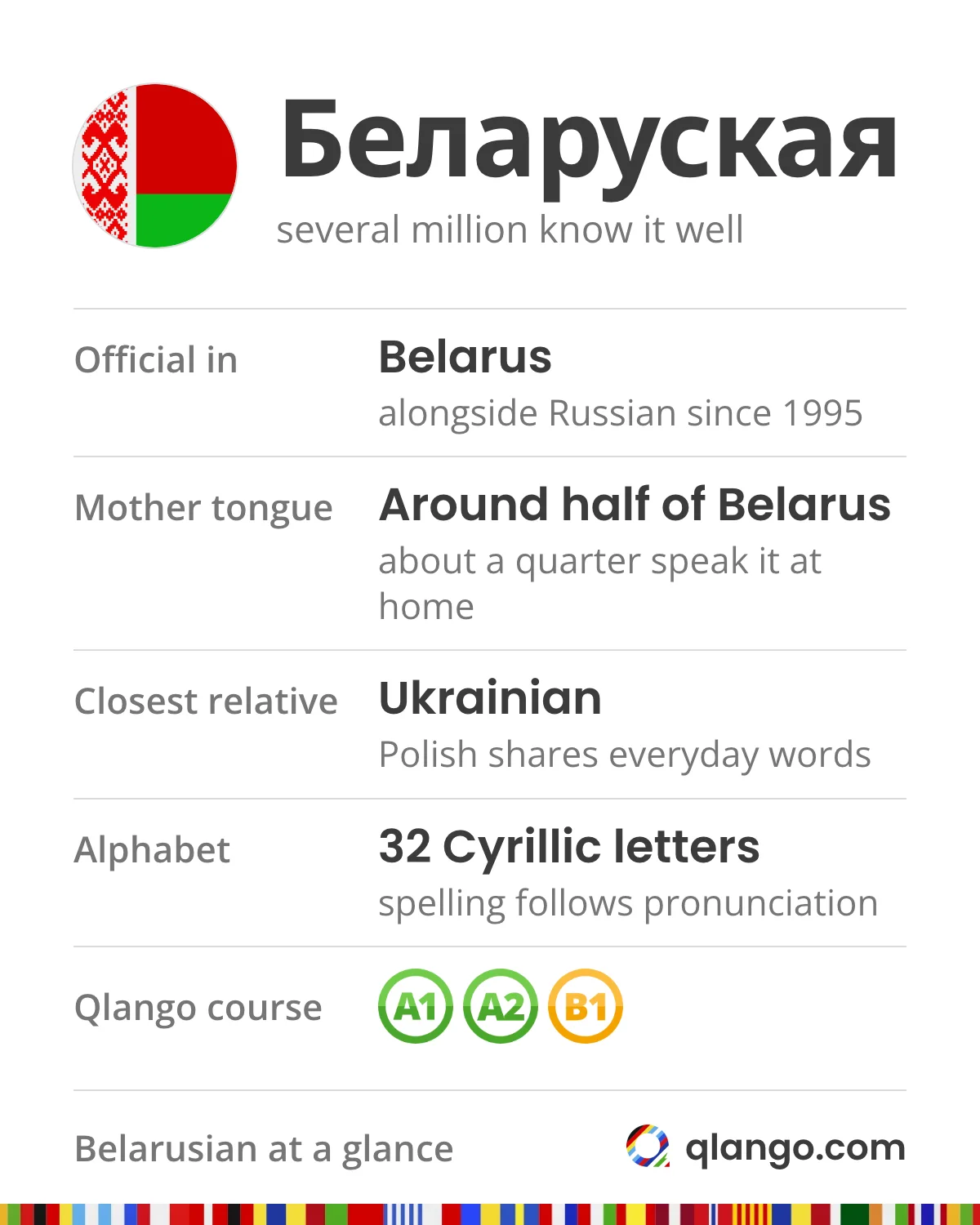
Belarusian is understood by most people in Belarus and spoken every day by far fewer. In census figures, around half the population names it as their mother tongue, yet only about a quarter say they speak it at home, and Russian dominates in cities, offices and shops. That paradox shapes what it means to learn Belarusian: the language is alive, with its own literature, music and plenty of online media, but you'll have to go looking for it.
The way in is clear enough. Learn the Cyrillic alphabet with Belarusian's own letters, і and ў, in the first week. Get used to spelling that follows pronunciation, which means vowels change on the page when the stress moves. Build the grammar step by step with a structured course, review vocabulary on a schedule, and make Belarusian books, podcasts and people part of your week on purpose.
Where Belarusian is spoken
Belarusian has shared official status with Russian in Belarus, a country of about nine million people, since a 1995 referendum. Outside the country it is spoken by the Belarusian minority in Poland's Podlaskie region around Białystok, by smaller communities in Lithuania and Latvia, and by a diaspora that has grown considerably since 2020, especially in Poland and Lithuania. A good share of Belarusian-language publishing and media now happens there. How many people use the language every day is hard to pin down; several million know it well.
The learners are a varied group: grandchildren of emigrants, partners of Belarusians, Slavic studies students, people who live alongside the Belarusian community in Warsaw or Vilnius, and readers who came to the language through its poetry.
The alphabet: familiar Cyrillic, different letters
Belarusian uses a Cyrillic alphabet of 32 letters. If you know Russian, the differences jump out:
- і replaces Russian и: Мінск, the capital.
- ў, the short u, sounds like the w in wolf: воўк (wolf), праўда (truth).
- There is no щ; Belarusian writes шч, as in шчасце (happiness).
- There is no hard sign; an apostrophe does its job, as in сям'я (family).
- г is a voiced sound from the throat, softer than English g: горад (city).
- дз and дж count as single sounds: дзень (day).
You'll also meet a Belarusian Latin alphabet, łacinka, with letters like ł, č, š and ŭ. It has a long history and turns up in some books and online, but Cyrillic is the standard. There are also two spelling systems in Cyrillic: the official one, taught in schools, and the classical spelling known as taraškievica, used by some independent media and in the diaspora. The differences are small but visible, as in снег and сьнег for snow. Learn the official spelling first; you'll read the other within days.
Spelling that follows speech
Russian writes молоко and pronounces it roughly malako. Belarusian simply writes малако. Unstressed о is written as а, so the spelling of a word changes with its stress: горад is a city, гарады are cities. Belarusian also turns д and т into дз and ц before soft vowels, which is why it says дзень where Russian says день, and цёплы where Russian has тёплый.
The result is a language that is easier to read aloud than Russian, because what you see is what you say, and harder to spell, because you have to know where the stress falls before you can write the vowels.
How hard is the grammar?
For English speakers, this is where the time goes. Belarusian has six cases, three genders, verbs in aspect pairs and stress that moves around. Even saying I have a book takes a construction English doesn't have: у мяне ёсць кніга, literally by me there is a book, while у мяне няма кнігі, I don't have a book, puts the book in the genitive. None of it is unusually irregular for a Slavic language; there is simply a lot of it.
If you already know another Slavic language, much of this transfers:
| English | Belarusian | Ukrainian | Polish | Russian |
|---|---|---|---|---|
| thank you | дзякуй | дякую | dziękuję | спасибо |
| yes | так | так | tak | да |
| please | калі ласка | будь ласка | proszę | пожалуйста |
| week | тыдзень | тиждень | tydzień | неделя |
| language | мова | мова | język | язык |
Ukrainian is the closest relative overall, and Polish shares a surprising amount of everyday vocabulary. Russian speakers recognise the grammar instantly and then trip over words like дзякуй and тыдзень.
First Belarusian words
- Прывітанне: hello
- Добры дзень: good day
- Дзякуй: thank you
- Калі ласка: please, and you're welcome
- Так and не: yes and no
- Прабачце: sorry, excuse me
- Як справы?: how are you?
- Мяне завуць ...: my name is ...
- Я не разумею: I don't understand
- Да пабачэння: goodbye
Few learners, and good reasons to join them
Most Belarusian courses are written for people who already speak Russian, and English-language material is limited to a few grammars, older textbooks and community projects. Universities with Slavic departments teach it now and then. The reason is simple: the number of learners is small, and publishers follow numbers.
Should you learn it anyway? If you have a reason, a family, a partner, a book you want to read in the original, yes. Speakers tend to be openly pleased that anyone bothers, and the language gives you a head start on Ukrainian and a foothold in Polish.
How to learn Belarusian in your first month
Think in habits rather than chapters.
- Every day, twenty to thirty minutes: one short lesson and a review of the words that are due. Read a few lines of Belarusian aloud, even before you understand them.
- Week one: the alphabet, with і, ў, дз and дж, and the greetings above.
- Week two: fifty everyday nouns with their gender, the numbers to twenty, and у мяне ёсць for talking about what you have.
- Week three: the present tense of common verbs, and five sentences a day about your own life.
- Week four: the past tense, which marks gender, so a man says я чытаў and a woman я чытала (I was reading), and the locative for places: у Мінску, in Minsk.
- Every week: one conversation or exchange of messages with a speaker or another learner, and one song or podcast episode in Belarusian.
How Qlango helps
Qlango's Belarusian course covers A1, A2 and B1. On the CEFR scale, B1 is where you can handle most everyday situations, describe your experiences and plans, and write simple connected text on familiar topics: the first level the CEFR calls independent. Lessons are short, new words come with example sentences, and spaced repetition brings them back before they fade. Written answers train exactly the spelling that trips learners up, горад in one sentence and гарады in the next, and sentence-building exercises make the case endings automatic.
You choose the language you learn through when you add the course: English, or another language you know well. It's free to start, and Premium adds offline learning and an AI teacher you can ask why a vowel changed or which case a verb takes. The full list of courses is on the languages and levels page.
Belarusian rarely arrives by accident, even in Minsk, so put it into your week on purpose. One short Qlango lesson a day, starting at A1, and one song in Belarusian every Sunday is a fine way to begin.


