
Spot ї or є in a Cyrillic text and you are almost certainly reading Ukrainian. Those two letters, along with і and ґ, are the first thing to get right when you learn Ukrainian, and they hint at the second: this is a language with its own sounds, vocabulary and grammar, not a regional flavour of Russian.
The plan is simple to state. Learn the 33-letter alphabet in the first week, paying special attention to и, і and ї, which look alike and sound different. Learn nouns with their gender, verbs in pairs, and the cases one at a time, starting with the ones you need daily. Work through the levels with a structured course, review vocabulary on a schedule, and talk to Ukrainians, who are more likely than ever to live in your own city.
Where Ukrainian is spoken
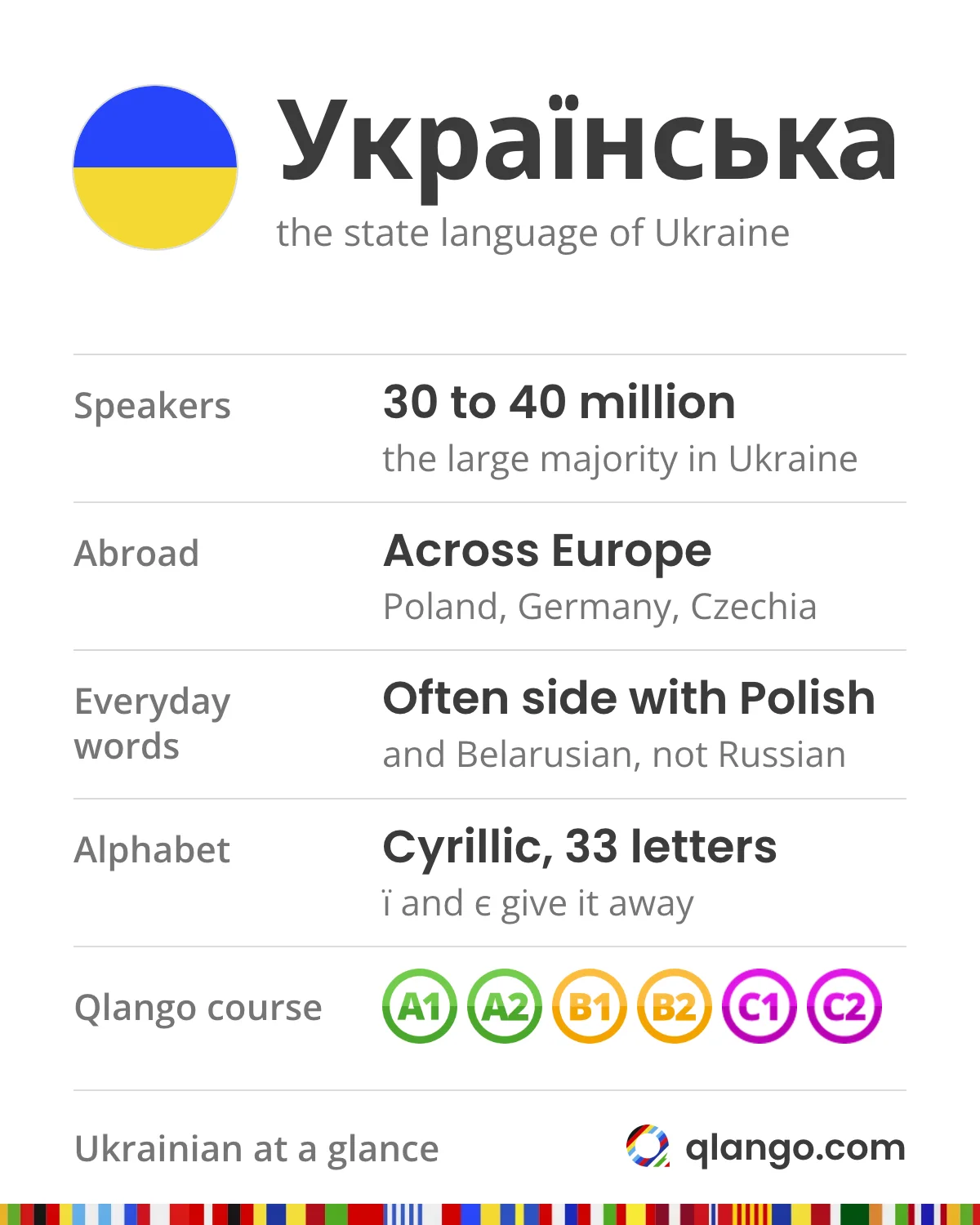
Ukrainian is the state language of Ukraine and is spoken by somewhere between thirty and forty million people, the large majority of them in Ukraine. There are big communities abroad: in Poland, Germany and Czechia, among others, and an older diaspora in Canada and the United States that goes back to the late nineteenth century. Many Ukrainians grew up bilingual with Russian, and over the past decade, especially since 2022, a lot of them have moved towards Ukrainian in everyday life.
The reasons people start are as varied as the diaspora: a Ukrainian partner, colleagues or neighbours, volunteering, grandparents from Lviv or Winnipeg, or simply wanting to read the news from the source.
Should you learn Ukrainian or Russian?
If your reason is Ukraine or Ukrainians, Ukrainian. The two languages are related and partly understandable to each other, but they are not interchangeable, and in everyday vocabulary Ukrainian often sides with Belarusian and Polish rather than Russian:
| English | Ukrainian | Polish | Russian |
|---|---|---|---|
| thank you | дякую | dziękuję | спасибо |
| week | тиждень | tydzień | неделя |
| July | липень | lipiec | июль |
| November | листопад | listopad | ноябрь |
If you've already studied Russian, you'll find the grammar familiar and the vocabulary full of traps, which is a better position than it sounds.
The Ukrainian alphabet
Ukrainian has 33 letters plus an apostrophe. Most will be familiar to anyone who has seen Cyrillic; these are the ones that need care:
| Letter | Sound | Example |
|---|---|---|
| г | a voiced, breathy h | гора (mountain) |
| ґ | g as in go | ґанок (porch) |
| и | i as in sit | син (son) |
| і | ee as in see | ліс (forest) |
| ї | yee | Київ (Kyiv) |
| є | ye as in yes | Європа (Europe) |
| е | e as in bed | день (day) |
| щ | shch, as in fresh cheese | що (what) |
| ' | keeps a consonant apart from the vowel after it | м'ясо (meat) |
Vowels keep their value more or less wherever the stress falls. Russian writes голова, head, and says something like galava; Ukrainian writes the same word and says holova, every o intact and an h at the front. For a learner that's good news: the spelling tells you the truth.
The grammar, honestly
Seven cases. One of them, the vocative, is very much alive: you address Олена as Олено, a friend as друже, a gentleman as пане. You'll hear it in shops, on the phone and in every second song.
Gender everywhere. Nouns have three genders, and the past tense agrees with the subject's gender, so a man says я читав and a woman я читала, both meaning I was reading.
Verbs in pairs. Most verbs come as an aspect pair, one for the process and one for the result: робити and зробити, to do and to get done.
Moving stress. Stress can fall on any syllable, moves between forms of the same word, and isn't marked in normal writing.
Some things are kinder than they look. There are no articles, the verb to be usually disappears in the present (я студент is I'm a student), and to have often becomes у мене є, literally by me there is. The US Foreign Service Institute puts Ukrainian in Category III, about 44 weeks of full-time study for an English speaker to reach professional working proficiency; our guide to how long it takes to learn a language explains what those numbers mean for a learner with a job and a life.
First Ukrainian words
- Привіт: hi
- Добрий день: good day, hello
- Дякую: thank you
- Будь ласка: please, and you're welcome
- Так and ні: yes and no
- Вибачте: excuse me, sorry
- Як справи?: how are you?
- Мене звати ...: my name is ...
- До побачення: goodbye
- Смачного: enjoy your meal
From Saturday schools to a wave of new learners
For decades, people studying the region were steered towards Russian, and Ukrainian was taught at a handful of universities and in diaspora Saturday schools. Since 2022 interest has grown enormously and a wave of free beginner material has appeared. Much of it stops early, though: there's plenty for your first hundred words and far less for the long stretch from B1 to C1, where structure matters most.
A first-month plan
Twenty to thirty minutes a day:
- Week 1: letters and greetings. The alphabet, with и, і, ї, є, г and ґ, and the words above. Practise on city names: Київ, Львів, Харків, Одеса, Дніпро.
- Week 2: nouns and numbers. Fifty everyday nouns with their gender, the numbers to twenty, and у мене є for what you have.
- Week 3: verbs. The present tense of common verbs (я читаю, ти читаєш) and the past tense with its gender endings. Write five sentences a day about your life.
- Week 4: places and people. The cases you use for getting around, у Києві (in Kyiv), до Львова (to Lviv), з Харкова (from Kharkiv), and the vocative of the names of people you know.
How Qlango helps you learn Ukrainian
Qlango teaches Ukrainian from A1 all the way to C2, so the course keeps going long after most beginner material stops. Lessons are short and new words come with example sentences. Spaced repetition then brings each word back just before it would slip away. Exercises switch between choosing the right answer, building sentences, writing and matching pairs, which is how case endings move from your notes into your fingers. Over a long course, a weekly learning plan, streaks and statistics across weeks, months and years show you how far you've come, and the chat lets you write to other learners, with translation for messages you can't read yet and AI help to draft a reply.
You choose the language you learn through when you add the course: English, or another language you know well. It's free to start, and Premium adds offline learning and an AI teacher you can ask about any case, aspect pair or word, as often as you like. Every course and level is on the languages and levels page.
Week one's practice list is really a map: Київ, Львів, Харків, Одеса, Дніпро. Read the five names aloud tonight after your first A1 lesson in Qlango, and you'll have met и, і and ї before bed.


