Learn Filipino (Tagalog) for Free: A Beginner's Guide
How to learn Filipino for free: how it relates to Tagalog, why Taglish helps, the verbs that take real work, po and opo, free resources and a month-one plan.
Author: QlangoPublished: Updated: 6 min read
Spend a minute near two friends chatting in Manila and you'll hear sentences like Mag-shopping tayo mamaya, "let's go shopping later". The verb is English. Everything around it, the mag- that turns it into a Filipino verb, the tayo that means "we, you included", the mamaya that means "later", is Filipino. People call the mix Taglish, and a great deal of everyday conversation in the Philippines sounds exactly like it. You can learn Filipino for free from the first week: Qlango is free to start, and the Philippine language commission and public television put Filipino online at no cost.
For anyone who wants to learn Filipino, that mix is good news and a trap. Good news, because a lot of vocabulary will feel familiar, from English and from Spanish. A trap, because the part that isn't borrowed, the verb system, is unlike anything in English, and Filipinos will switch to English to spare you long before you've had a chance to wrestle with it. The way through is to learn the core words and greetings quickly, then spend most of your effort on verbs, a few at a time, inside full sentences.
Filipino or Tagalog: which one?
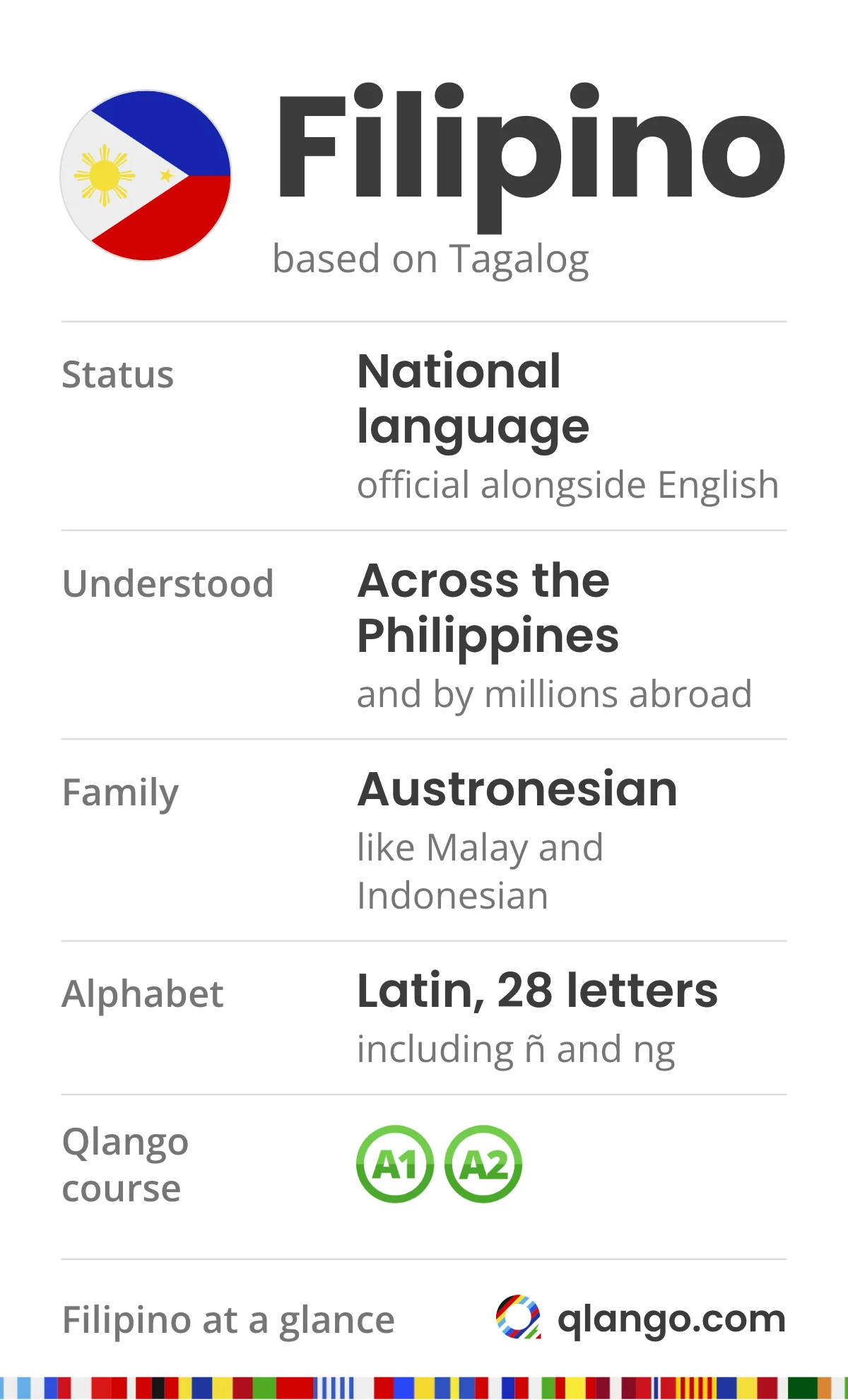
They're very nearly the same thing. Filipino is the national language of the Philippines and, with English, one of its two official languages. It's based on Tagalog, the language of Manila and the surrounding provinces, and takes in more words from English, Spanish and other Philippine languages. If one course says Tagalog and another says Filipino, they're teaching you to talk to the same people.
Tagalog is the first language of tens of millions. Filipino is understood across a country of more than 100 million, many of whom grew up speaking Cebuano, Ilocano, Hiligaynon or another of the Philippines' more than a hundred languages first, and by millions of Filipinos abroad, from California to the Gulf. It belongs to the Austronesian family, which is why mata (eye), anak (child), lima (five) and langit (sky) are the same words in Malay and Indonesian. It's written in the Latin alphabet, 28 letters including ñ and ng. The old Tagalog script, baybayin, has had a revival in art, logos and tattoos.
What's easier than you'd think
No gender. Siya means both "he" and "she".
No verb endings for person. Kumain ako, kumain ka, kumain siya: I ate, you ate, she ate.
Spanish everywhere. Kutsara (spoon), mesa (table), sapatos (shoes), bintana (window), the days of the week from Lunes to Sabado, and clock time: alas tres is three o'clock. Even kumusta, "how are you", comes from Spanish.
English everywhere else. Taglish means you can borrow an English word when you're stuck and still be understood.
Spelling. Words are written much as they sound.
The hard part: verbs
Filipino verbs care less about when something happened than about whether it's finished, under way, or not yet started. Linguists call that aspect, and it's marked with affixes and by repeating a syllable:
Root
Completed
Ongoing
Not yet started
kain (eat)
kumain
kumakain
kakain
bili (buy)
bumili
bumibili
bibili
luto (cook)
nagluto
nagluluto
magluluto
Then comes focus. Kumain ako ng mangga means "I ate a mango", with the spotlight on me. Kinain ko ang mangga means "I ate the mango", with the spotlight on the mango. The verb form and the little markers ang, ng and sa shift together, and names have a set of their own: si, ni and kay. Focus is the biggest topic in Filipino grammar. You'll absorb it from hundreds of short sentences far better than from the terminology, and nobody masters it in a month.
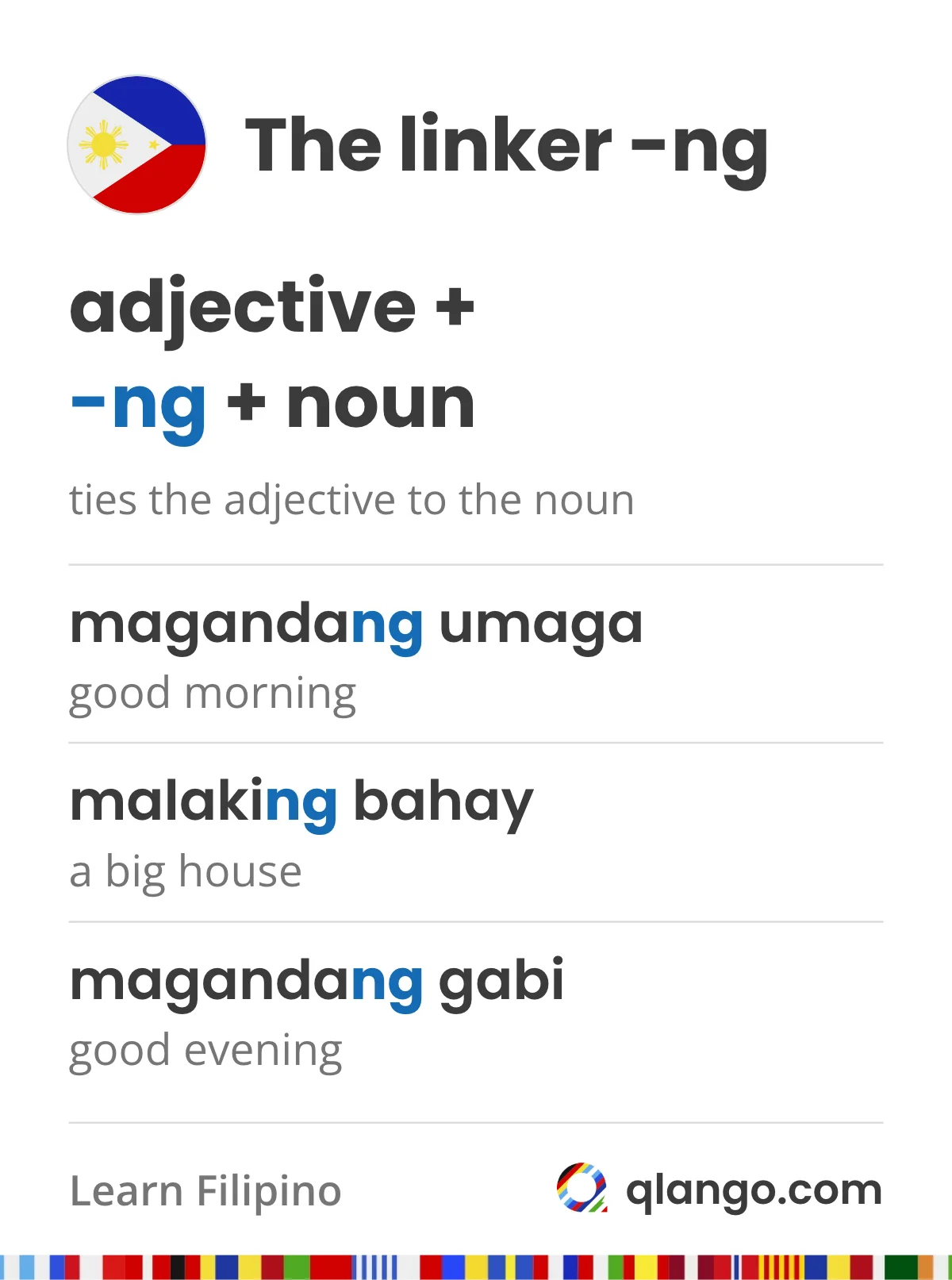
One more small piece does a lot of work: the linker. Maganda means beautiful; in magandang umaga, "good morning", the -ng ties the adjective to the noun. Malaki means big; malaking bahay is a big house.
Po and opo: respect is grammar
Add po to a sentence and it becomes respectful: salamat po is "thank you" said to someone you look up to. Opo is the respectful yes; oo is the everyday one. Use po with older people, strangers, customers and anyone you want to treat with courtesy. Leaving it out with your partner's grandmother will be noticed, even if nobody mentions it.
First Filipino words
Kumusta ka?: how are you? Mabuti naman: I'm fine.
Salamat, maraming salamat po: thanks, thank you very much.
Opo, oo, hindi: yes (respectful), yes, no.
Magandang umaga, magandang hapon, magandang gabi: good morning, good afternoon, good evening.
Ano ang pangalan mo?Ako si Ana: what's your name? I'm Ana.
Ingat: take care, a common goodbye.
Kain tayo: let's eat. Said to almost anyone who walks in while people are eating.
Textbook Filipino and the Taglish on the street
Most Filipinos speak good English, so the commercial pressure to teach Filipino to foreigners has always been weak. Much of what exists is aimed at Filipino-American children who understand their parents but answer in English, or at tourists who need ten phrases for a week in Palawan. An adult who wants to learn Filipino properly, verbs and all, has a narrower choice. There's also a wide gap between textbook Filipino and the Taglish people actually speak, and little material helps you cross it.
A plan to learn Filipino in your first month
Budget twenty minutes a day, more at weekends if you can.
Week one: greetings, po and opo, and numbers. Learn the native ones, isa, dalawa, tatlo, and the Spanish ones Filipinos use for telling time and, often, for prices.
Week two: pronouns, including the two words for "we": tayo includes the person you're talking to, kami doesn't. Add fifty everyday nouns and the markers ang, ng and sa.
Week three: um- verbs in all three aspects, kumain, kumakain and kakain, using the table above as your pattern.
Week four: mag- verbs and a first look at focus. Write short messages to a Filipino speaker and ask for answers in Filipino. Taglish allowed.
How can you learn Filipino for free?
Start with Qlango. Download it free on Android or iOS, or open it in your browser, choose the language you learn through, and take your first A1 lesson, which takes about five minutes. It's free to start, and the daily lessons give the verb work a steady rhythm.
These free resources come from Philippine public institutions and US government archives:
KWF Diksiyonaryo ng Wikang Filipino: the Komisyon sa Wikang Filipino, the national language commission, runs a free online dictionary of Filipino, with a link to a Filipino-English dictionary on the same site.
PTV: People's Television, the state broadcaster, streams its programs live on its website for free, in Filipino and English. The news is a good test of how much of the Taglish around you is really Filipino.
Older US government courses: the Foreign Service Institute and the Peace Corps both produced Tagalog courses that are now in the public domain and free to download from archive sites. They're old, but the verb drills still work.
Look words up in the KWF dictionary, drill verbs with the public domain courses, and keep PTV for the evenings when you want to hear Filipino at full speed.
Learning Filipino with Qlango
Qlango teaches Filipino at A1 and A2, the levels at which you can introduce yourself, talk about your family and daily life in simple sentences and get through everyday exchanges. Its exercises suit the verb problem well. When you build sentences or write answers yourself, the verb form and the markers have to be right, and you'll get them wrong a few times before they settle, which is exactly how it should go. Spaced repetition brings each form back when it's about to fade, and with Premium an AI teacher explains why a sentence needs kinain ko rather than kumain ako, as often as you ask. The app's chat lets you write to other learners too, translating their messages and helping you draft replies with AI.
You choose the language you learn through when you add the course, and the FAQ explains how that works. The table of languages and levels shows everything Qlango teaches, and Premium adds offline learning and the AI teacher.
Your partner's grandmother won't quiz you on focus. She will notice po. Put it in your very first sentence, and leave the verbs to Qlango's A1 course, a few forms a day.
Is there an app to learn Filipino?
Yes. Qlango teaches Filipino from A1 to A2 on iPhone, Android and the web, and it’s free to start. Duolingo, Babbel and Busuu don’t offer a Filipino course for English speakers (checked November 2026).
How to learn Malay: where it's spoken, why the grammar is light, how it differs from Indonesian, Rumi and Jawi, first words, and a realistic month-one plan.
How to learn Indonesian from English: why it's one of the easier Asian languages, the affixes that take real work, formal vs everyday speech, and a 4-week plan.
How to learn Vietnamese from English: the six tones, pronouns that depend on age, the grammar that's kinder than it looks, first words, and a month-one plan.