
Ask Indonesians whether they've eaten, whether they're married or whether they've been to Bali, and if the answer is no, you'll often hear belum: "not yet". It's a small word that leaves the door open, and a good first lesson for anyone who wants to learn Indonesian. The grammar is famously light. What takes attention is how people actually say things.
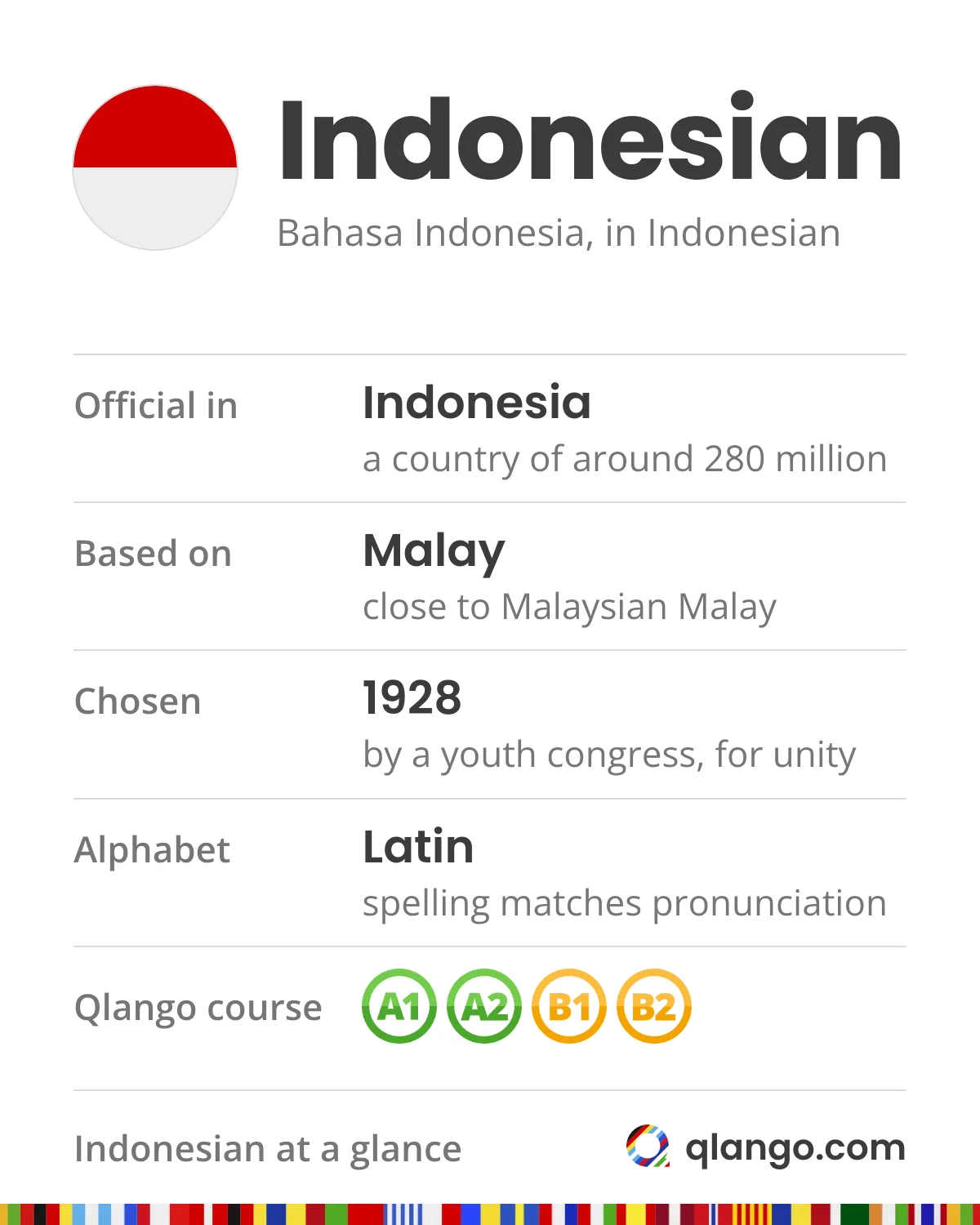
Indonesian is one of the most approachable Asian languages for English speakers: the Latin alphabet, spelling that matches pronunciation, no tones, no grammatical gender and no verb conjugation. The US Foreign Service Institute, measuring for English speakers, puts it in Category II with Malay, Swahili and German, at about 36 weeks of full-time study to professional level. The real work is in affixes, and in moving between the formal Indonesian of textbooks and the relaxed speech of daily life. Learn high-frequency vocabulary hard in the first month, start on affixes in the second, and pick up colloquial forms from the beginning.
Where Indonesian is spoken, and by whom
Indonesian, Bahasa Indonesia, is the official language of Indonesia, a country of around 280 million people spread across thousands of islands. It's a standardised form of Malay, chosen as the language of national unity by a youth congress in 1928, years before independence. That choice is why a country with more than 700 languages has one that everybody learns at school. For many Indonesians it's a second language, after Javanese, Sundanese, Balinese or one of hundreds of others; in big cities, and for many younger people, it's the first.
Indonesian and Malaysian Malay are close enough that speakers understand each other, with differences in vocabulary and spelling. Our guide to Malay has a table of the ones that cause confusion.
Why it's easy to start
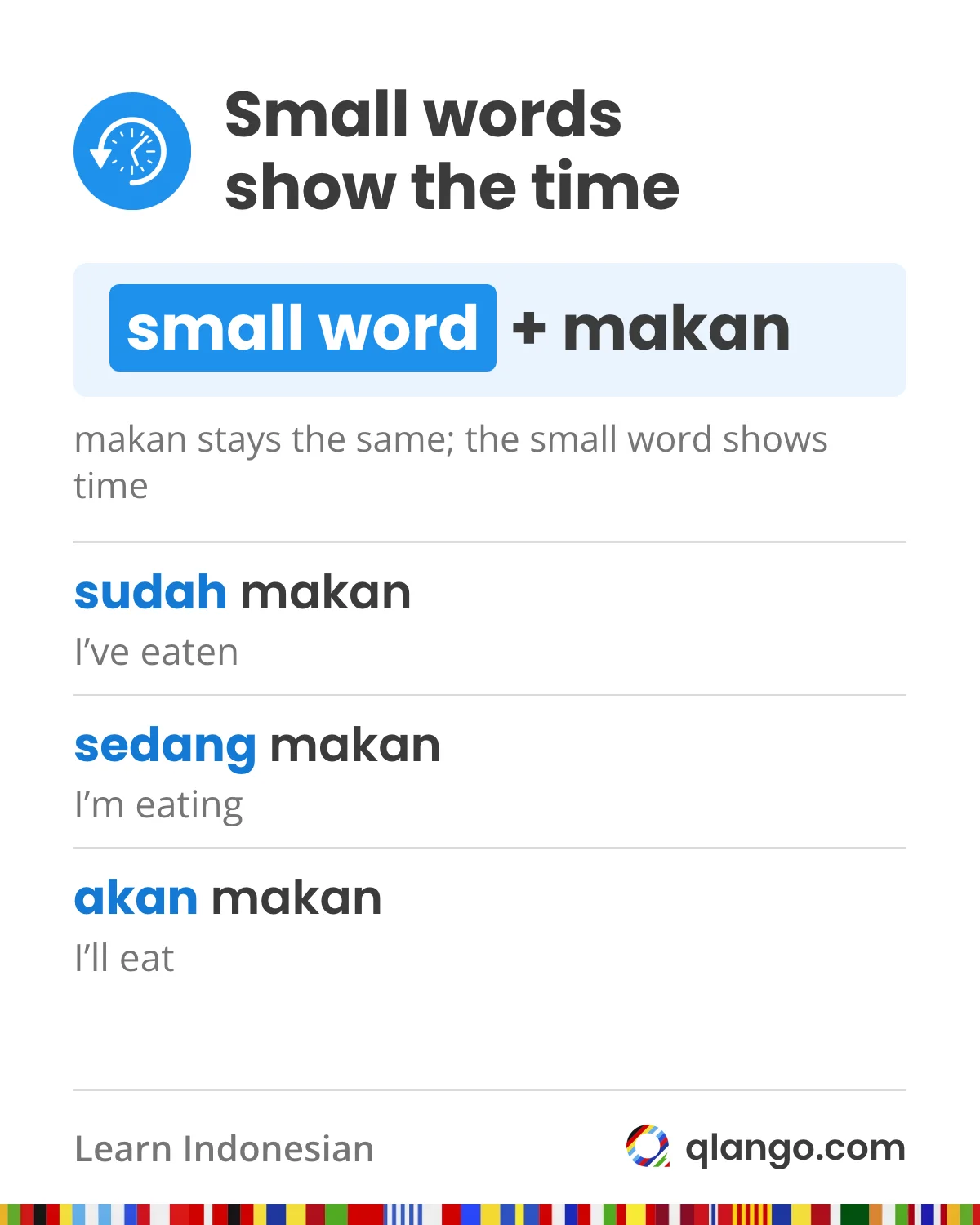
Time is shown with small words, when it's shown at all: saya makan can mean "I eat" or "I ate", while saya sudah makan, sedang makan and akan makan mean "I've eaten", "I'm eating" and "I'll eat". Belum makan is "I haven't eaten yet". Nouns don't need plural forms: buku is one book or several, and anak-anak, children, doubles the word when you want to be explicit. Dia is both "he" and "she".
The vocabulary is a history lesson. From Dutch came kantor (office), handuk (towel), kulkas (fridge) and gratis (free of charge). From Portuguese came sepatu (shoe), meja (table) and gereja (church); from Sanskrit, bahasa (language) and agama (religion); from Arabic, kabar (news) and waktu (time). English supplies the rest, komputer included. Our guide to the easiest languages to learn counts Indonesian among the languages that are harder on paper than in practice.
The real work: affixes
Indonesian builds words by adding prefixes and suffixes to a root, and the most common prefix, me-, changes shape depending on the first sound of the root. Some letters drop out entirely:
| Root | With me- | Meaning |
|---|---|---|
| baca | membaca | to read |
| tulis | menulis | to write |
| pakai | memakai | to use, to wear |
| sapu | menyapu | to sweep |
| kirim | mengirim | to send |
The same root then takes other affixes: ditulis (written), tulisan (writing, a text), penulis (writer). One practical tip: most dictionaries list words under the root, so you look up menulis under t and memakai under p. Learners who don't know this spend a lot of time convinced the dictionary is broken.
Formal and everyday Indonesian
Textbook Indonesian says saya tidak tahu, "I don't know". Friends in Jakarta say gue nggak tahu. Tidak becomes nggak or gak, saya becomes aku or, in Jakarta, gue, and kamu becomes lo. You don't need to speak slang, but you do need to understand it, because nobody at the next table is going to switch to textbook Indonesian for you.
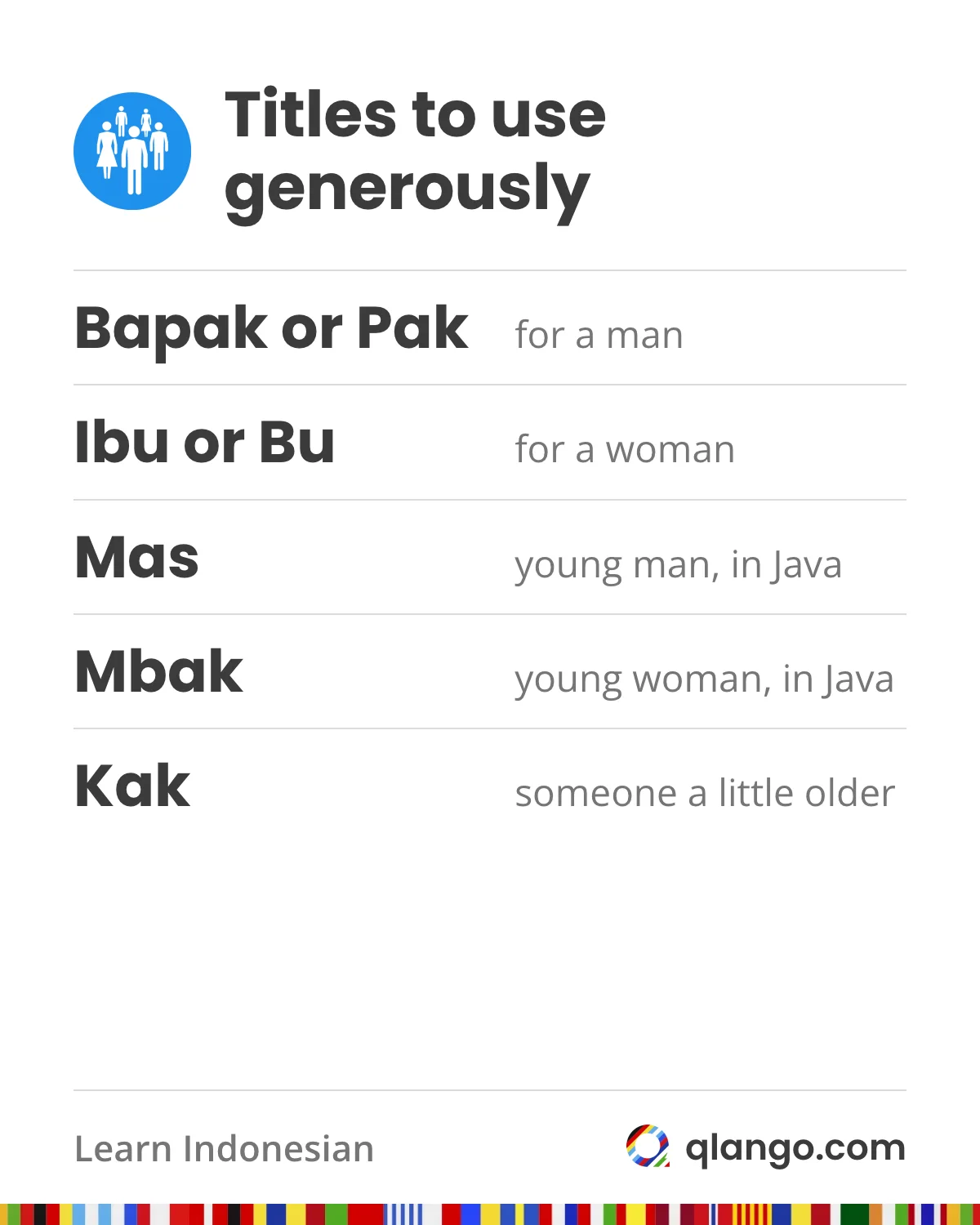
Use titles generously: Bapak or Pak for a man, Ibu or Bu for a woman, Mas and Mbak for young men and women in Java, Kak for someone a little older than you. Pak for the driver, Bu for the shopkeeper, and you've already been more polite than most visitors.
First Indonesian words
- Selamat pagi, selamat siang, selamat sore, selamat malam: good morning, good day, good afternoon, good evening.
- Apa kabar? Baik: how are you? Fine.
- Terima kasih: thank you. Sama-sama: you're welcome.
- Permisi: excuse me, to get past or get attention. Maaf: sorry.
- Tolong: please, when asking for help.
- Berapa?: how much?
- Saya tidak mengerti: I don't understand.
- Mau ke mana?: where are you going? More greeting than question; jalan-jalan, "just out for a walk", is a fine answer.
- Belum: not yet.
Too formal for the warung, too late with affixes
Indonesian teaching tends to slip in two places. It stays formal too long, so learners end up speaking like a news anchor and can't follow a conversation at a warung, the small family-run eating place found on every street. And it treats the grammar as so easy it barely needs teaching, so affixes arrive late and all at once. A learner who has to stop at every me- word to work out the root is, by month three, a frustrated learner. A book, a tutor or a course on your phone can all work, as long as it covers both the warung and the me- prefix.
Four weeks to a working start
| Week | Focus | By Sunday you can |
|---|---|---|
| 1 | greetings, numbers, saya, kamu, dia, ini, itu, fifty nouns | introduce yourself and ask prices |
| 2 | fifty everyday verbs; sudah, sedang, akan, belum | say what you did, are doing and will do |
| 3 | me- and ber- verbs; the di- passive when reading | find the root inside an affixed word |
| 4 | colloquial forms; short texts and messages | exchange simple messages with a speaker |
Twenty to thirty minutes a day is enough. Keep a daily vocabulary review going all month; our guide to vocabulary learning methods explains how to space it.
How Qlango helps you learn Indonesian
Qlango teaches Indonesian from A1 to B2, from your first apa kabar to the point where you can follow the main ideas of a conversation, a news item or an article on a familiar topic and take part in everyday discussion with some ease. That suits the advice above: a lot of vocabulary early, learned properly. Spaced repetition brings each word back shortly before it would slip away, flashcards and pick-one-of-four exercises keep the pace up, and building sentences yourself trains sudah and belum until they come out without thinking. With Premium, an AI teacher answers questions such as why baca becomes membaca but tulis becomes menulis, and lessons work offline. The chat with other learners translates messages and helps you draft a reply, and a weekly learning plan keeps the daily habit honest.
You pick the language you learn through when you add the course. The full table of languages and levels and the Premium plans are a click away.
Ask yourself a month from now whether you speak Indonesian, and the honest answer will still be belum. By then, though, it will mean what Indonesians mean by it: not yet, and on the way. Qlango's A1 course is a good place to set off.


