
In Finnish you don't live in Helsinki. You live Helsingissä: the nk in the middle of the name has softened to ng, and -ssä means "in". Someone from Turku lives Turussa, someone from Lahti lives Lahdessa. A k vanishes in one, a t turns into a d in the other, and none of it is irregular. It's consonant gradation, and together with the case endings and vowel harmony it accounts for most of what makes Finnish feel strange in the first weeks.
Here is how to learn Finnish without being flattened by those three. Learn words in the forms you'll actually use, not only the dictionary form. Treat endings as part of the word from day one. And accept early that written and spoken Finnish differ noticeably, so you will need both. None of this is quick, but all of it is regular, and regular is learnable.
Where Finnish is spoken
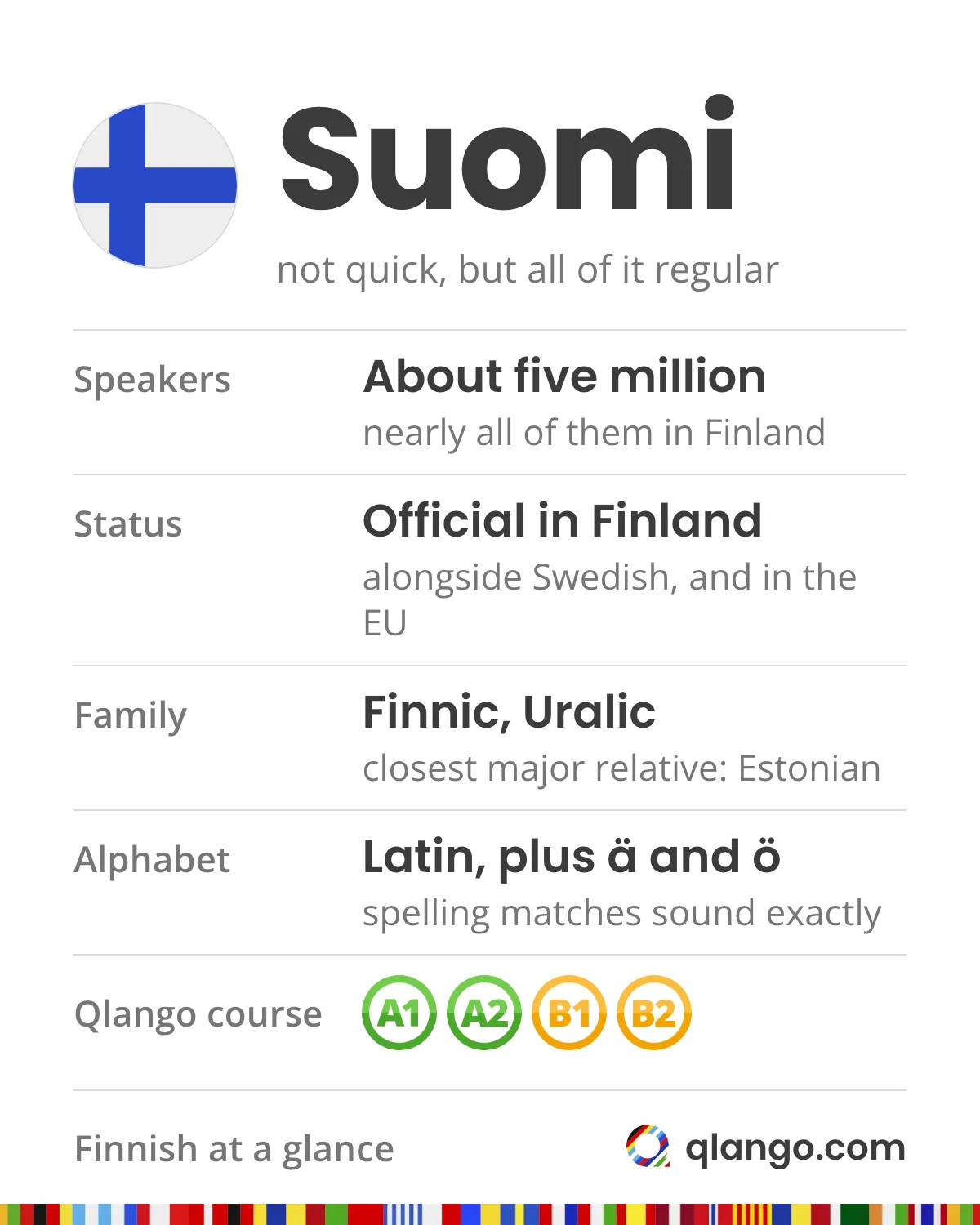
About five million people speak Finnish, nearly all of them in Finland, where it's an official language alongside Swedish. Sweden recognises Finnish as an official minority language, a legacy of six centuries of shared history and of the labour migration of the 1960s and 70s, and there are Finnish speakers in Norway too. Finnish is also one of the EU's official languages.
People come to it for work in Helsinki, Tampere or Oulu, for a Finnish partner, for study, or because they live in Finland and want to stop answering in English. If that's you, the national language certificate, YKI, is the exam you'll hear about.
A Uralic language with a friendly alphabet
Finnish isn't Indo-European. It belongs to the Finnic branch of the Uralic family, and its closest major relative is Estonian, close enough that speakers can make out a fair amount of each other's writing (see our Estonian guide). Hungarian is a much more distant cousin, with no mutual understanding at all; our Hungarian guide covers that one.
The alphabet is Latin, with ä and ö added. Spelling is phonemic: every letter is pronounced, always the same way. Stress falls on the first syllable. The vocabulary is mostly Finnish's own, apart from loans old and new. Kuningas (king) came from early Germanic so long ago that it preserves an older shape of the word than any Germanic language has today. Pankki, posti and kahvi are more recent and easier.
What's easy and what's hard
| Easier than its reputation | Harder than it looks |
|---|---|
| Spelling matches sound exactly | Long and short sounds change meaning |
| No grammatical gender: hän is he and she | Fifteen cases |
| No articles | Consonant gradation |
| No separate future tense | Vowel harmony |
| Verbs fall into a few regular types | "Not" is a verb |
Long sounds
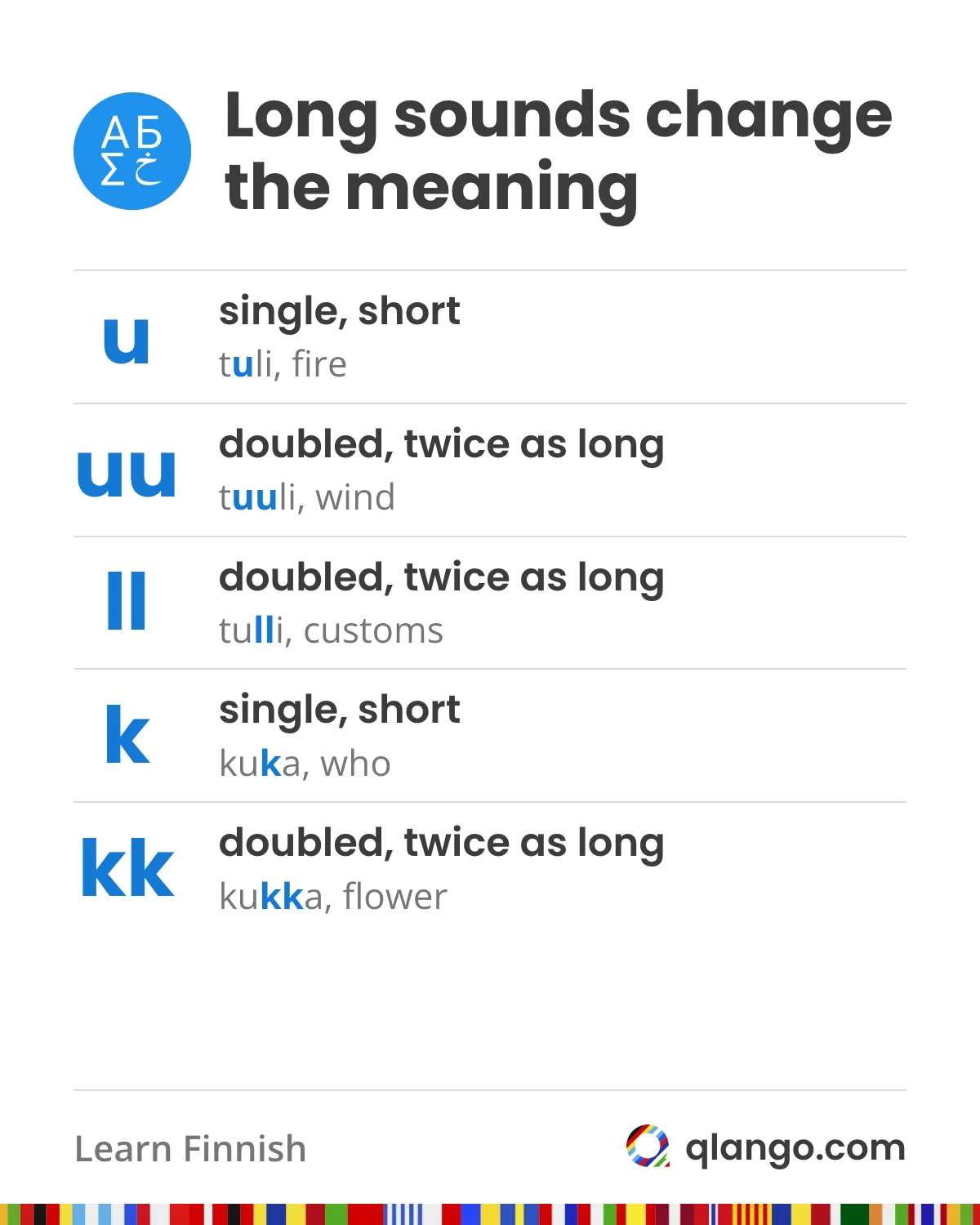
Doubling a letter doubles its length, and length changes meaning: tuli is fire, tuuli is wind, tulli is customs. Kuka means who, kukka means flower. English speakers rarely hold a sound long enough, so exaggerate at first.
Vowel harmony
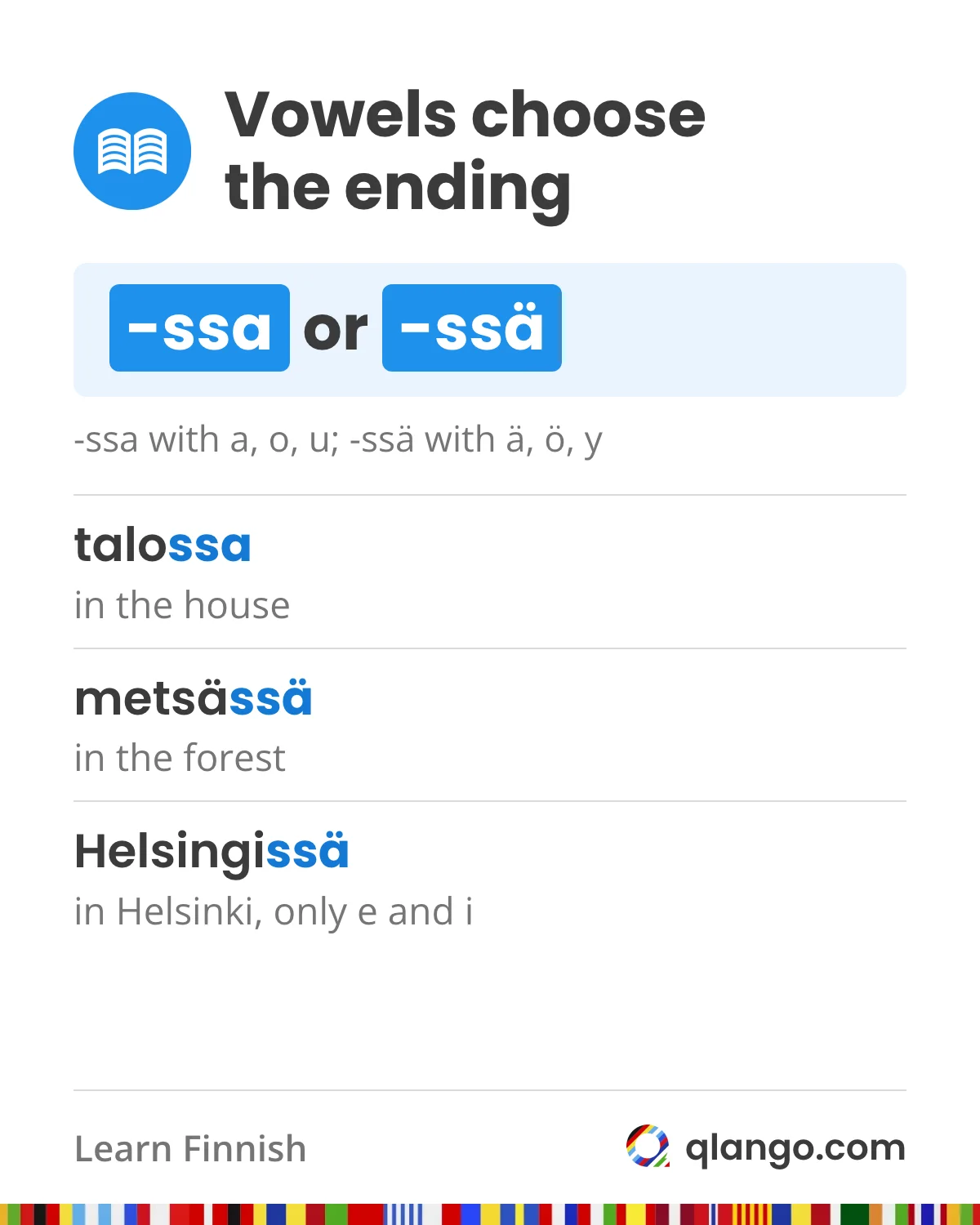
A word's vowels decide its endings. Back vowels (a, o, u) take one version, front vowels (ä, ö, y) the other: talossa, in the house, but metsässä, in the forest. E and i are neutral, which is why Helsinki, with only e and i, takes the front ending.
Consonant gradation
| Dictionary form | With an ending | What changed |
|---|---|---|
| kauppa (shop) | kaupassa (in the shop) | pp to p |
| pankki (bank) | pankissa (in the bank) | kk to k |
| katu (street) | kadulla (on the street) | t to d |
| pöytä (table) | pöydällä (on the table) | t to d |
| Helsinki | Helsingissä | nk to ng |
The pattern is regular, but it hides the dictionary form. Until you know it, kadulla doesn't look as if it has anything to do with katu.
Cases and the partitive
Fifteen cases sounds like a lot, and many are just prepositions glued on: -ssa in, -sta out of, -lla on, -lta off, -lle onto. The one that takes real time is the partitive, used for parts, unfinished actions and after numbers: kaksi kahvia, two coffees, with coffee in the partitive.
Saying no
Finnish says no with a verb that conjugates: en (I don't), et (you don't), ei (he or she doesn't), while the main verb stays in a plain form. En tiedä, I don't know.
Kirjakieli in the book, puhekieli in the café
Courses rightly start with written Finnish, kirjakieli, but many leave spoken Finnish, puhekieli, for a later stage that never quite arrives. The gap is real. The textbook says minä olen, "I am"; people say mä oon. Sinä olet becomes sä oot, minulla on ("I have") becomes mulla on, and me menemme ("we go") becomes me mennään. Numbers lose their ends: yks, kaks. In Helsinki, "I don't know" often comes out as en mä tiiä. Learn the written forms first, because they're what you read and write, but start listening to real speech by the second month, and use Yle's news in plain Finnish, selkosuomi, as easy reading once you have a few hundred words.
First Finnish words
- Hei, moi: hi
- Moi moi, heippa: bye, informal
- Kiitos: thank you, and also how you say please at the end of a request: kahvi, kiitos
- Ole hyvä: here you are, you're welcome
- Kyllä, joo: yes, formal and everyday
- Ei: no
- Anteeksi: sorry, excuse me
- En ymmärrä: I don't understand
- Puhutko englantia?: do you speak English?
- Mitä kuuluu?: how are you?
- Näkemiin: goodbye
- Kippis: cheers
Learn Finnish in four weeks: a realistic start
- Week 1: sounds and length. Read aloud daily, holding long vowels and double consonants properly. Learn the words above and the numbers one to ten: yksi, kaksi, kolme, neljä, viisi, kuusi, seitsemän, kahdeksan, yhdeksän, kymmenen.
- Week 2: olla and places. The verb "to be" (olen, olet, on, olemme, olette, ovat), its negative (en ole), and the "in" ending with ten places from your own week.
- Week 3: gradation in practice. Learn every new noun with one inflected form beside it: katu and kadulla, kauppa and kaupassa. Add the partitive after numbers.
- Week 4: your own sentences. Write five sentences a day about your routine, and start listening for mä and sä in real speech.
By the end of the month you'll be partway through A1. If you're studying without a class, our guide to learning a language on your own has more on keeping a solo routine alive.
How Qlango helps with Finnish
Qlango has Finnish from A1 to B2. B2 is where you can follow a meeting, read the news and talk about most things that come up at work. Lessons are short, and spaced repetition keeps returning each new word just before it would fade, until it sticks. Writing answers yourself, not just picking them, trains the long vowels and double consonants that Finnish spelling insists on. Word Duel, MinuteRush and Wordle turn vocabulary review into a game, and statistics over weeks, months and years show the progress that's hard to feel in a language this different.
With Premium, the AI teacher answers unlimited questions about grammar, vocabulary and example sentences, which is the fastest way to find out why it's kadulla and not katulla. You choose the language you learn through when you add the course; the table of languages and levels lists all 80.
Kahvi, kiitos: two words, and the second one does the work of please. Order your coffee that way this week, start Qlango's A1 course alongside, and by the time you can say where you live, Helsingissä will feel like a word rather than a typing exercise.


