
The first obstacle when you learn Swedish isn't the grammar. It's the Swedes, who speak excellent English and will switch to it, out of pure politeness, the moment you hesitate over a word.
So plan for that from the start. Get through the core grammar quickly, which is possible because there isn't much of it. Learn how words are actually said, not only how they're spelled, because the two part company more often than textbooks admit. And build a stock of everyday phrases you can produce without stopping to think, since a few fluent sentences keep a conversation in Swedish better than a long hesitant one. For English speakers, the US Foreign Service Institute files Swedish under its easiest group, at about 24 weeks of full-time study; there's more on how long it takes to learn a language in our separate guide.
Where Swedish is spoken
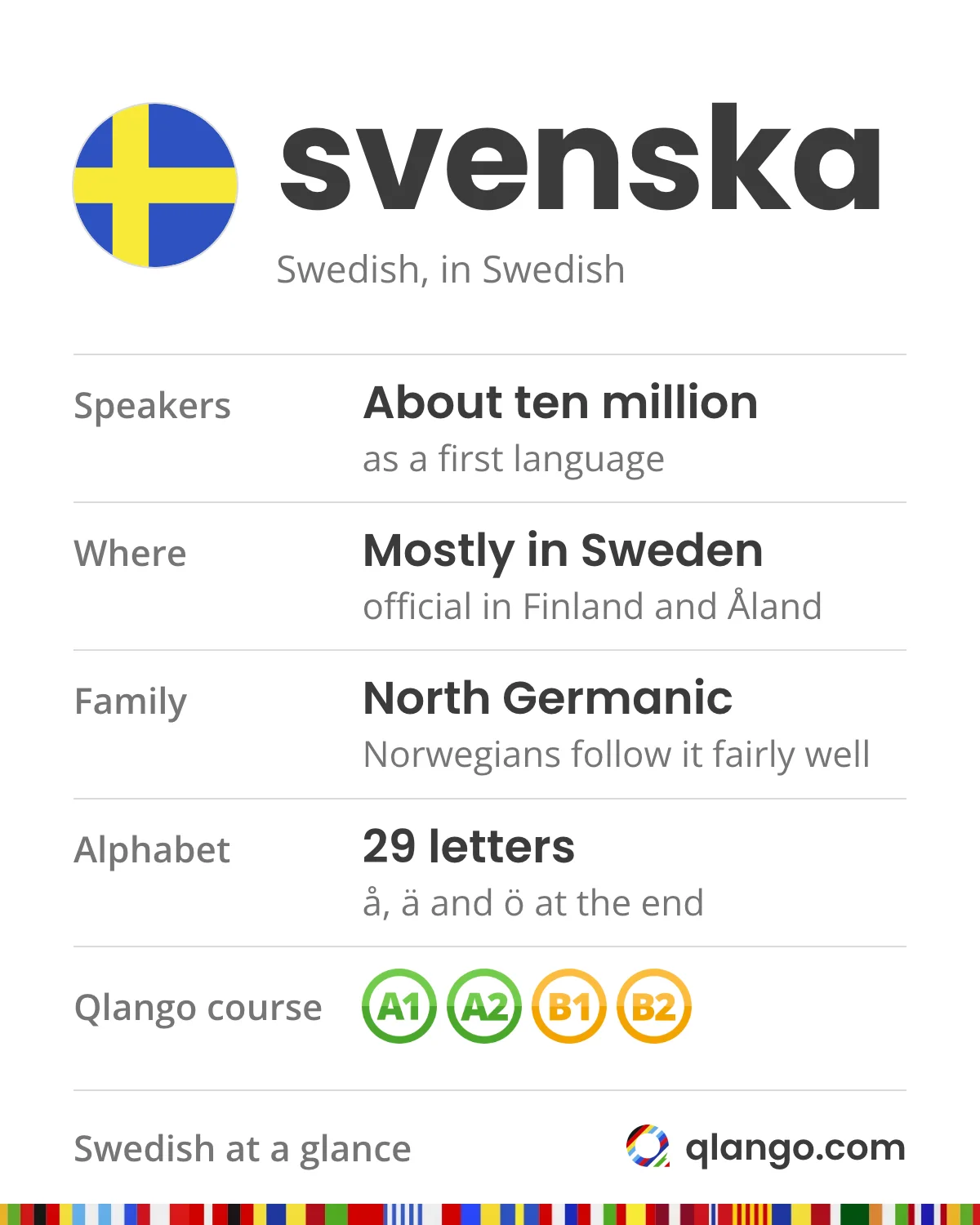
About ten million people speak Swedish as their first language. Most live in Sweden, but Swedish is also an official language of Finland, spoken by a minority along the west and south coasts, and the only official language of the Åland Islands. It is an official language of the European Union. If you're moving to Finland, bear in mind that most of the country speaks Finnish; our Finnish guide covers that one.
Swedish is North Germanic. Swedes and Norwegians understand each other's speech fairly well, and Danish is easier for Swedes to read than to hear. The alphabet has 29 letters, with å, ä and ö at the end, where Danish and Norwegian write æ and ø.
Why Swedish grammar won't hold you back
Verbs don't change for the person: jag är, du är, hon är. The past is var for everyone. Nouns are en or ett words, en bil and ett hus, and "the" goes on the end: bilen, huset. With an adjective you mark it twice: det stora huset, the big house. The verb comes second in a statement, so a sentence that starts with a time puts the subject after the verb: på fredag åker jag till Göteborg, on Friday go I to Gothenburg.
Politeness is easy too. Since the late 1960s Swedes have said du to almost everyone, and the formal ni now sounds stiff or old-fashioned to many ears.
False friends are the main vocabulary trap. Glass is ice cream. Semester is a holiday, not half of a school year. Rolig means fun, which confuses Danes and Norwegians, for whom it means calm.
What makes it hard to learn Swedish
Vowels and the sj-sound
Swedish has nine vowel letters, and nearly every one comes in a long and a short version, so there are far more vowel sounds to keep apart than English speakers are used to. Then there's the sj-sound, a breathy sound with no English equivalent, the first sound of sju (seven) and sjö (lake). Swedes test it on foreigners with sju sjösjuka sjömän, "seven seasick sailors".
Pitch accent
Like Norwegian, Swedish gives words one of two melodies. Anden with one melody is "the duck", with the other "the spirit". You'll be understood without it, but it's a large part of what makes Swedish sound Swedish. If Norwegian is also on your mind, our Norwegian guide covers the neighbour.
Spelled jag, said ja
Textbooks tend to teach Swedish as it's spelled and get round to the spoken forms late. The result is learners who pronounce mig with a hard g and can't work out why people smile.
| Written | Usually said | Meaning |
|---|---|---|
| jag | ja | I |
| mig, dig, sig | mej, dej, sej | me, you, oneself |
| de, dem | dom | they, them |
| och | å | and |
| sedan | sen | then, later |
| någon | nån | someone |
| säga | säja | to say |
Most of this is ordinary spoken Swedish, not slang: you'll hear mej and dej from newsreaders as readily as from teenagers. Learn both columns from the start and listening becomes much less of a shock.
First Swedish words
| Swedish | English |
|---|---|
| Hej | hi |
| Hej då | bye |
| God morgon | good morning |
| Tack, tack så mycket | thanks, thank you very much |
| Ja, nej | yes, no |
| Förlåt | sorry |
| Ursäkta | excuse me |
| Jag förstår inte | I don't understand |
| Pratar du engelska? | do you speak English? |
| Vad heter du? | what's your name? |
| Skål | cheers |
| Ska vi fika? | shall we have a coffee? |
Fika is a noun and a verb: coffee, something sweet and a conversation, and an invitation to fika is a standard way to get to know a colleague.
Keeping the conversation in Swedish
Ask directly: kan vi prata svenska, can we speak Swedish? Most people will happily switch back, at least for a while. Keep a few phrases ready for the moment you don't understand, so that you can stay in Swedish instead of retreating to English. If you live in Sweden, SFI, Swedish for immigrants, is the free state course for adults, and 8 Sidor publishes news in easy Swedish that a beginner can read within a few months.
A first month
The first week is sounds and greetings: the vowels, the sj-sound and the words in the table, said aloud every day. The second brings forty nouns with en or ett and their definite forms, plus the present tense, which ends in -r for everyone: jag pratar, du pratar, hon pratar. In the third week, practise verb-second word order by starting sentences with i dag, i morgon and på jobbet. In the fourth, write short messages to a Swedish speaker or another learner and ask them not to switch languages. You'll be partway through A1, with the spoken forms already in your ear.
How Qlango helps you learn Swedish
Qlango's Swedish runs from A1 to B2. At B2 you can work in Swedish, follow a discussion and hold your own in one. Lessons are short, spaced repetition brings words back just before you'd forget them, and sentence-building exercises drill the verb-second order until it feels normal. You can chat with other learners, people who have every reason to keep things in Swedish, with message translation and AI help to write a reply. Word Duel lets you play against friends or other learners when you'd rather compete than review.
Starting is free. With Premium you can learn offline and put unlimited grammar and vocabulary questions to the AI teacher. You pick the language you learn through when you add the course; see all languages and levels.
Ska vi fika? is the most useful question in a Swedish office, and the coffee buys you twenty minutes of conversation. Give Qlango's A1 course the weeks before that first fika, and when the talk drifts into English, ask kan vi prata svenska? and carry on.


