In Georgian, დედა (deda) means mother and მამა (mama) means father. Everyone who sets out to learn Georgian gets caught by that at least once, ideally not while being introduced to someone's parents, and it's a fair preview of the language as a whole: pieces that look familiar and aren't, inside a system that is entirely its own.
Georgian is hard, and nobody who has studied it will tell you otherwise. But the difficulty is concentrated in one place, the verb, and the rest is more manageable than its reputation. The script takes a week. The sounds take a month or two of regular practice. The verbs take years, and you can say useful things long before you've tamed them. So the way to start is with the script, then the sounds, then verbs learned as whole phrases rather than as tables. This guide covers what to expect at each step.
Where Georgian is spoken, and what it's related to
Georgian is the official language of Georgia and the mother tongue of roughly four million people, nearly all of them in Georgia, with communities in Russia, Turkey and Iran and a growing number of emigrants in the EU and the US. It belongs to the Kartvelian family, together with Mingrelian, Svan and Laz, which are spoken in western Georgia and, in the case of Laz, along Turkey's Black Sea coast. It isn't Indo-European or Turkic. Armenian, next door, is a completely different language with its own alphabet; see how to learn Armenian if that's the one you're weighing up.
Nothing from school French or German transfers to Georgian, and that's oddly freeing: everyone starts from the same line. Plenty of Georgians speak Russian, and many younger people in Tbilisi speak good English, so you can live in the capital for years without Georgian. Make the effort anyway. A few sentences in Georgian change the temperature of almost any conversation.
The alphabet: 33 letters and no capitals
Modern Georgian is written in Mkhedruli, an alphabet of 33 letters. There are no capital letters in ordinary writing, which removes a whole layer of work, and spelling follows pronunciation closely: one letter, one sound. At first many letters look like variations on the same handful of loops. By the fourth or fifth day they don't. Georgia's three historical scripts were inscribed together on UNESCO's list of intangible cultural heritage in 2016, and you'll see the older forms carved on church walls. You don't need them to read a menu.
Learn five or six letters a day, write each a dozen times, and practise on words you already know. Loanwords are perfect for this: ტაქსი (t'aksi, taxi), ბანკი (bank'i, bank) and კაფე (k'ape, café) give you quick wins and teach several letters at once.
How to learn Georgian sounds
The vowels are the easy part: a, e, i, o, u, pure and never swallowed. The consonants are the work.
| Type | Letters | How to make them |
|---|---|---|
| Aspirated | ფ თ ქ ც ჩ (p, t, k, ts, ch) | as in English "pin", with a puff of air |
| Ejective | პ ტ კ წ ჭ (p', t', k', ts', ch') | throat closed, released with a small pop and no puff |
| Uvular ejective | ყ (q') | an ejective made far back, where you'd gargle |
| Fricatives | ხ (kh), ღ (gh) | kh as in Scottish "loch"; gh close to a French r |
Ejectives are the sound English speakers find strangest. A trick that works for many people: hold your breath, then say k without letting any air out of your lungs. The small click you get is close to კ. The difference matters: ქარი (kari) is wind, კარი (k'ari) is a door.
Then there are the clusters. მწვრთნელი (mts'vrtneli) means coach or trainer, and Georgians are well aware of how it looks to outsiders. Clusters get easier once you stop slipping vowels between the consonants; say them quickly and they hold together. Stress, at least, is light and doesn't change meaning, so that's one thing you can stop worrying about.
Why the Georgian verb has a reputation
Georgian verbs agree with the subject and often with the object too, using both prefixes and suffixes. მიყვარხარ (miq'varkhar), "I love you", is a single word with both "I" and "you" inside it.
Tense, aspect and mood are organised into groups that grammarians call screeves, arranged in three series, and the series decides which case the subject takes. In the present, "the man writes" is კაცი წერს (k'atsi ts'ers). In the past it becomes კაცმა დაწერა (k'atsma dats'era): same man, different ending, because Georgian marks the subject differently in some tenses, a pattern linguists call split ergativity. Then come preverbs, small prefixes that add direction or completion: მიდის (midis) is "he goes", მოდის (modis) is "he comes".
There's no shortcut through all this, but there is a sensible order. Learn verbs as whole phrases first: მიყვარხარ, მინდა ყავა (minda q'ava, I want coffee), არ მესმის (ar mesmis, I don't understand). Then look for the patterns in what you already know. Only then open the tables. People who start with the full screeve charts tend to give up around page forty.
Georgian nouns are kinder
Nouns have seven cases, but the endings are regular, there's no grammatical gender, and there are no articles. Much of what English does with prepositions, Georgian does with endings fixed to the noun: თბილისი (Tbilisi) becomes თბილისში (Tbilisshi), "in Tbilisi".
Your first Georgian words
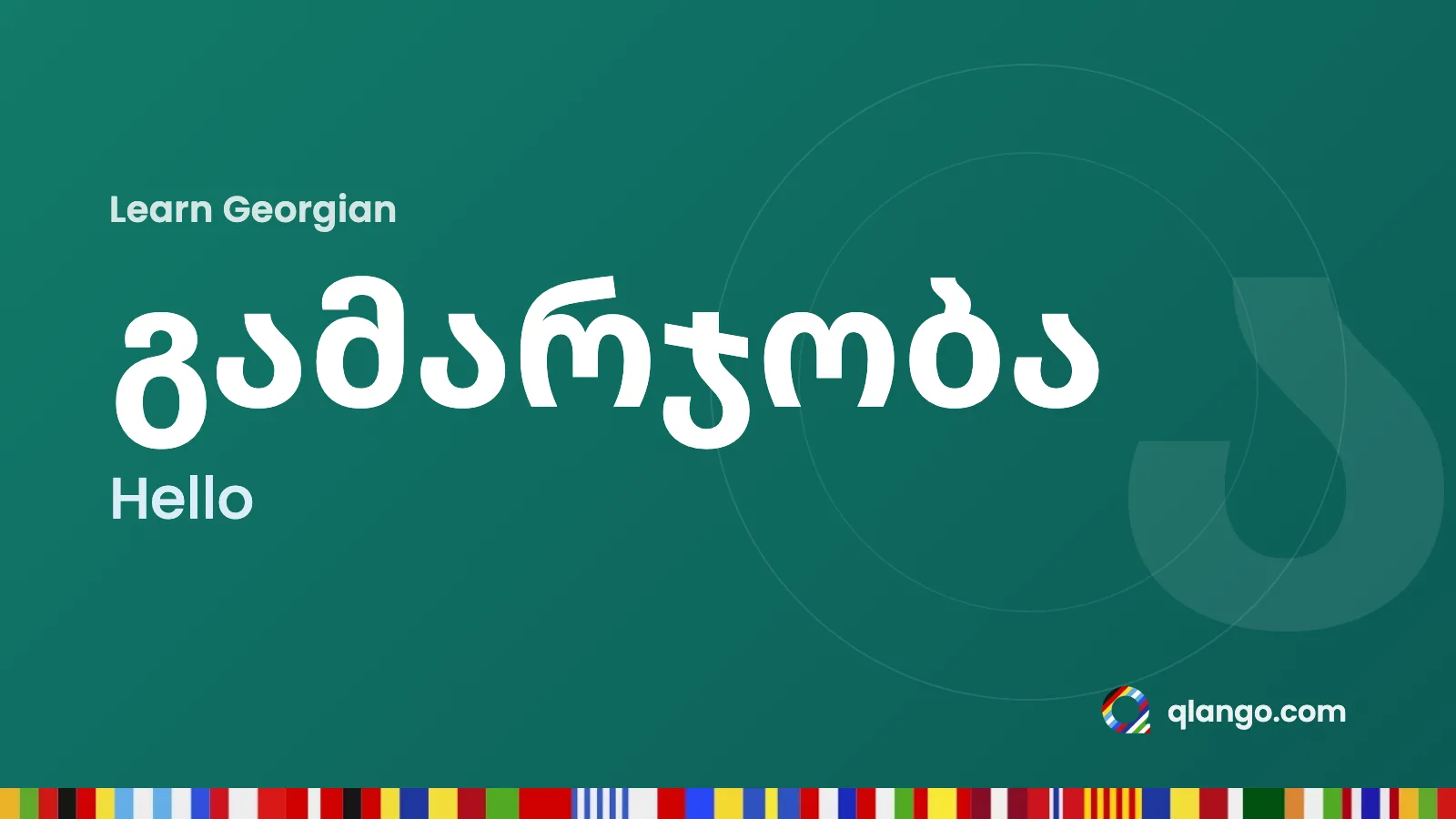
- გამარჯობა (gamarjoba): hello, a greeting built on the word for victory
- მადლობა (madloba): thank you
- კი (k'i): yes, casual; დიახ (diakh) is the polite form
- არა (ara): no
- ბოდიში (bodishi): sorry, excuse me
- ნახვამდის (nakhvamdis): goodbye
- გაუმარჯოს (gaumarjos): cheers, which you'll hear at every supra, the long Georgian feast led by a toastmaster
- ქართული (kartuli): Georgian, the language
- საქართველო (sakartvelo): Georgia, as Georgians call it
And, once more, because it bears repeating: deda is your mother, mama is your father.
Why it's hard to find Georgian courses
What exists tends to sit at the two extremes: phrasebooks for a ten-day trip and academic grammars written for linguists, with screeve tables by chapter three. The middle, an ordinary step-by-step course from A1 upward for adults, is thin. People search for "learn Georgian in Tbilisi" because a school in the city is the obvious answer, and it is, if you can be there.
A first month
Week 1: the script
Learn the 33 letters, five or six a day. Write them by hand and read loanwords aloud. Learn gamarjoba and madloba on the first day so you have something to say.
Week 2: sounds and survival phrases
Practise the ejectives daily for five minutes, comparing them with their aspirated partners. Learn the phrases above, the numbers to ten, and twenty everyday nouns. Keep a list of words you mix up.
Week 3: the present tense in phrases
Learn ten useful verb phrases whole: I want, I have, I don't understand, I love, I'm going. Write five short sentences a day about yourself, copying the patterns rather than building them from rules.
Week 4: first messages
Write to a Georgian speaker or another learner and ask for corrections. Add the "in" ending to your nouns. Our guide to vocabulary learning methods will help with the words that refuse to stick.
How Qlango teaches Georgian
Qlango has Georgian from A1 to B2, which covers exactly the gap described above: from your first გამარჯობა to the level where you can hold a real conversation without either side straining (here's what each CEFR level means). Lessons are short, and each new word comes with example sentences, so verbs arrive in context rather than in tables. The writing exercises make you type in Mkhedruli from the start, and spaced repetition brings words back just before they'd slip away. Premium includes an AI teacher you can ask why კაცმა has that ending, as many times as you need. When you add the course, you choose the language you learn through, which can be your native language rather than English. See all languages and levels and the Premium plans.
Start the A1 course today, with your own language as the bridge. Learn გამარჯობა first and leave the screeves for later.