Learn Azerbaijani: Alphabet, Grammar and First Words
How to learn Azerbaijani: the 32-letter Latin alphabet, where it is spoken, the grammar that takes work, your first words, and a realistic first-month plan.
Author: QlangoPublished: 5 min read
The letter that gives Azerbaijani away on a page is ə, the upside-down e that English dictionaries use for a lazy, unstressed vowel. In Azerbaijani it means something quite different, an open a close to the vowel in cat, and you'll write it constantly: təşəkkür edirəm, thank you, uses it three times. If you want to learn Azerbaijani, that letter is a good first step, because the rest of the alphabet behaves just as predictably once you know a few rules.
Here is the short version of how. Learn the 32-letter Latin alphabet in your first week. Then learn how suffixes attach and change with vowel harmony, how the verb closes the sentence, and the handful of cases you need from the start. Get through A1 and A2 with a structured course and steady vocabulary review. And if you know Turkish, use it shamelessly: the two languages are close relatives.
Where Azerbaijani is spoken, and why the numbers vary so much
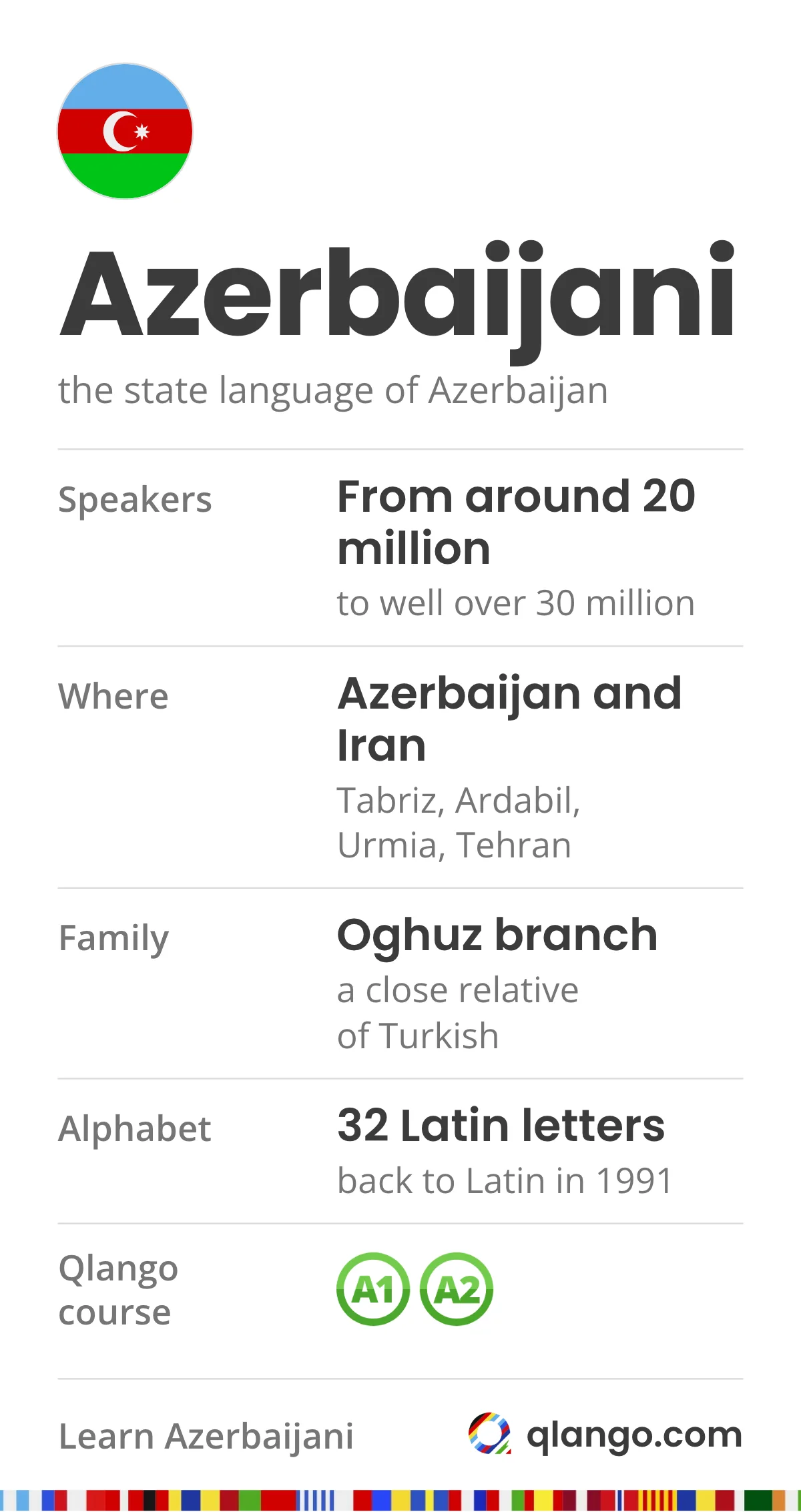
Azerbaijani is the state language of Azerbaijan, a country of about ten million people. The larger Azerbaijani-speaking population, though, almost certainly lives in Iran: in the northwest around Tabriz, Ardabil and Urmia, and in Tehran. There is no reliable count there, which is why estimates of the total range from around twenty million to well over thirty million. Smaller communities live in Georgia, in Russia's Dagestan and in Turkey.
The two main varieties differ. In Azerbaijan the language is written in Latin letters and has absorbed Russian loans; in Iran it is written in the Perso-Arabic script and borrows more from Persian. Most learning material, including this guide, follows the standard of Baku.
The alphabet: Latin, again, since 1991
In Azerbaijan, within a single century, the language went from Arabic script to a Latin alphabet in 1929, to Cyrillic in 1939, and back to a new Latin alphabet in 1991, which has been the only one in official use since the early 2000s. It has 32 letters, and these are the ones to learn carefully:
Letter
Sound
Example
ə
a as in cat
əl (hand)
ı
an i made further back, like Turkish ı
altı (six)
q
at the start of a word, a hard g
qız (girl)
g
a soft g, almost gy
gəl (come)
ğ
a soft sound made in the throat, like a French r
dağ (mountain)
x
ch as in Scottish loch
xahiş (request)
c
j as in jam
cavab (answer)
ç
ch as in church
çay (tea)
j
s as in pleasure
jurnal (magazine)
ş
sh
şəhər (city)
ö, ü
as in German
göz (eye), üç (three)
If you've studied Turkish, c, ç, ş, j, ı, ö and ü behave the same way. The surprises are ə, x and q, plus g, which is softer than in Turkish, and ğ, which is pronounced more firmly.
What makes Azerbaijani easier than it looks
There's no grammatical gender and no word for the, and spelling follows pronunciation. Words are built by adding suffixes in a fixed order, so ev (house) becomes evlər (houses), evlərim (my houses) and evlərimdə (in my houses). The suffixes are regular enough that once you've learned a pattern you can apply it to hundreds of words, and the grammar has few of the exceptions that make European languages so tiring.
Turkish helps a great deal, and so does Turkmen, another member of the same Oghuz branch. Compare Turkish teşekkür ederim with Azerbaijani təşəkkür edirəm and you can see how close they are.
What takes work
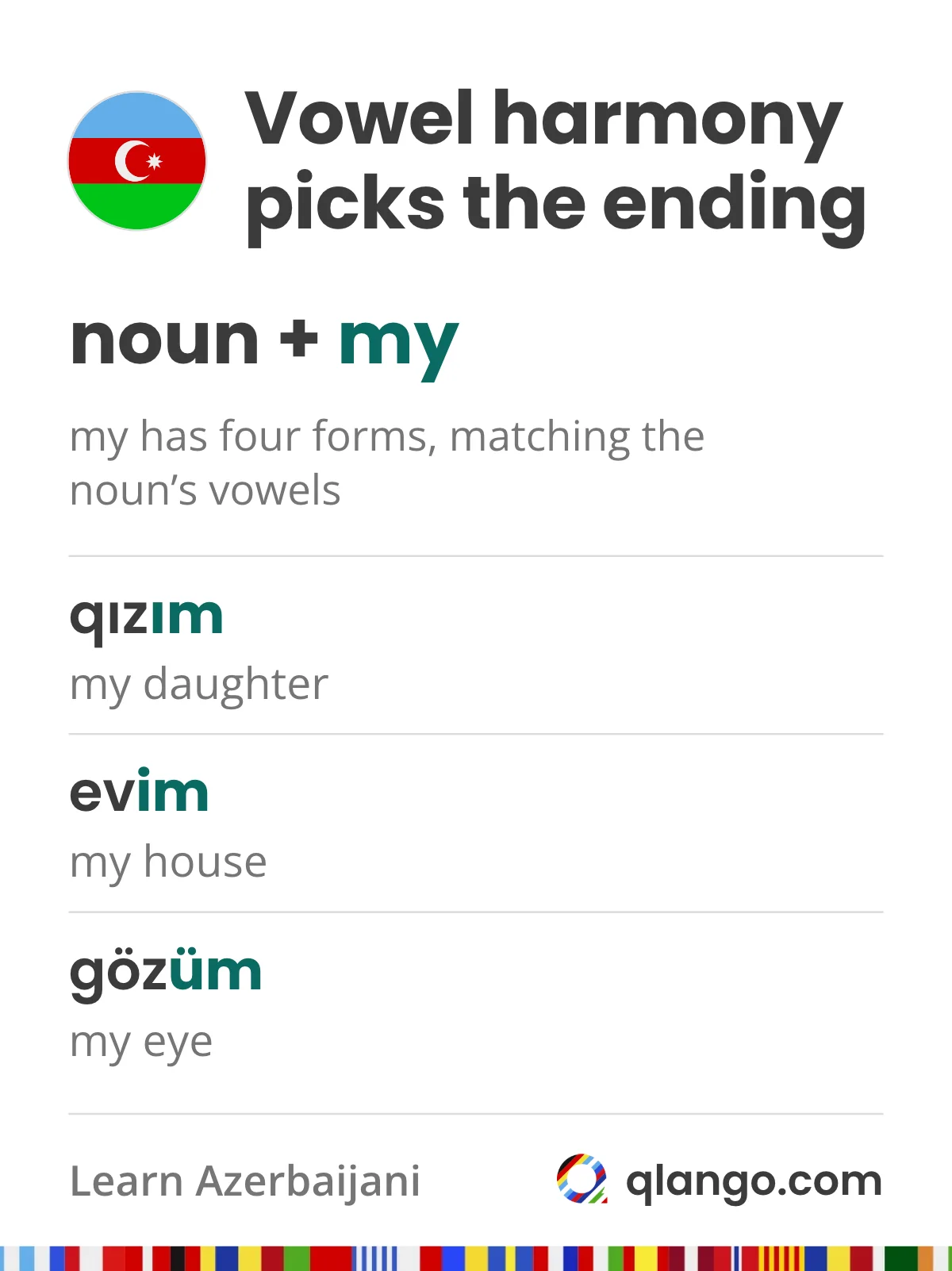
Vowel harmony. Suffixes change to match the vowels of the word they attach to. Some have two forms, like the plural -lar and -lər; others have four, like my in qızım (my daughter), evim (my house) and gözüm (my eye).
The verb at the end. Long sentences hold the verb back until the last word, and relative clauses come before the noun they describe, which reverses the English order.
More than one past tense. Like Turkish, Azerbaijani has a past tense in -mış for things you didn't witness yourself and only heard about or worked out.
Not overdoing the Turkish. Turkish speakers learning Azerbaijani have it easy until they realise how often they're still speaking Turkish: it's çox, not çok, for very.
First Azerbaijani words
Salam: hello
Necəsən? and Necəsiniz?: how are you? (informal and polite)
Yaxşıyam: I'm fine
Təşəkkür edirəm and sağ ol: thank you (polite and informal)
Xahiş edirəm: please, and also you're welcome
Bəli and hə: yes (formal and everyday)
Xeyr and yox: no (formal and everyday)
Mənim adım ...: my name is ...
Xoş gəlmisiniz: welcome
Görüşərik: see you
Engineers, diplomats and heritage learners
Azerbaijani's adult learners are a mixed group: engineers and managers in Baku's energy sector, diplomats, researchers, people with Azerbaijani partners, and Iranian Azerbaijanis who grew up speaking the language but never learned to read it in Latin letters. None of these groups is big enough on its own to make publishers rush, and most existing textbooks were written for Russian or Turkish speakers. Universities and private schools in Baku run courses for foreigners, which is a fine option if you can live there for a while; from anywhere else the choice is thin.
How to learn Azerbaijani in your first month
Give it twenty to thirty minutes a day. Spend the first week on the alphabet and greetings, reading every Azerbaijani word you can find aloud until ə, x and q stop slowing you down. In the second week, learn fifty everyday nouns with the plural and the possessive endings, so you can say evim and qızım without thinking, and the numbers to twenty.
The third week belongs to verbs. The present tense will carry you a long way: oxuyuram (I'm reading), işləyirəm (I'm working). Write five sentences a day about your own life, verb last. In the fourth week, add the cases for place, which are as tidy as anything in the language: Bakıda, Bakıya and Bakıdan mean in, to and from Baku. Then start sending short messages to a speaker or another learner and ask for corrections.
Review vocabulary on a schedule rather than in bursts; our overview of vocabulary learning methods explains why that works better than rereading lists.
How Qlango helps
Qlango's Azerbaijani course covers A1 and A2, from the first salam to everyday conversations about family, work, shopping and travel. Lessons are short, new words come with example sentences, and spaced repetition brings each one back right before you'd forget it. Flashcards and quick multiple-choice rounds build vocabulary; sentence-building exercises drill the suffix order; written answers get you used to typing ə and ğ.
When you add a course, you select the language you want to learn through, which, as the FAQ puts it, can be your native language or a language you want to strengthen. Starting is free, and Premium adds offline learning and an AI teacher you can ask about vowel harmony, cases or the -mış past as often as you like.
Təşəkkür edirəm holds three of those upside-down e's. Count them now, open the A1 course in Qlango, and within a week your fingers will find all three without the counting.
Is there an app to learn Azerbaijani?
Yes. Qlango teaches Azerbaijani from A1 to A2 on iPhone, Android and the web, and it’s free to start. Duolingo, Babbel and Busuu don’t offer a Azerbaijani course for English speakers (checked November 2026).
How to learn Turkmen as an English speaker: its Latin alphabet, the grammar that takes time, your first words, and a simple daily routine for the first month.
How to learn Kyrgyz: where it is spoken, Cyrillic with three extra letters, vowel harmony with a twist, your first words, and a week-by-week first-month plan.
Is Uzbek hard? How to learn Uzbek in Latin and Cyrillic script, what is easy and hard for English speakers, your first words, and a plan for your first month.