Icelanders would rather build a new word than borrow one. A computer is a tölva, put together from tala, "number", and völva, "prophetess". A telephone is a sími, from an old word for "thread". Where most languages take a word from English and move on, Icelandic makes its own out of parts it already owns, and that habit tells you a lot about what it means to learn Icelandic.
The good news comes first. English and Icelandic are both Germanic, so hús, bók and fiskur need no translation, and many everyday words turn out familiar once you know where to look. The harder news is that Icelandic kept the grammar English mostly lost in the Middle Ages: four cases, three genders, and nouns, adjectives, pronouns and even the numbers one to four that change their endings to match. The way through is a daily habit, grammar in small portions, and more reading than you think you need.
Who speaks Icelandic, and where it comes from
Icelandic is the national language of Iceland, a country of fewer than 400,000 people, plus small communities abroad, in the other Nordic countries and in Canada. It's a North Germanic language, descended from the Old Norse that settlers brought to the island in the late 800s. Faroese is its closest living relative.
Norwegian, Swedish and Danish are cousins too, but they simplified over the centuries and Icelandic didn't. Icelanders can read sagas written in the 1200s and 1300s without a translation, though not without some effort. That conservatism is the reason Norwegian and Swedish show up on lists of the easiest languages for English speakers and Icelandic doesn't.
The alphabet: 32 letters and two old friends
Icelandic uses 32 letters. Two of them, þ (thorn) and ð (eth), were once used to write English as well, before "th" replaced them. Þ is the "th" in "thin" and starts words like þú (you) and þakka (to thank). Ð is the "th" in "this" and never starts a word.
The accented vowels aren't stress marks. They're separate letters with their own sounds: á is the "ow" in "cow", é is the "ye" in "yes", ó is the "o" in "go", ú is the "oo" in "too", and æ is the "i" in "ice". Stress always falls on the first syllable, which is one thing you can stop worrying about.
A few spellings will catch you out early:
- A double l often sounds closer to "tl", as in fjall (mountain) and jökull (glacier).
- Hv at the start of a word is said "kv", so hvað (what) sounds roughly like "kvath", with the "th" of "this".
- In takk there's a small puff of breath before the k.
How to learn Icelandic grammar in small pieces
Nouns come in three genders, and the definite article sits at the end of the word: hestur is "a horse", hesturinn "the horse"; bók, bókin; hús, húsið. That ending is your friend. Learn every noun with it from day one and you get the gender for free.
Then add the cases one at a time: nominative and accusative first, dative next, genitive last, since you'll need it least in early conversation. Learn prepositions inside short phrases rather than as rules about which case they take. A phrase sticks; a rule about a phrase doesn't.
Two things will feel strange for a while. Numbers change with gender, so "two" is tveir, tvær or tvö depending on what you're counting. And some verbs put their subject in another case: Mér er kalt means "I'm cold", but literally says "to me is cold". You won't need to understand that in week one. You'll just need to say it in January.
The family words are a gift, on the other hand: móðir, faðir, bróðir, systir. So is vatn, water.
Why Icelandic courses are rare
A language with a few hundred thousand speakers doesn't support a large publishing industry, and most serious courses are aimed at people who have already moved to Iceland. Outside the country, options thin out fast. Tourism didn't help: visitors get by in English, so the market produced phrasebooks rather than courses. Icelanders add to the problem themselves by speaking very good English and switching to it out of politeness.
A first month, week by week
Week one: letters and greetings
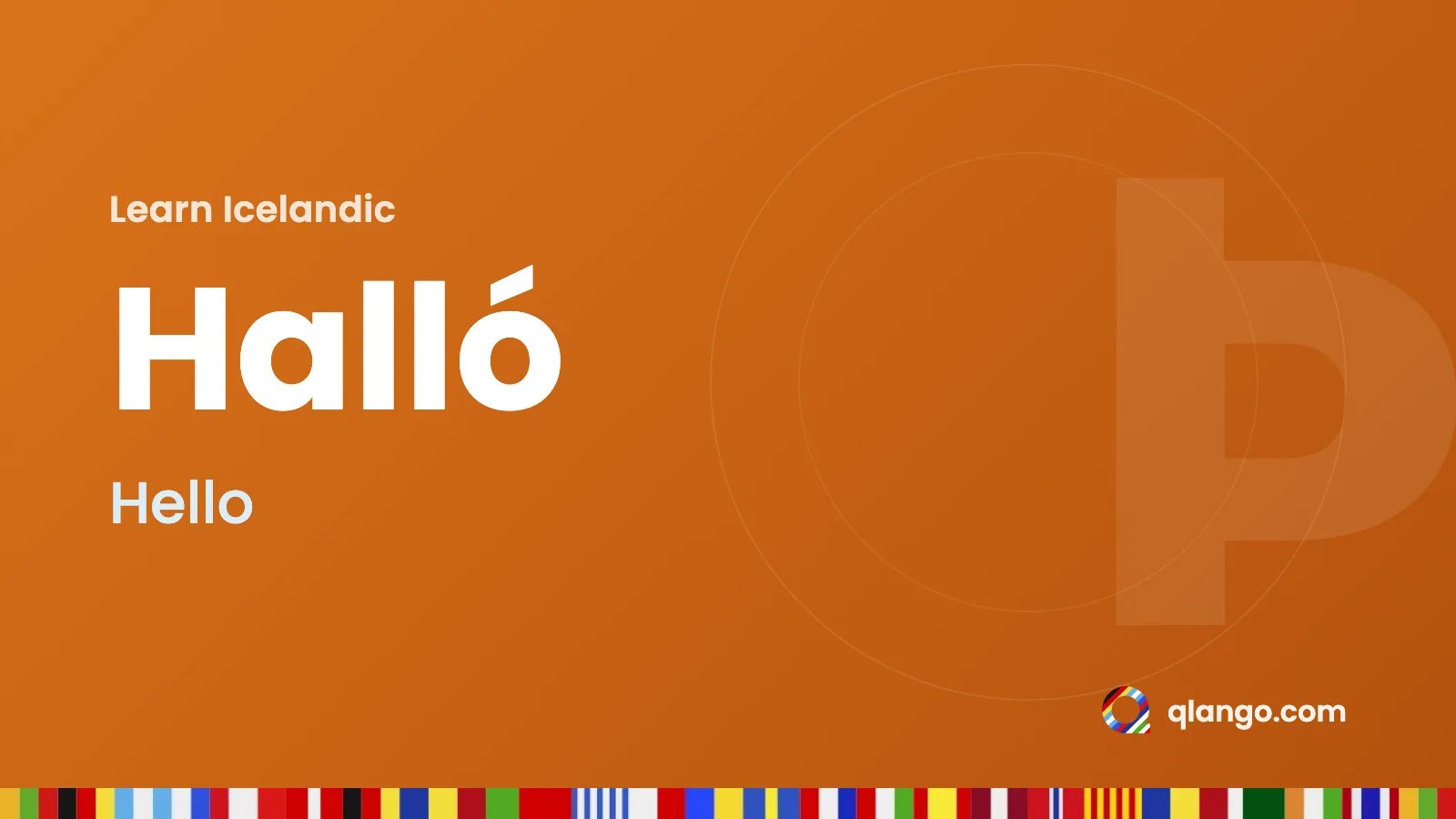
Work through the alphabet and the sounds above. Learn halló or hæ (hello, hi), góðan daginn (good day, used in the morning and daytime), gott kvöld (good evening), takk or takk fyrir (thanks), bless (bye), já and nei. Add Ég heiti..., "my name is...", and Hvað segirðu?, the everyday "how's it going?", answered with Allt gott, "all good".
Week two: nouns with their articles
Thirty common nouns, each learned in two forms, with and without the article. Sort them by gender as you go, and say them out loud.
Week three: "to be" and the accusative
The verb vera: ég er, þú ert, hann, hún or það er, við erum, þið eruð, þeir, þær or þau eru. Notice that "they" has three forms, one per gender. Then meet the accusative through a few verbs and phrases you'll actually use.
Week four: read and review
Read very short texts and write five sentences a day about your life. Review on a schedule rather than when you feel like it; our comparison of vocabulary learning methods explains why that matters so much in a language this heavy on endings.
How Qlango teaches Icelandic
Qlango teaches Icelandic at A1 and A2, and it's fair to say exactly what that means: a beginner foundation. You'll be able to introduce yourself, handle simple everyday exchanges and read short, simple texts. You won't be fluent, and nobody honest would promise fluency from two levels. What the course gives you is the base that makes later study possible: core vocabulary, brought back by spaced repetition before you forget it, and endings practiced by writing answers yourself rather than only recognizing them. Building sentences trains the word order. With Premium, the AI teacher answers questions like why it's bókin but hesturinn, whenever they come up. The languages page lists every course and level.
Questions people ask before they start
Is Icelandic harder than Norwegian?
Yes, noticeably. Norwegian dropped most of its case endings and Icelandic kept them, so you spend far more time on grammar. Pronunciation has its own traps in both.
Can you learn Icelandic for free?
You can start for free. Qlango's lessons are free to begin with, and Premium gives you everything, including offline learning and the AI teacher, on a monthly, yearly or one-time Forever plan. Once you know a few hundred words, there's plenty of free Icelandic to read online as well.
Will Icelanders just answer in English?
Often, at first. Tell them you're learning and ask them to keep going in Icelandic. Most will.
Start with the alphabet tonight and do the first A1 lesson right after it. By Sunday, hæ, takk and bless should come out without thinking.