Before you learn Kurdish, decide which Kurdish. Plenty of beginners find this out the hard way: they buy a book, open it, and discover it's written in an Arabic-based script while their Kurdish friends text in Latin letters, or the other way around. Kurdish is a group of closely related varieties rather than one standard language, and the two big ones are Kurmanji and Sorani.
The rule of thumb is simple. If the people you want to talk to come from Turkey, Syria or the Duhok region of Iraq, which covers most Kurdish families in Germany and much of the diaspora elsewhere in Europe, learn Kurmanji. If they come from Erbil, Sulaymaniyah or parts of western Iran, Sorani is more likely what they speak. Most of this guide is about Kurmanji: the alphabet, the grammar that surprises English speakers, a few first phrases and a plan for the first month.
Kurmanji or Sorani: an honest comparison
| Kurmanji | Sorani | |
|---|---|---|
| Also called | Northern Kurdish | Central Kurdish |
| Spoken mainly in | Turkey, Syria, the Duhok region of Iraq, northwest Iran, the Caucasus, the European diaspora | Iraqi Kurdistan around Erbil and Sulaymaniyah, western Iran |
| Usual script | Latin | Arabic-based |
| Grammatical gender | Masculine and feminine | None |
| Case endings | A direct and an oblique case | Largely gone |
| Saying "the" | No article; a bare noun usually reads as definite | An ending, -eke |
Speakers of the two can understand a fair amount of each other once they've had some exposure, but a beginner who learned one will struggle with the other. To complicate things, in Iraq's Duhok region Kurmanji is usually called Badini and is often written in the Arabic-based script, so learners there may eventually want both alphabets.
Nobody has a reliable count of Kurdish speakers, because census data is thin or politically sensitive in most of the countries involved. Estimates for all varieties together run from about 20 million to well over 30 million, and Kurmanji is generally considered the largest of them. It's also the variety Qlango teaches.
Is Kurdish hard to learn for English speakers?
Moderately, and in specific places. Kurdish is Indo-European, from the Iranian branch, which makes it a distant cousin of English. You can see it in nav (name), nû (new), du (two) and bira (brother). It's related to Persian too, but the two aren't mutually intelligible.
The Kurmanji alphabet has 31 Latin letters, and spelling is close to phonetic. Many letters work as they do in Turkish, which helps if you know Turkish. If you don't, these are the ones to watch:
- c is the "j" in "jam", and j is the "s" in "measure"
- ç is "ch", and ş is "sh"
- x is the "ch" in Scottish "loch", and q is a "k" made further back in the throat
- ê, î and û are long vowels, while i is short and light, much like the "i" in "bit"
Two pieces of grammar take real effort.
Gender you can't see. Mal (house) is feminine and nav (name) is masculine, but the nouns themselves don't show it. The linking ending does. When a noun is described or possessed, it takes an ending called the ezafe: mala min, "my house", but navê min, "my name". Likewise dayika min, "my mother", and bavê te, "your father". Get the ending wrong and you've changed the gender of the house.
The past tense flips. In the present, Kurmanji works roughly the way English does. In the past tense of verbs that take an object, it doesn't. Ez çûm means "I went", with ez for "I". But "I ate bread" is Min nan xwar: the "I" turns into min, and the verb agrees with the bread. Linguists call this ergativity. Learners call it other things.
Why Kurdish courses are hard to find
For long stretches of the 20th century, Kurdish was restricted in schools, publishing and broadcasting in Turkey and Syria. Generations learned it at home rather than in classrooms, and standard teaching materials came late. On top of that, the market is split by variety and by script, so each slice is small. And a course labeled simply "Kurdish" may turn out to be Sorani, which is fine if that's what you need and an unpleasant surprise if it isn't. Check before you pay for anything, whether it's a book, a tutor or an app.
How to learn Kurdish in your first month
Plan on twenty to thirty minutes a day.
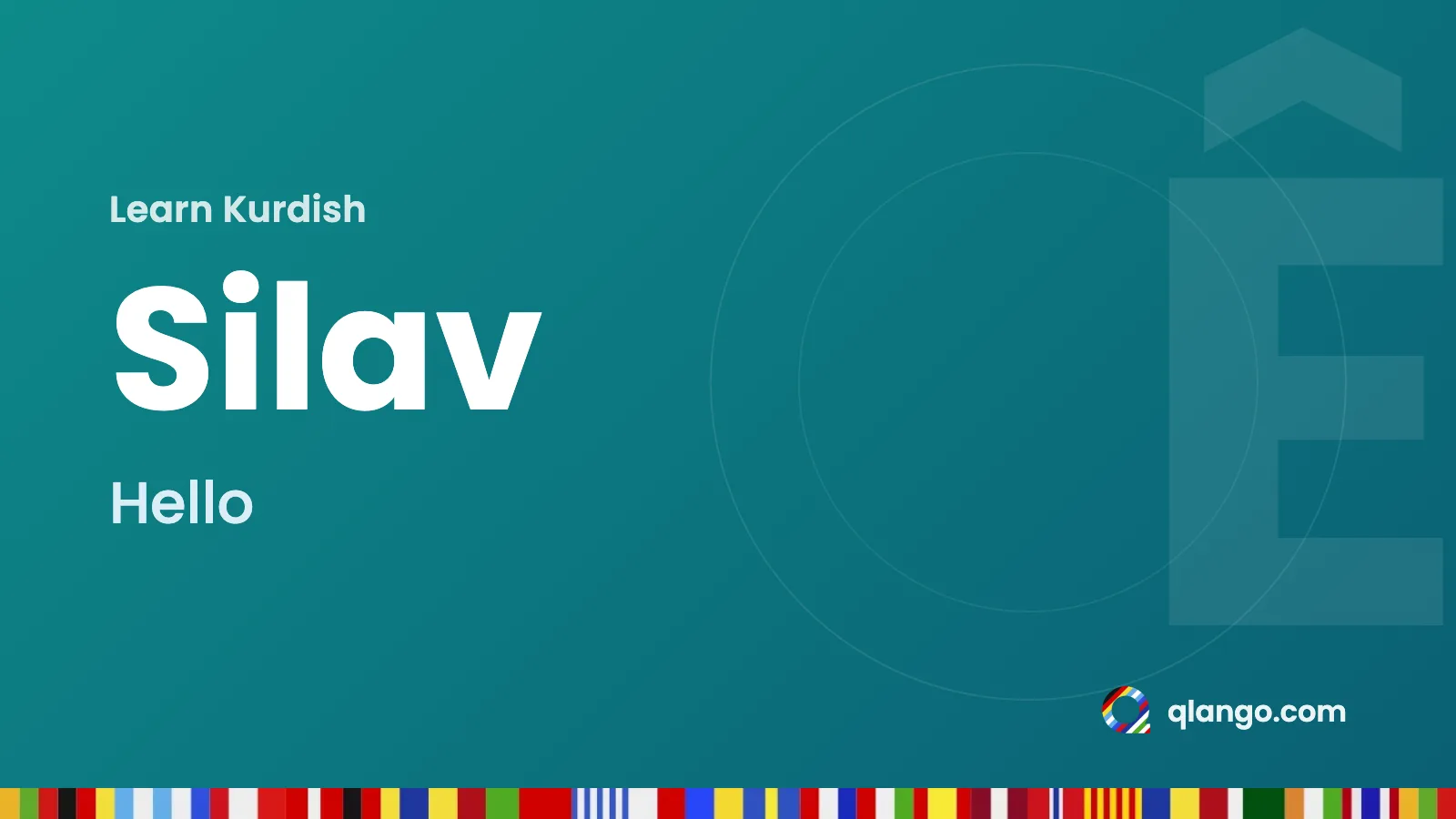
In week one, learn the alphabet, with extra attention to c, j, x, q and the long vowels, and the first phrases: Silav (hello), Rojbaş (good morning), Spas (thank you), Erê (yes), Na (no), Tu çawa yî? (How are you?), Ez baş im (I'm fine), Bi xêr hatî (welcome), and Xatirê te (goodbye, said by the person leaving).
In week two, practice the ezafe with words for family and things you own: navê min, mala min, dayika min, bavê te. Add the numbers one to ten: yek, du, sê, çar, pênc, şeş, heft, heşt, neh, deh. Then introduce yourself with Navê min ... e, "My name is ...", which becomes ye after a name that ends in a vowel.
In week three, move to the present tense, which is built with the prefix di-: ez dixwînim (I read, I study), tu dixwînî, ew dixwîne.
In week four, meet the past tense and learn to recognize the min ... xwar pattern, even if you can't produce it reliably yet. Write a few sentences a day. If you're studying without a teacher, our guide to learning a language on your own has a weekly routine that fits around this plan.
What Qlango's Kurmanji course covers
Qlango lists the course as Kurdish (Kurmanji), at levels A1 and A2. That's a beginner foundation, and it's worth being clear about what it means. Our guide to the CEFR levels has the full picture; in short, by the end of A2 you can handle greetings, introductions, family, shopping and simple everyday exchanges, and read short, simple texts. It's exactly the stage most self-taught learners struggle to put together, because the materials are scattered.
The course gives you short lessons, spaced repetition so words return just before you'd forget them, and exercises where you write the answer yourself, which is where ê, î and û stop being decoration. With Premium, the AI teacher answers the ezafe and past-tense questions above, in English, whenever they come up. If you need Sorani for Erbil or Sulaymaniyah, be honest with yourself: a Kurmanji course will give you shared vocabulary and a feel for the family, but not the Sorani script or its grammar. The full list of languages shows every course and its levels. You can start learning Kurmanji for free, and Premium plans cover the rest.
If Kurmanji is your Kurdish, add it today and do the first A1 lesson with English as the language you learn through. Silav is a good first word, and spas is a good second.