
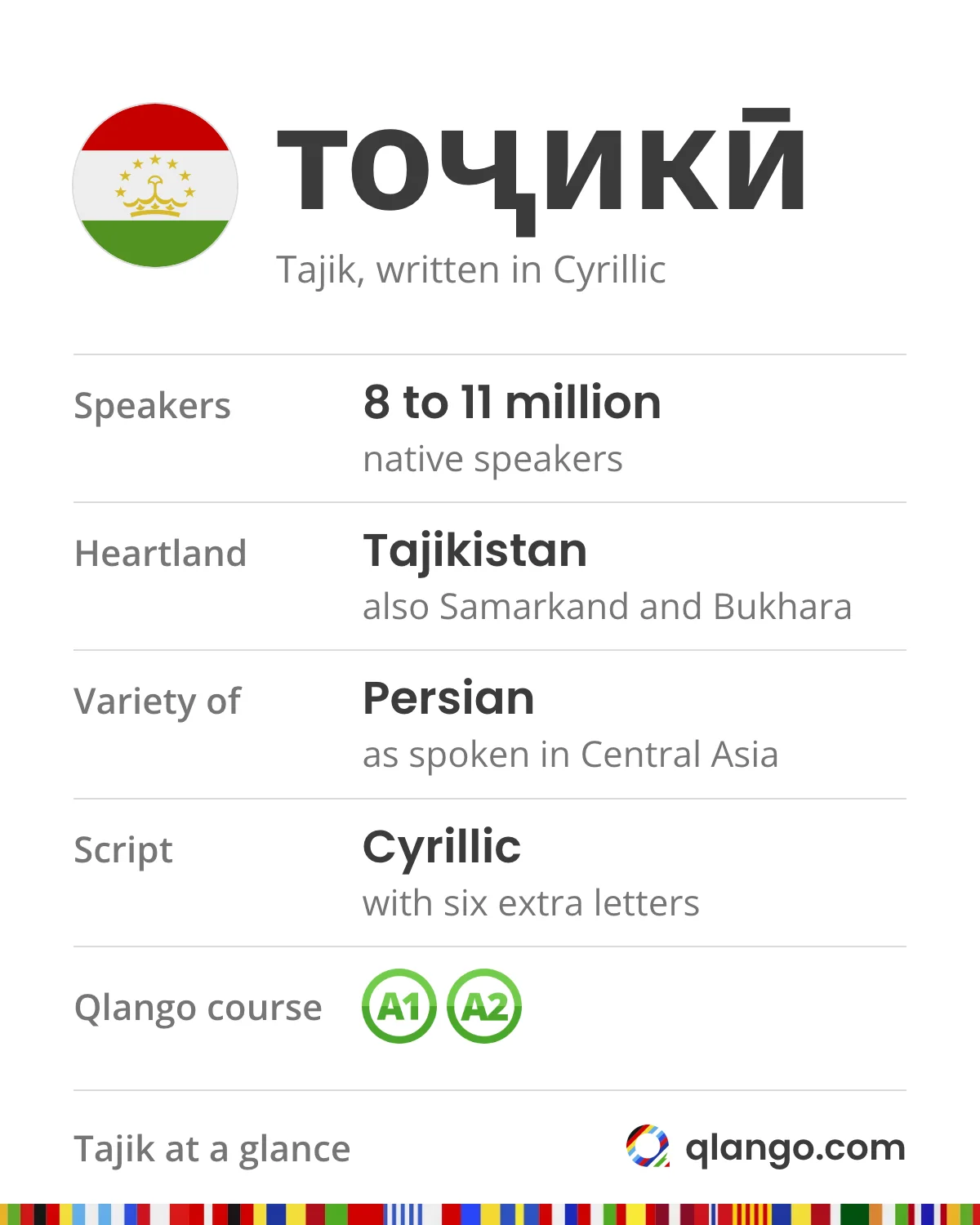
Tajik is Persian, written in Cyrillic. Linguists treat it as the Central Asian variety of the language spoken in Iran and Afghanistan, shaped by a century of Russian influence and many more centuries next door to Uzbek. If you want to learn Tajik, that one fact does a lot of the work for you: the grammar is among the friendliest in Asia, some of the most basic words are distant relatives of English ones, and Persian reference books can fill gaps that Tajik material leaves.
In practice: learn the Cyrillic alphabet and its six extra letters in the first week. Learn every verb with its two stems, and learn from day one the small linking vowel that joins a noun to its adjective. Work through A1 and A2 with a structured course, review words on a schedule instead of whenever you remember, and find one Tajik speaker to write to.
Where Tajik is spoken
Tajik is the state language of Tajikistan, whose constitution gives Russian the role of language of interethnic communication. It is also the home language of many families in Samarkand and Bukhara, two cities in today's Uzbekistan that were centres of Persian poetry long before the current borders. In Afghanistan, Tajiks speak Dari, the Afghan standard of Persian, which Tajik speakers understand once they get past differences in accent and vocabulary. Add a large migrant community in Russia, and you arrive at somewhere between eight and eleven million native speakers.
Adult learners of Tajik nearly always have a specific reason: a posting in Dushanbe, research on Central Asia, a partner's family in Khujand, trekking in the Fann Mountains or the Pamirs. In the Pamirs, though, many people grow up speaking a Pamiri language such as Shughni and use Tajik at school and with outsiders.
Three alphabets in one century
Tajik was written in the Perso-Arabic script, the one Iranian Persian still uses, until the late 1920s. The Soviet authorities introduced a Latin alphabet, replaced it with Cyrillic around 1940, and Cyrillic is still the official script.
If you already read Russian, you know most of the alphabet. Tajik drops a few Russian letters and adds six of its own, and those six carry sounds you can't skip:
| Letter | Sound | Example |
|---|---|---|
| ғ | a g made deep in the throat, close to a French r | боғ (garden) |
| ӣ | a stressed ee, very often at the end of a word | тоҷикӣ (Tajik, the language) |
| қ | a k pronounced further back, near the throat | қалам (pen) |
| ӯ | a rounded vowel between u and o | рӯз (day) |
| ҳ | a plain, breathy h | ҳафт (seven) |
| ҷ | j as in jam | панҷ (five) |
Two familiar letters need attention too. Х is the rough sound at the end of Scottish loch, as in хуб (good). And о often stands where Iranian Persian has a long a: Tajik writes бозор for the word English eventually borrowed as bazaar, and ном where Tehran says nām.
What makes Tajik approachable for English speakers
No grammatical gender. One word, ӯ, covers both he and she, and adjectives don't agree with anything.
No case tables. Tajik gives you one suffix to worry about early on: -ро, which marks a definite direct object. Ман китоб хондам is I read a book; ман китобро хондам is I read the book.
Verbs that behave. Each verb has a past stem and a present stem, and the personal endings barely change from verb to verb. From кардан, to do, you get кардам, I did, and мекунам, I do.
Old relatives. Tajik and English both descend from Indo-European, and the oldest words show it: модар (mother), падар (father), бародар (brother), духтар (daughter, girl), ном (name), нав (new). Наврӯз, the spring new year, is literally new day.
What takes longer
The ezafe. Tajik links a noun to the word that describes or owns it with an unstressed -и: китоби нав (a new book), номи ман (my name), забони тоҷикӣ (the Tajik language). It's tiny, it's everywhere, and leaving it out is the classic beginner mistake.
Compound verbs. A large share of Tajik verbs are a noun plus a light verb such as кардан (to do) or шудан (to become). Кор кардан, to work, is literally to do work; ёд гирифтан, to learn, is literally to take memory. You learn them as units.
The verb comes last. Ман дар Душанбе кор мекунам, I work in Dushanbe, ends with the verb, and in long sentences you wait for it.
Getting practice. Many people in Dushanbe switch to Russian the moment they hear a foreign accent, so you'll need to arrange your own conversations.
First Tajik words
- Салом: hello
- Хуш омадед: welcome
- Ташаккур: thank you
- Бале or ҳа: yes, the first more formal
- Хуб: good, fine
- Номи ман ... аст: my name is ...
- Хайр: goodbye
- Як, ду, се, чор, панҷ: one to five
Tajik material is mostly written for Russian speakers
Much of the Tajik teaching material in circulation was written for Russian speakers, and a good deal of it dates from decades ago. Publishers build courses for languages with many learners, and Tajik's are a small, scattered group of diplomats, researchers, aid workers and in-laws. Schools in Dushanbe teach it if you can get there; most people start from home.
Persian material helps, because the grammar is nearly the same, but Iranian vocabulary and pronunciation differ and the script is different, so working only from it means learning two things at once. Our guide to learning Persian covers the Iranian standard; use it as a reference and keep a Tajik course as your spine.
How to learn Tajik in your first month
Plan on twenty to thirty minutes a day.
Week one: the alphabet
Learn Cyrillic with the six extra letters until you can read any word aloud, slowly. Then read street names on a map of Dushanbe. Рӯдакӣ, the main avenue, named after the poet, tests two of the new letters at once.
Week two: nouns and the ezafe
Fifty everyday nouns, the numbers to twenty, and the ezafe from the start: китоби нав, never китоб нав. Review on a schedule; our piece on vocabulary learning methods explains why spacing beats cramming.
Week three: verbs
The present tense of a handful of common verbs, рафтан (to go), омадан (to come), гуфтан (to say) and кардан, plus your first compound verbs. Write five short sentences a day about your own life, verb at the end.
Week four: real exchanges
Send short messages to a Tajik speaker or another learner and ask for corrections. Most of them will be about the ezafe and -ро, which is exactly where you should be.
How Qlango helps
Qlango's Tajik course covers A1 and A2, the levels that take you from your first салом to everyday situations: shopping, asking the way, talking about your work and your family. Lessons are short, new words come with example sentences, and spaced repetition brings words back just before you'd forget them, which matters when so few of them resemble English. Sentence-building exercises are where the ezafe and the verb-final word order become automatic, because you put every piece in place yourself, and written answers get your fingers used to ӣ and ӯ.
When you add the course, you choose the language you learn through: English, or another language you know well. The course is free to start, and Premium adds offline learning and an AI teacher you can ask about -ро, the ezafe or any compound verb as often as you like. Every course is listed on the languages and levels page.
Рӯдакӣ is a fair reading test for the end of week one: two of the new letters in a single street name. Spend this week in Qlango's A1 course, and by Sunday you should read it aloud without pausing at either macron.


