
Until the last day of 1992, Czechs and Slovaks shared a country, and Czechoslovak television moved between the two languages without subtitles. That history is the first thing to understand if you want to learn Slovak. Much of what you read about Czech applies, and many of the mistakes you'll make come from treating the two as one language with different spellings. They are two languages, and Slovaks notice.
So the method is this. Learn the sounds first, because the spelling is regular and you can read anything aloud within a week. Learn phrases in context before you go near case tables. Keep Czech material out of your first months. And give it a little time every day rather than a lot of time once a week, because a Slavic language rewards repetition more than heroics.
Where Slovak is spoken
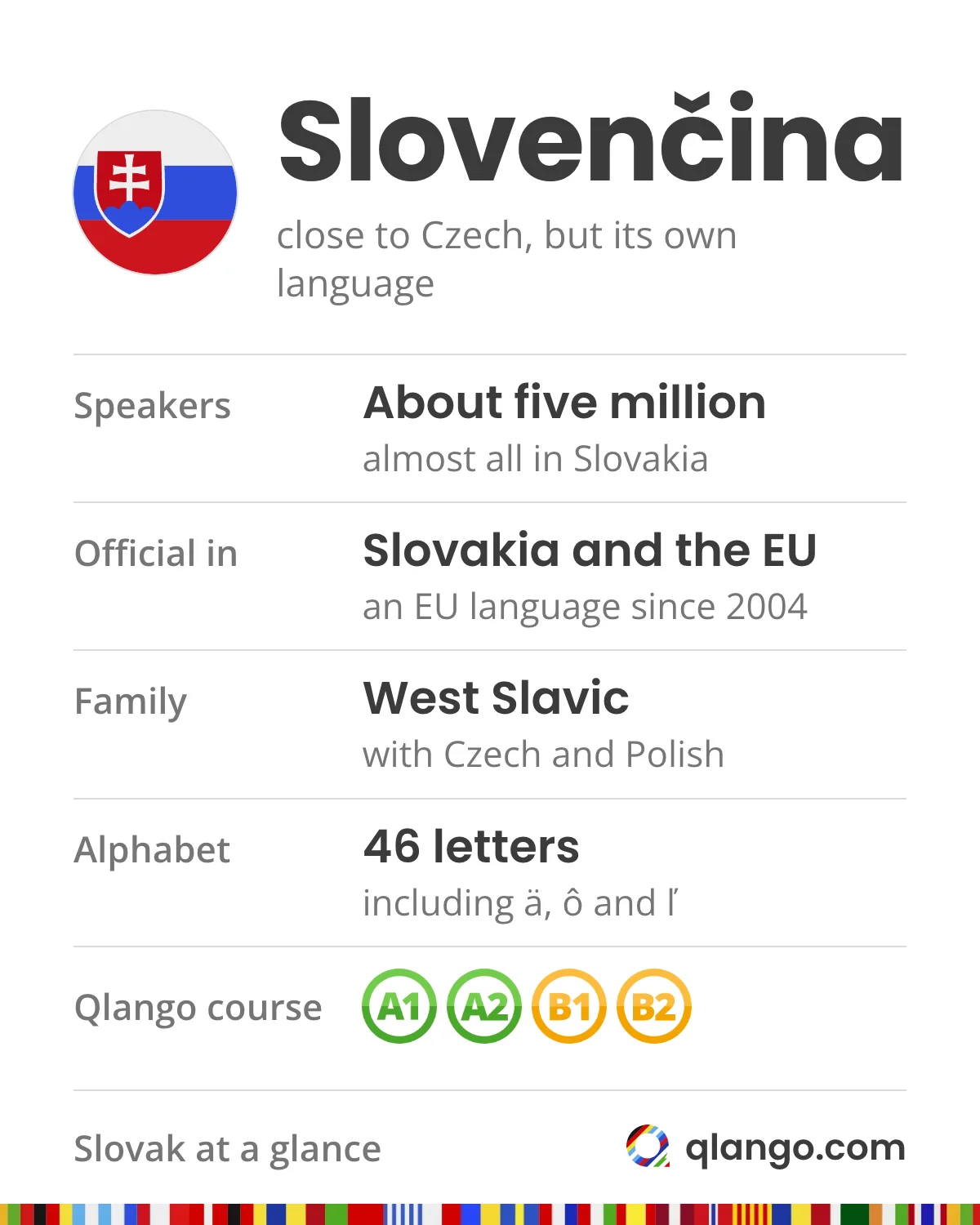
About five million people speak Slovak, almost all of them in Slovakia, where it is the official language. Smaller communities live in the Czech Republic, Hungary, Romania and Ukraine, and in Serbia's Vojvodina province Slovak is one of the official languages. Slovak-American families, many in Pennsylvania and Ohio, keep it going as a heritage language. Slovak has been an official EU language since Slovakia joined the Union in 2004.
People learn it for a partner or a family, for a job at one of the car plants or service centres, or because they live in Bratislava, a capital that sits on the borders of both Austria and Hungary, with Vienna an hour down the road.
Slovak and Czech side by side
Slovak belongs to the West Slavic branch with Czech and Polish, and it is closest to Czech. Close enough that a Slovak and a Czech can talk without either one switching, different enough that vocabulary and spelling part ways constantly:
| English | Slovak | Czech |
|---|---|---|
| thank you | ďakujem | děkuji |
| yes, no | áno, nie | ano, ne |
| I am | som | jsem |
| three | tri | tři |
| beautiful | krásny | krásný |
| horse | kôň | kůň |
| milk | mlieko | mléko |
| goodbye | dovidenia | na shledanou |
Three differences in that table matter for beginners. Slovak has no ř, which English speakers greet with relief. Slovak has letters of its own: ä as in mäso (meat), which most speakers say like the e in "bed", ô as in kôň, roughly "uo", and ľ as in ľudia (people), a soft l. The full alphabet runs to 46 letters. And Slovak follows a rhythmic rule: two long syllables don't normally follow each other within a word, which is why Czech krásný has two long vowels and Slovak krásny has one.
Questions people ask before they learn Slovak
Is Slovak harder than Czech?
About the same, with the trouble in different places. Slovak spares you ř and one case. In exchange you get a few extra letters and the rhythmic rule. The US Foreign Service Institute, which rates difficulty for English speakers, puts both in the same group, at around 44 weeks of full-time study for professional proficiency. There's more on timescales in our article on how long it takes to learn a language.
How many cases does Slovak have?
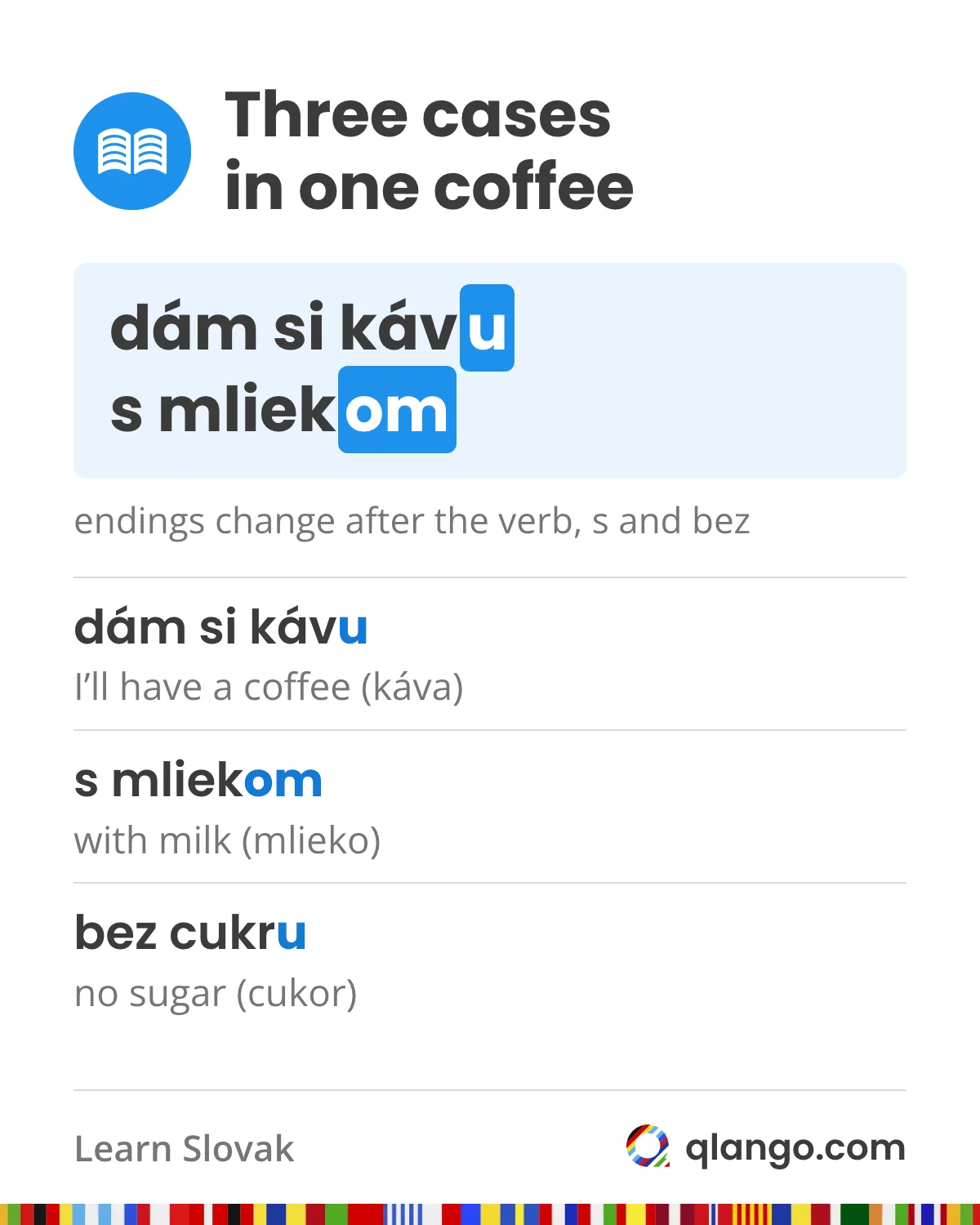
Six: nominative, genitive, dative, accusative, locative and instrumental. Czech keeps a seventh, the vocative, which Slovak has largely given up. You meet three of the six in your first coffee order: dám si kávu s mliekom, bez cukru, "I'll have a coffee with milk, no sugar". Káva becomes kávu after the verb, mlieko becomes mliekom after s, and cukor becomes cukru after bez.
Can I learn Slovak from Czech materials?
Not in your first year. The grammar overlaps, but the words differ just often enough to fill your head with a mixture that belongs to neither language. Learn Slovak properly first and Czech will come cheaply later. If you're heading the other way, our Czech guide covers what changes.
Between the Tatras phrase list and the declension table
Slovak material tends to fall into two piles: phrase lists for a weekend in the High Tatras, and grammar books that open with declension tables on page twelve. The adult beginner lives somewhere in between. Some grammar books also teach áno and stop there, when the yes you will hear all day is hej. Others treat the rhythmic rule as a footnote, so learners who picked up words from Czech-flavoured sources spend months unlearning krásný.
First Slovak words
- Dobrý deň: hello, good day, polite and safe everywhere
- Ahoj: hi, and bye, among friends
- Ďakujem: thank you
- Prosím: please, and "here you are"
- Áno, hej: yes, formal and everyday
- Nie: no
- Prepáčte: excuse me, sorry
- Nerozumiem: I don't understand
- Hovoríte po anglicky?: do you speak English?
- Dovidenia: goodbye
- Na zdravie: cheers, and also what you say when someone sneezes
A first month that works
Spend the first week on sounds and greetings. Learn what ä, ô, ľ, dz and dž do, and read a short text aloud every day until you stop hesitating over them.
In the second week, collect forty everyday nouns, each with its gender, along with the present tense of byť (som, si, je, sme, ste, sú) and mať, "to have" (mám, máš, má), and the numbers to twenty.
The third week belongs to the accusative and that coffee order. Write five sentences a day about what you want, have and like: mám rád čaj, "I like tea", if you're a man, mám rada čaj if you're a woman.
In the fourth week, add the locative for places (v Bratislave, v práci, "at work") and start sending short messages to a Slovak speaker or another learner. Most of your corrections will be endings, which is exactly where they should be at this stage.
How Qlango helps you learn Slovak
Qlango teaches Slovak from A1 to B2, the level where you can follow a conversation among Slovaks and take part in it without anyone slowing down for you. Each lesson is short, and spaced repetition returns every word shortly before it would fade, which is how ďakujem and dovidenia become automatic. The answer modes go from choosing one of four options to finding pairs, building sentences and writing words yourself, and writing them yourself is what fixes krásny in your head.
You can also chat with other learners, with message translation and AI help to write a reply, so your first real Slovak sentences have somewhere to go. Statistics over weeks, months and years show how far you've come. Starting is free; Premium adds offline learning and an AI teacher you can ask about any ending, as often as you like. Every course lets you choose the language you learn through, and the full table of languages and levels shows what's available.
Dám si kávu s mliekom, bez cukru packs three cases into one coffee. Work towards it from today with Qlango's A1 lessons, and order it in Slovak the first time a café in Bratislava gives you the chance.


