Written without its dots and accents, the Yoruba word oko could mean a husband, a vehicle, a hoe or a farm. With them, it's four different words: ọkọ, ọkọ̀, ọkọ́ and oko. Anyone who wants to learn Yoruba should meet that fact on day one rather than hope to put it off. The marks aren't decoration. They are the spelling.
So the plan is simple to state. Learn the three tones and the dotted letters in your first week, type them from the start, and treat every new word as a sound with a melody, not a string of letters. Everything after that gets easier, because Yoruba grammar is gentle. There's no grammatical gender, there are no case endings, and verbs don't change for person: Mo lọ is "I went", O lọ is "you went", and Ó lọ is "he went" or "she went". The last two differ only by a tone mark.
Where Yoruba is spoken
Yoruba is one of the major languages of Nigeria, spoken across the southwest, in Lagos, Ibadan, Abeokuta, Oyo, Osogbo, Ile-Ife and Akure, and in parts of Kwara State around Ilorin. It's also spoken in Benin and Togo. Most estimates put native speakers somewhere above 40 million, and there are large communities in the UK and the US. Yoruba-derived words survive in religious traditions in Brazil and Cuba, and Nigerian cinema has a long Yoruba-language tradition.
In Nigeria's north the main language is Hausa, which belongs to a different language family altogether.
The alphabet and the three tones
Yoruba uses 25 Latin letters. There's no c, q, v, x or z, and there are a few additions: ẹ (an open "e", as in "bed"), ọ (an open "o", close to the "aw" in "law"), ṣ (like "sh") and gb, which counts as one letter and is said with the lips and the back of the tongue closing at the same moment. The letter p is the same kind of double sound, kp, so it isn't quite an English p. An n after a vowel usually means the vowel is nasal, as in French.
Then the tones. An acute accent marks a high tone, a grave accent a low tone, and no mark means mid.
| Written | Tones | Meaning |
|---|---|---|
| ọkọ | mid, mid | husband |
| ọkọ̀ | mid, low | vehicle: car, boat, canoe |
| ọkọ́ | mid, high | hoe |
| oko | mid, mid, with plain o | farm |
You'll see plenty of Yoruba written without any marks, in text messages, on signs and all over the internet. Native readers fill them in from context. You can't, not yet, so learn every word with its marks and drop them later, if ever.
What's easy and what's hard when you learn Yoruba
The grammar is the easy part. Yoruba marks time with small words placed before the verb, and the verb itself never changes: Mo ń lọ, "I'm going"; Mo ti lọ, "I've gone". Word order is subject, verb, object, as in English, so Mo ń lọ sí ọjà, "I'm going to the market", runs in the order you'd expect.
The hard parts are the sounds and the social rules. Tones take months to hear reliably and longer to produce without thinking. The gb and kp sounds need practice. Numbers are their own project, because Yoruba counts in twenties and builds some numbers by subtraction, so leave anything above twenty for later. And respect is grammar: you address elders, and anyone you should be polite to, with ẹ instead of o. A breezy greeting to someone's grandmother lands badly.
First words and greetings
- Ẹ káàárọ̀: good morning, to an elder or to several people
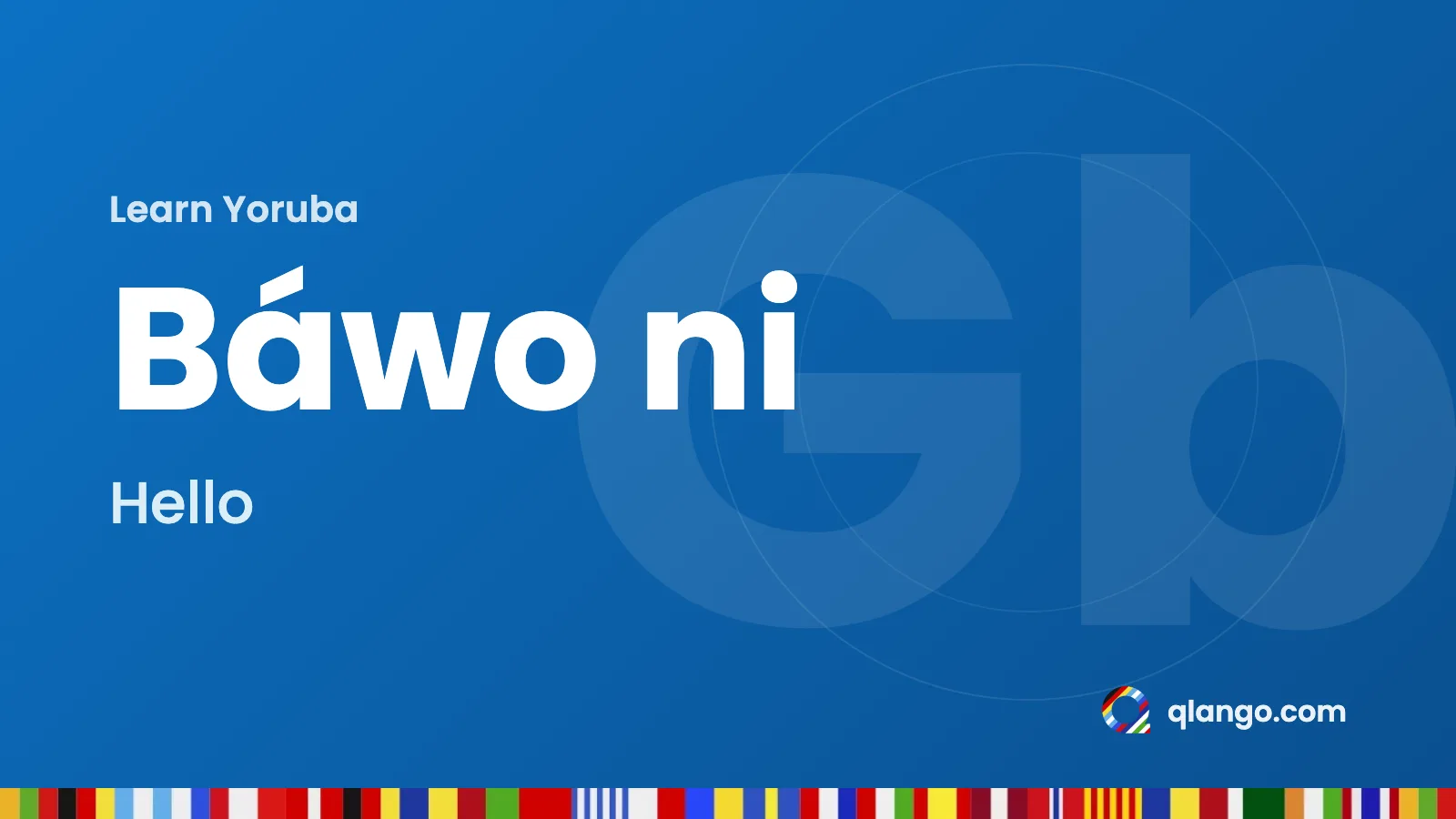
- Báwo ni?: how are you? (casual)
- Ẹ ṣé: thank you, respectful; O ṣé to a friend or someone younger
- Mo dúpẹ́: I'm grateful, thank you
- Bẹ́ẹ̀ni: yes
- Rárá: no
- Ó dàbọ̀: goodbye
- Ẹ kú iṣẹ́: said to someone at work, roughly "well done on the work"
Yoruba has a greeting for almost every situation, from the time of day to the weather to whatever someone happens to be doing, and using the right one says more about you than your vocabulary does.
Why Yoruba courses are hard to find
Part of the answer is technical. Tone marks and dotted letters are a nuisance to type and to display, so a lot of material online drops them, and producing course content with every mark correct is slow, careful work. Part of it is the market: for years, serious Yoruba study meant university departments and academic grammars. And many of the people who want to learn are heritage learners, children of Nigerian families abroad who understand a fair amount at home but were never taught to read or write it. Search for ways to learn Yoruba for free and you'll mostly find word lists without tone marks, which teaches you the wrong habit on day one.
A plan for your first month
Plan on twenty to thirty minutes a day. In week one, learn the alphabet and the three tones, and set up a way to type the marks on your phone before you need it. Say each new word out loud, and hum its melody first, which feels silly and works. In week two, learn the greetings above and practice the respectful forms with ẹ until they're automatic. In week three, learn the pronouns and the small words that mark time, and build sentences like Mo ń lọ sí ọjà. In week four, review everything that's due and write five short sentences a day, marks included.
Reviewing on a schedule matters more than usual here, because you're memorizing melodies as well as spellings. Our comparison of vocabulary learning methods explains why spacing beats cramming.
How Qlango teaches Yoruba
Qlango's Yoruba course covers A1 and A2. That's a beginner foundation: greetings, introductions, everyday vocabulary, simple sentences and short texts, and our guide to the CEFR levels shows exactly what each of those two levels includes. You choose the language you learn through, which for most readers here is English. Lessons are short, and flashcards with spaced repetition bring each word back right before you'd forget it. Picking one of four and finding pairs help you recognize words; writing the answers yourself makes you produce them. With Premium, the AI teacher answers questions like when to use ẹ instead of o, as often as they come up. The list of languages shows every course and its levels.
Questions before you start
Do I really need the tone marks?
While you're learning, yes. Without them you can't tell ọkọ from ọkọ̀, and you'll store words with the wrong melody. Fluent readers can skip them. You'll earn that later.
Is Yoruba hard to learn for English speakers?
The grammar is easier than in most European languages: no gender, no cases, no verb endings. The tones and a few sounds are harder. Expect the first two months to feel slow, then faster once your ear adjusts.
Can I learn Yoruba online for free?
You can start for free. Qlango is free to begin, and Premium, on a monthly, yearly or one-time Forever plan, gives you the whole course plus the AI teacher. Free word lists online are fine as extras, as long as they keep the marks.
Pick one greeting, Ẹ káàárọ̀, and use it on someone older than you tomorrow morning. Then do your first A1 lesson, with English as the language you learn through.