Yes, you can learn Chinese for free, and you can be saying your first sentences within days. What you need is a clear order: tones and pinyin first, then characters a few at a time, with daily review so nothing slips. In this guide, "Chinese" means Mandarin, the standard language of mainland China and Taiwan and one of the official languages of Singapore. You will find what is easy and hard for English speakers, how to choose between simplified and traditional characters, the best free resources and a 12-week plan.
Is Chinese hard for English speakers?
It is one of the longer projects, but the difficulty sits in two places rather than everywhere. The US Foreign Service Institute puts Mandarin in Category IV, its hardest group, together with Arabic, Cantonese, Japanese and Korean: about 88 weeks, or 2,200 class hours, for English speakers to reach professional working proficiency. The two hard places are tones and characters. The grammar is friendlier than most people expect.
What is easier than you think:
- Verbs never change. 我吃 (wǒ chī) is "I eat", 他吃 (tā chī) "he eats". The particle 了 (le) marks a completed action: 我吃了 (wǒ chī le), "I ate" or "I've eaten".
- No plural endings, genders or articles. 书 (shū) can be "book", "books", "a book" or "the book".
- Familiar word order. Subject, verb, object, as in English, with time words before the verb: 我明天去北京 (wǒ míngtiān qù Běijīng), "I'm going to Beijing tomorrow".
- Words built from parts. 电 (diàn) is electricity: 电脑 (diànnǎo, "electric brain") is a computer, 电话 (diànhuà, "electric speech") a phone and 电影 (diànyǐng, "electric shadow") a film.
What takes real work:
- Tones. The same syllable means different things depending on its pitch.
- Characters. There is no alphabet to fall back on; each character is learned with its sound and its meaning.
- Measure words. Nouns need a counter: 一本书 (yì běn shū, a book), 一杯茶 (yì bēi chá, a cup of tea), and 个 (gè) as the all-purpose one, as in 一个人 (yí ge rén, a person).
- Few shared words. Loanwords such as 咖啡 (kāfēi, coffee) and 巧克力 (qiǎokèlì, chocolate) are rare exceptions.
How do Mandarin tones and pinyin work?
Mandarin has four tones plus a light, neutral tone. The classic demonstration uses the syllable ma:
| Tone | Pinyin | How it sounds | Character | Meaning |
|---|---|---|---|---|
| 1st | mā | high and level | 妈 | mother |
| 2nd | má | rising, like a question | 麻 | hemp |
| 3rd | mǎ | low and dipping | 马 | horse |
| 4th | mà | falling sharply | 骂 | to scold |
| neutral | ma | short and light | 吗 | question particle |
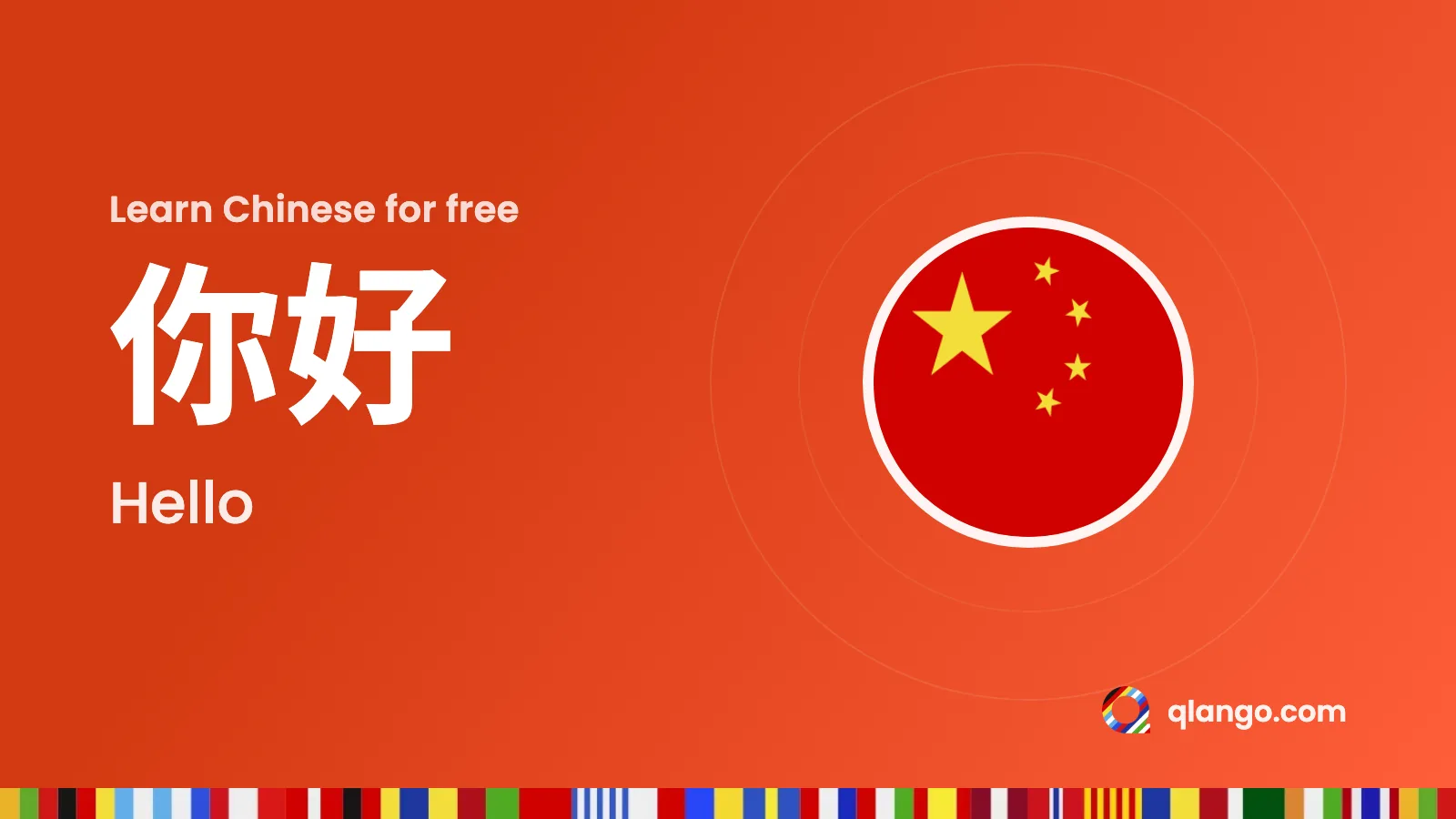
Tones also change in combination. When two third tones meet, the first becomes a second tone, so 你好 is written nǐ hǎo but said ní hǎo.
Pinyin is the official romanization of mainland China, and it is also how you type Chinese: you type the pinyin and pick the character. A few letters don't sound the way English suggests:
| Letter | Sounds like | Example |
|---|---|---|
| q | ch in "cheese" | 去 qù (to go) |
| x | between s and sh | 谢谢 xièxie (thank you) |
| c | ts in "cats" | 菜 cài (dish, vegetables) |
| zh | j in "jam", tongue curled back | 中国 Zhōngguó (China) |
| ü | ee said with rounded lips | 女 nǚ (woman) |
Learn every word with its tone from day one and say it out loud. Learners who put tones off spend months unlearning later. Schools in Taiwan teach children a different phonetic script, Zhuyin, also called Bopomofo, but pinyin works for learners everywhere.
Simplified or traditional characters?
Choose by where you will use Chinese. Mainland China and Singapore use simplified characters; Taiwan, Hong Kong and Macau use traditional ones. Many common characters are the same in both, such as 人 (rén, person), 大 (dà, big) and 好 (hǎo, good). Others differ:
| Simplified | Traditional | Pinyin | Meaning |
|---|---|---|---|
| 学 | 學 | xué | to study |
| 书 | 書 | shū | book |
| 马 | 馬 | mǎ | horse |
| 说 | 說 | shuō | to speak |
| 门 | 門 | mén | door |
Characters are less random than they look. Most combine a part that hints at the meaning with a part that hints at the sound: 妈 (mā, mother) is 女 (nǚ, woman) plus 马 (mǎ, horse), which supplies the sound. Learn the common components, and every new character gets easier.
If your goal is Hong Kong, keep in mind that its everyday spoken language is Cantonese, not Mandarin; our guide on how to learn Cantonese explains the difference.
How to learn Chinese for free with Qlango
Qlango is free to download on Android and iOS, also runs in the browser, and you can start learning for free. Choose English as the language you learn through, then pick your Chinese: Chinese (Mandarin, Simplified) runs from A1 to B2, Chinese (Mandarin, Traditional) from A1 to B1, and a separate Chinese (Cantonese) course covers A1 and A2. Your first A1 lesson takes about five minutes.
Spaced repetition brings each word back right before you would forget it, which is what characters need most: you meet 学 or 學 again and again, in new words, until you read it without thinking. Exercises start with picking one of four answers, move on to building sentences and end with writing your own. Flashcards and games add variety, and streaks, a weekly plan and statistics show the habit building. In the chat you can message other learners, with translation and AI help to write a reply. Premium adds an AI teacher and offline learning. For what the top of the Simplified course means in exam terms, see Chinese B2 and the HSK, and for every course and level, the languages page.