Albanian has no close relatives. That one fact explains most of what a beginner runs into: the vocabulary looks unfamiliar even if you already speak three European languages, structured courses are scarce, and the people who decide to learn Albanian usually have a very particular reason. A partner from Tirana. A grandmother in Prishtina who never learned English. A posting with an aid agency, a wedding to get through, a family that switches to English the moment you walk in.
The good news arrives quickly. Albanian is written the way it sounds, in a Latin alphabet you can read aloud within a week, and its grammar is demanding but orderly. The US Foreign Service Institute, which rates difficulty for English speakers, puts Albanian in its Category III: about 44 weeks of full-time study to reach professional working proficiency; there's no official equivalent for speakers of other languages. You won't need that much to talk to your in-laws. You will need a plan, and that's what the rest of this guide is.
Where Albanian is spoken, and which Albanian to learn
Albanian is the official language of Albania and an official language of Kosovo and North Macedonia, where about a quarter of the population speaks it as a mother tongue. It's also spoken in Montenegro and southern Serbia, by the Arbëreshë in villages of southern Italy, whose ancestors arrived more than five centuries ago, and by a large diaspora in Italy, Greece, Germany, Switzerland, the UK and the US. Put together, that's somewhere around six to eight million speakers.
There are two main dialect groups, divided roughly by the Shkumbin river: Gheg in the north and in Kosovo, Tosk in the south. Standard Albanian, used in schools, newspapers and almost all learning material, is based mainly on Tosk. A family from Kosovo will sound different from your course, since Gheg has nasal vowels and some forms of its own, but they read and write the standard and will understand you fine. Learn the standard and pick up Gheg by ear; there's very little Gheg material to learn from anyway.
How to learn Albanian sounds: 36 letters, one sound each
Albanian uses the Latin alphabet with 36 letters: the familiar ones minus w, two with marks (ç and ë), and nine pairs that count as single letters: dh, gj, ll, nj, rr, sh, th, xh and zh. Each stands for one sound, so once you know the table below you can read any Albanian text aloud. You won't understand it yet, but you'll pronounce it, which is more than most learners of English can say about English.
| Letter | Sound | Example |
|---|---|---|
| ë | the "a" in "about", very light at the end of a word | një (one) |
| c | "ts" as in "cats" | cili (which) |
| ç | "ch" as in "church" | çaj (tea) |
| q | a soft "ky" sound, tongue against the hard palate | qen (dog) |
| gj | the voiced partner of q, close to "gy" | gjuhë (language, tongue) |
| x | "dz" as in "adze" | nxënës (pupil) |
| xh | "j" as in "jam" | xhami (mosque) |
| dh | "th" as in "this" | dhe (and) |
| th | "th" as in "think" | thotë (says) |
| ll | a dark "l" as in "full" | mollë (apple) |
| rr | a rolled r | rrugë (street) |
| y | like French u or German ü | yll (star) |
English speakers usually stumble over three things: hearing q and ç as different sounds, remembering that x is never "ks", and over-pronouncing the ë at the end of words, which is usually very light.
The grammar that takes time
The article goes at the end
Like Romanian and Bulgarian, Albanian attaches "the" to the end of the noun. Qytet is a city, qyteti is the city. Shtëpi is a house, shtëpia is the house, and shtëpisë covers both "of the house" and "to the house". Learn every noun as a pair from the first day, qytet and qyteti, because the definite form is the one you'll use most and it isn't always predictable.
Five cases
Nominative, accusative, genitive, dative and ablative, each with definite and indefinite forms. On paper it's a big table. In practice a small set of endings repeats, and at A1 you'll live in the nominative and accusative for weeks.
The little linking words
Albanian puts a short word between many adjectives and their noun, and between a thing and its owner: djalë i mirë (a good boy), vajzë e mirë (a good girl), libri i vajzës (the girl's book). The linking word changes with gender, number and case. Beginners forget it or pick the wrong one, people understand them anyway, and the right forms arrive with exposure rather than rules.
A verb form for surprise
Albanian has an admirative mood, verb forms for something you've just discovered and didn't expect, where English relies on tone of voice: "Oh, so you do speak Albanian". You'll hear it long before you need it.
Vocabulary from every neighbour
Centuries of contact left Latin, Greek, Turkish, Slavic and Italian words in Albanian: shkollë (school) and mik (friend) come from Latin, çaj and xhami came through Turkish. The core vocabulary, though, is Albanian's own, and words like ujë (water), bukë (bread) and mirë (good) have no English hooks to hang them on. That's where spaced repetition earns its keep; our guide to vocabulary learning methods explains why.
First Albanian words worth knowing
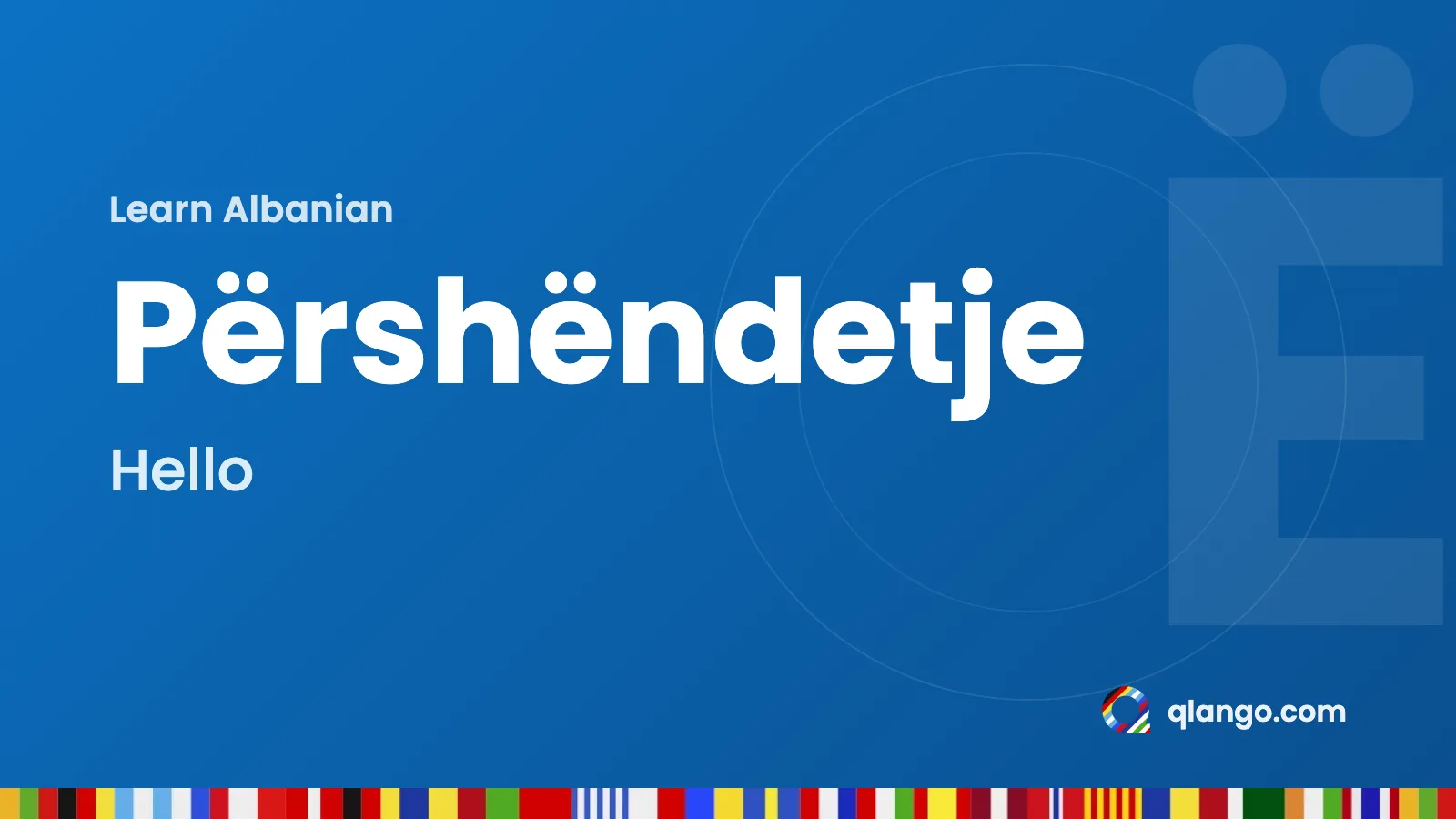
- Përshëndetje: hello
- Mirëdita: good day, the all-purpose polite greeting
- Si jeni?: how are you? (polite; to a friend, Si je?)
- Mirë, faleminderit: fine, thank you
- Ju lutem: please
- Po and jo: yes and no
- Më falni: excuse me, sorry
- A flisni anglisht?: do you speak English?
- Mirupafshim: goodbye
- Gëzuar: cheers
Notice how often mirë turns up: mirëdita is "good day", mirëmëngjes "good morning", and mirupafshim began life as "may we see each other well".
Why it's hard to find Albanian courses
Search for "learn Albanian app" or "learn Albanian for free" and you'll see the problem within a minute: phrase lists, a few older textbooks, videos of uneven quality, and material for heritage children who understand their grandparents but can't read. An adult starting from zero who wants to go level by level has little to choose from. Publishers start with the languages tens of millions of people want, and Albanian's learners are a small, scattered group, however determined.
A realistic first month
Plan on twenty to thirty minutes a day.
- Week 1: sounds and greetings. Work through the letter table until you can read any word aloud, and learn the phrases above. Read something Albanian aloud every day, even without understanding it.
- Week 2: nouns in pairs. Forty everyday nouns, each with its definite form, the numbers to twenty, and the present tense of jam (I am) and kam (I have).
- Week 3: your own sentences. A few regular verbs such as punoj (I work) and flas (I speak); flas pak shqip, "I speak a little Albanian", is a satisfying first sentence. Write five short sentences a day about your life.
- Week 4: real exchanges. Send short messages to an Albanian speaker or another learner and ask for corrections. Most of your mistakes will be linking words and definite endings, which is exactly as it should be.
By the end of the month you'll be partway through A1 on the CEFR scale: not conversational yet, but past the stage where Albanian sounds like noise.
How Qlango teaches Albanian
Qlango has Albanian from A1 to B2, the level where you can hold a real conversation without either side straining. Lessons are short, every new word comes with example sentences, and spaced repetition brings it back just before you'd forget it. The sentence-building exercises are where the linking words stick, because you have to place i or e yourself, and dictation, with AI-generated speech you can slow down, trains your ear for ë and for q against ç.
When you add the course, you choose the language you learn through, and it can be your native language rather than English. See the full table of languages and levels. The course is free to start; Premium adds offline learning and an AI teacher you can ask about any grammar point, which is handy the first time the admirative mood ambushes you.
Add Albanian, choose the language you want to learn through, and do the first A1 lesson today. Përshëndetje comes first. Faleminderit can wait until tomorrow.