
Anyone who did maths or science at school already knows half the Greek alphabet: alpha, beta, pi, sigma, omega and their friends. That head start is real, and it's also a trap. Modern Greek pronounces several of those letters differently from the way your physics teacher did, and a few capitals look exactly like Latin letters while standing for different sounds. To learn Greek, start by unlearning a little. After that the language is generous: thousands of its words already live in English, and its spelling, odd as it looks, follows rules.
Where Greek is spoken
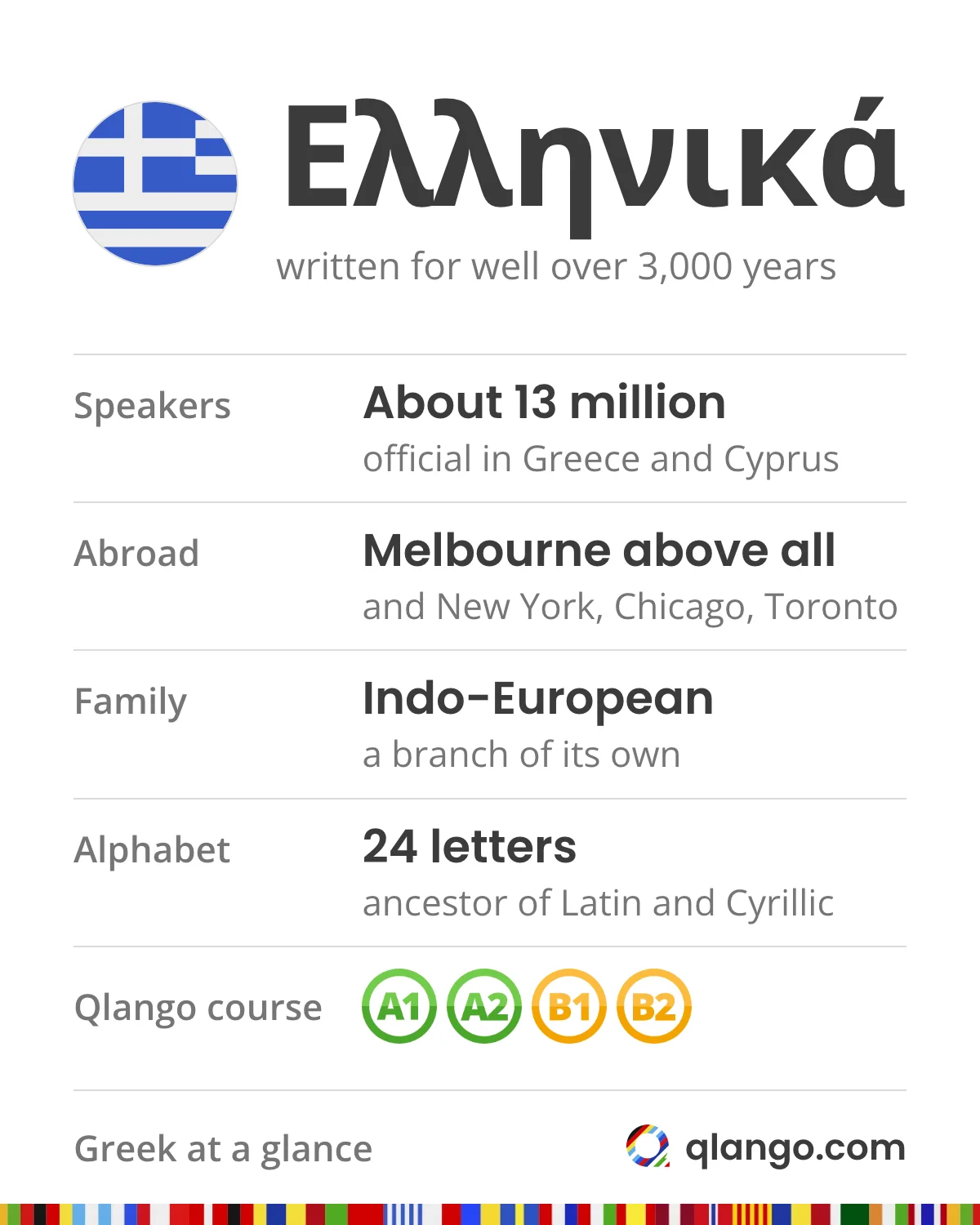
Greek is the official language of Greece and, together with Turkish, of Cyprus, and it has about 13 million speakers. Large communities live abroad, above all in Melbourne, which has one of the biggest Greek-speaking populations outside Greece and Cyprus, and in New York, Chicago, Toronto, Germany and Britain. Small historic Greek-speaking communities survive in southern Italy and southern Albania.
Greek forms its own branch of the Indo-European family and has been written for well over three thousand years. Modern Greek descends directly from the ancient language but differs from it in pronunciation, grammar and much of its everyday vocabulary. If you want to talk to people, learn Modern Greek.
The letters that lie
Greek has 24 letters, and the Latin and Cyrillic alphabets both descend from it. A week of daily practice is usually enough to sound out words. These are the letters that cause trouble:
| Letter | Looks like | Sounds like | Example |
|---|---|---|---|
| Ρ ρ | P and p | r | ρολόι (rolói, clock) |
| Η η | H and n | i as in "machine" | ήλιος (ílios, sun) |
| Ν ν | N and v | n | νερό (neró, water) |
| Υ υ | Y and u | i | ύπνος (ípnos, sleep) |
| Χ χ | X and x | ch as in Scottish "loch" | χέρι (chéri, hand) |
| Β β | B | v | βιβλίο (vivlío, book) |
| Δ δ | a triangle | th as in "this" | δέκα (dhéka, ten) |
| Γ γ | a y, in lower case | a soft gh, or y before e and i sounds | γάλα (ghála, milk) |
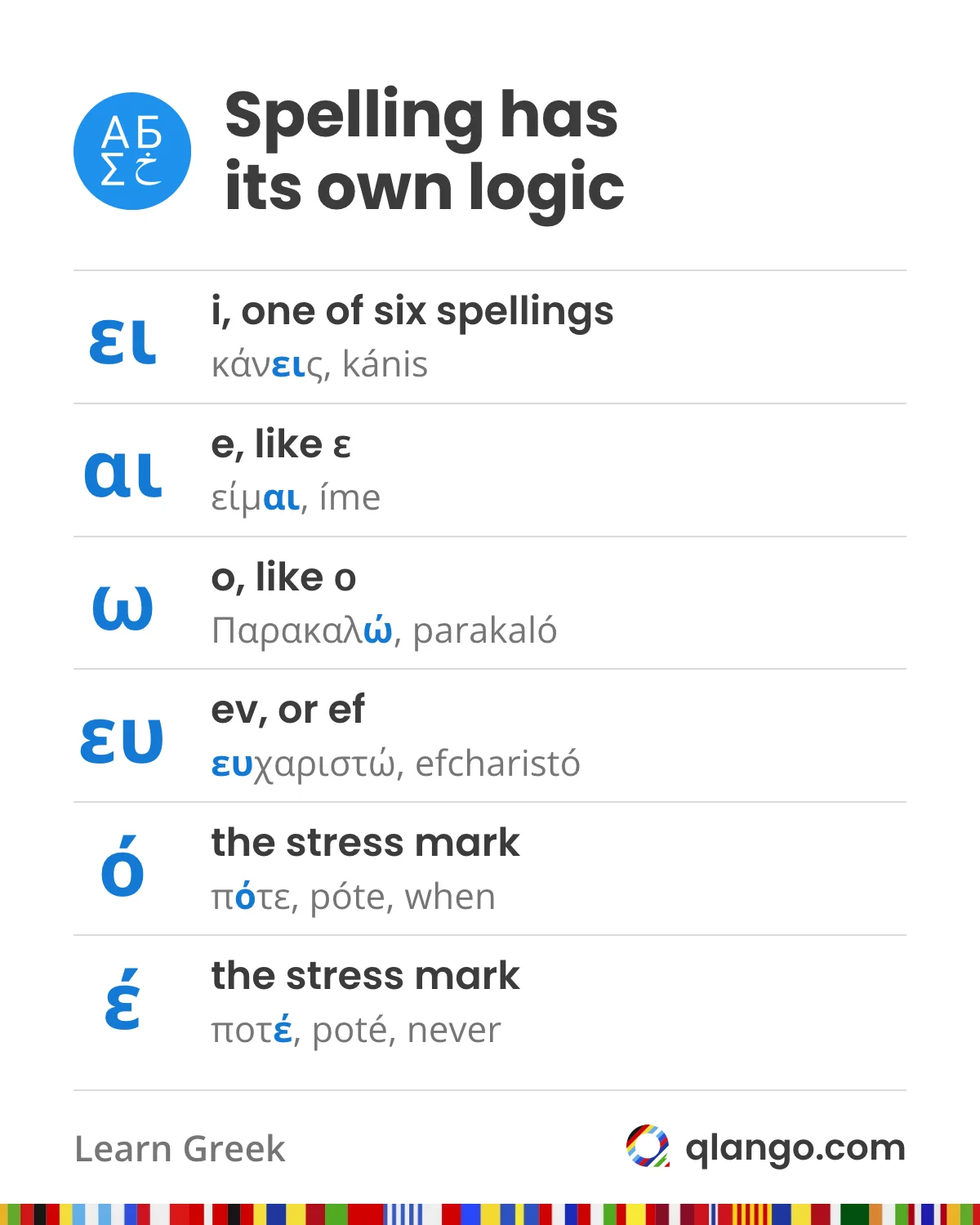
Spelling has its own logic. The sound i can be written six ways: ι, η, υ, ει, οι and υι. E can be ε or αι, and o can be ο or ω. Some pairs make a single sound: μπ is b, ντ is d and γκ is g, while αυ and ευ are av and ev, or af and ef before certain consonants, which is why ευχαριστώ (thank you) is efcharistó.
Every word of more than one syllable carries a stress mark, and it matters: πότε (póte) means "when" and ποτέ (poté) means "never". The Greek question mark, meanwhile, looks like an English semicolon: Τι κάνεις; means "how are you?"
The grammar you need to learn Greek
Three genders, four cases
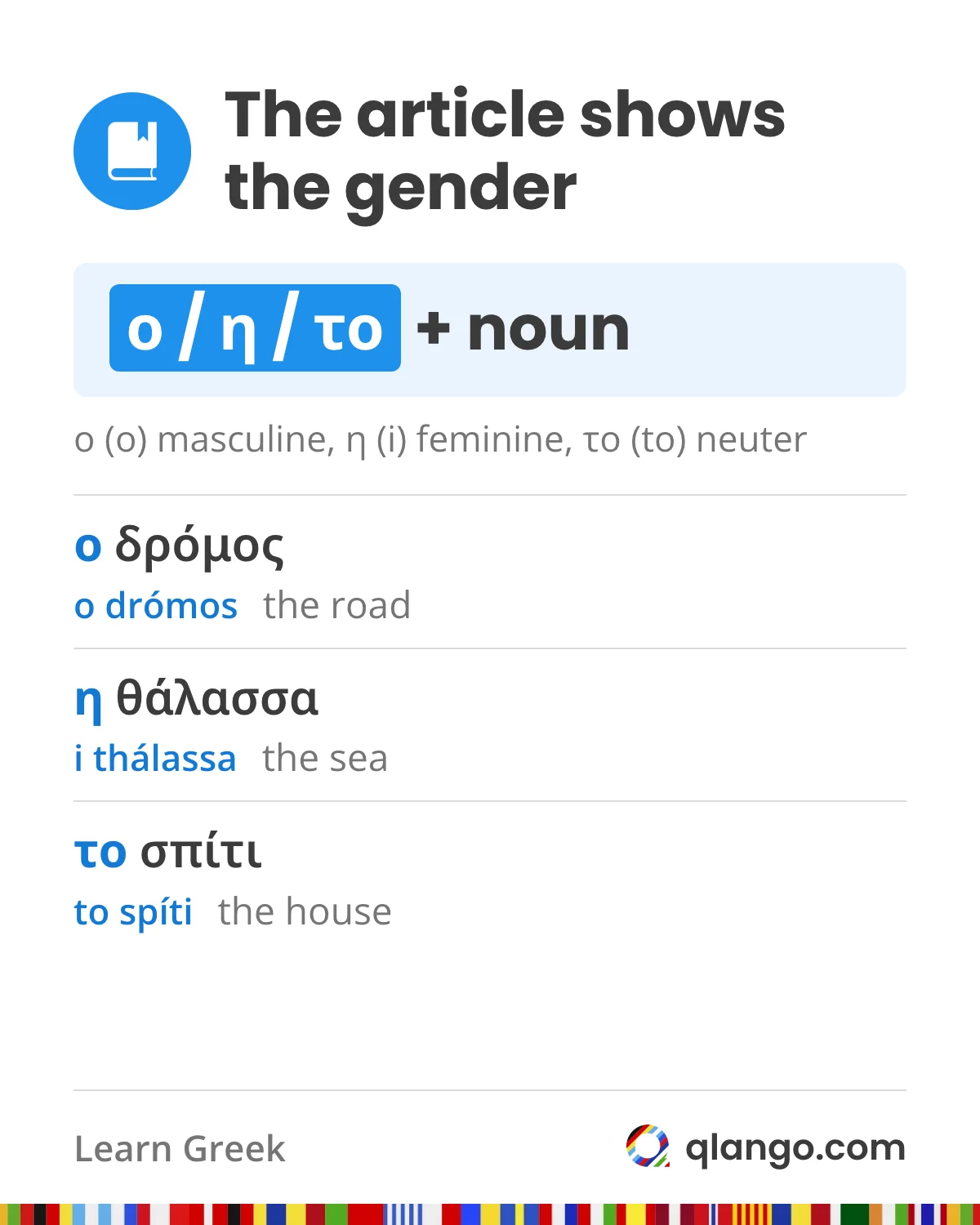
Every noun is masculine, feminine or neuter, and the article shows which: ο δρόμος (o drómos, the road), η θάλασσα (i thálassa, the sea), το σπίτι (to spíti, the house). Nouns, articles and adjectives change across four cases: nominative, genitive, accusative and vocative. The endings are the main memory load of Greek, and they come with practice more than from tables.
No infinitive
Greek verbs have no infinitive. Dictionaries list them in the first person, γράφω (gráfo), "I write", and "I want to write" is θέλω να γράψω (thélo na grápso), literally "I want that I write".
Two stems for most verbs
Notice that γράφω became γράψω. Greek verbs usually have one stem for ongoing or repeated actions and another for single, completed ones, and you need both. θα γράφω (tha gráfo) is "I'll be writing" or "I'll write regularly"; θα γράψω (tha grápso) is "I'll write", once.
Subject pronouns are usually dropped, since the verb ending already says who's acting, and word order is freer than in English.
Words you already know, and some false friends
Thousands of English words come from Greek, so plenty of vocabulary arrives almost free: τηλέφωνο (tiléfono), θέατρο (théatro), μουσική (mousikí), δημοκρατία (dimokratía). Some familiar-looking words mean something else, though. συμπαθητικός (simpathitikós) means likeable, not sympathetic. And the two words you'll use most are the wrong way round to English ears: ναι (ne) means yes, and όχι (óchi) means no.
For the words with no English relative, spaced repetition is the tool that works; our guide to vocabulary learning methods explains why.
First Greek words
- Γεια σου (yia sou): hi, to one person you know; Γεια σας (yia sas): hello, politely or to several people
- Καλημέρα (kaliméra): good morning
- Ευχαριστώ (efcharistó): thank you
- Παρακαλώ (parakaló): please, and you're welcome
- Ναι (ne) and Όχι (óchi): yes and no
- Τι κάνεις; (ti kánis?): how are you?
- Συγγνώμη (signómi): sorry, excuse me
- Δεν καταλαβαίνω (den katalavéno): I don't understand
Your first month
Spend the first week on the alphabet and the spelling rules above, reading signs, menus and product labels aloud. In the second week, learn the greetings, the numbers to ten and the present tense of a few verbs, starting with είμαι (íme, I am) and έχω (écho, I have). In week three, learn nouns together with their article, so the gender comes attached, and start building short sentences. In week four, write a few lines a day about yourself and send them to a Greek speaker or another learner for corrections. A month puts you partway through A1.
How Qlango helps you learn Greek
Qlango teaches Greek from A1 to B2, the level the CEFR scale describes as fluent and spontaneous enough to talk with Greek speakers without strain on either side. While you're still decoding letters you can show a Latin transliteration under each word and hide it as the alphabet becomes second nature. Writing answers yourself fixes spellings like ι and η in your memory, building sentences drills the case endings, and spaced repetition brings words back just before you would forget them. The weekly learning plan, streaks and statistics over weeks, months and years show how far you've come. Premium adds offline lessons, handy on a ferry, and an AI teacher you can ask about cases, verb stems or anything else in the grammar.
Questions about learning Greek
Is Greek hard to learn?
Moderately. The alphabet takes a week, a lot of vocabulary has English relatives, and the grammar, with its cases and verb stems, is what takes time. The US Foreign Service Institute, which rates languages for English speakers, places Greek in Category III: about 44 weeks of full-time study for professional working proficiency.
Should I learn Ancient or Modern Greek?
Modern, if you want to talk to people, travel or understand your family. Ancient Greek, including the Koine of the New Testament, is a separate study for classics, philosophy or theology, and the pronunciation usually taught for it differs from Modern Greek's. Knowing Modern Greek does make the older texts less forbidding later.
What does it cost?
Nothing to begin: the Greek course in Qlango is free to start, and Premium comes as a monthly, yearly or one-time Forever plan. The full list of courses and levels is on the languages page.
Give the letters that lie a week of attention, and ναι another week to stop sounding like a refusal. Qlango's A1 course keeps you company through both, and Καλημέρα makes a good first word to read, at least until about noon.


