
Bulgarian is the Slavic language that gave up its noun cases. Russian keeps six, Polish and Czech seven, while Bulgarian, after centuries of sharing the Balkans with Greek, Romanian and Albanian, let nearly all of them go. For anyone setting out to learn Bulgarian, that's the best news on the table: nouns don't change their endings for case, and prepositions and word order carry the meaning, much as they do in English.
The trade-off sits in the verbs, which have more tenses than English and special forms for things you only heard about rather than saw. Add the Cyrillic alphabet, which takes about a week, and a stress that can land on any syllable, and you have the honest picture: moderately difficult for English speakers, easier than its alphabet suggests, and easier still if you already know Russian or another Slavic language. Start with the alphabet, learn every noun with its article, and leave the rarer tenses for later.
Where Bulgarian is spoken
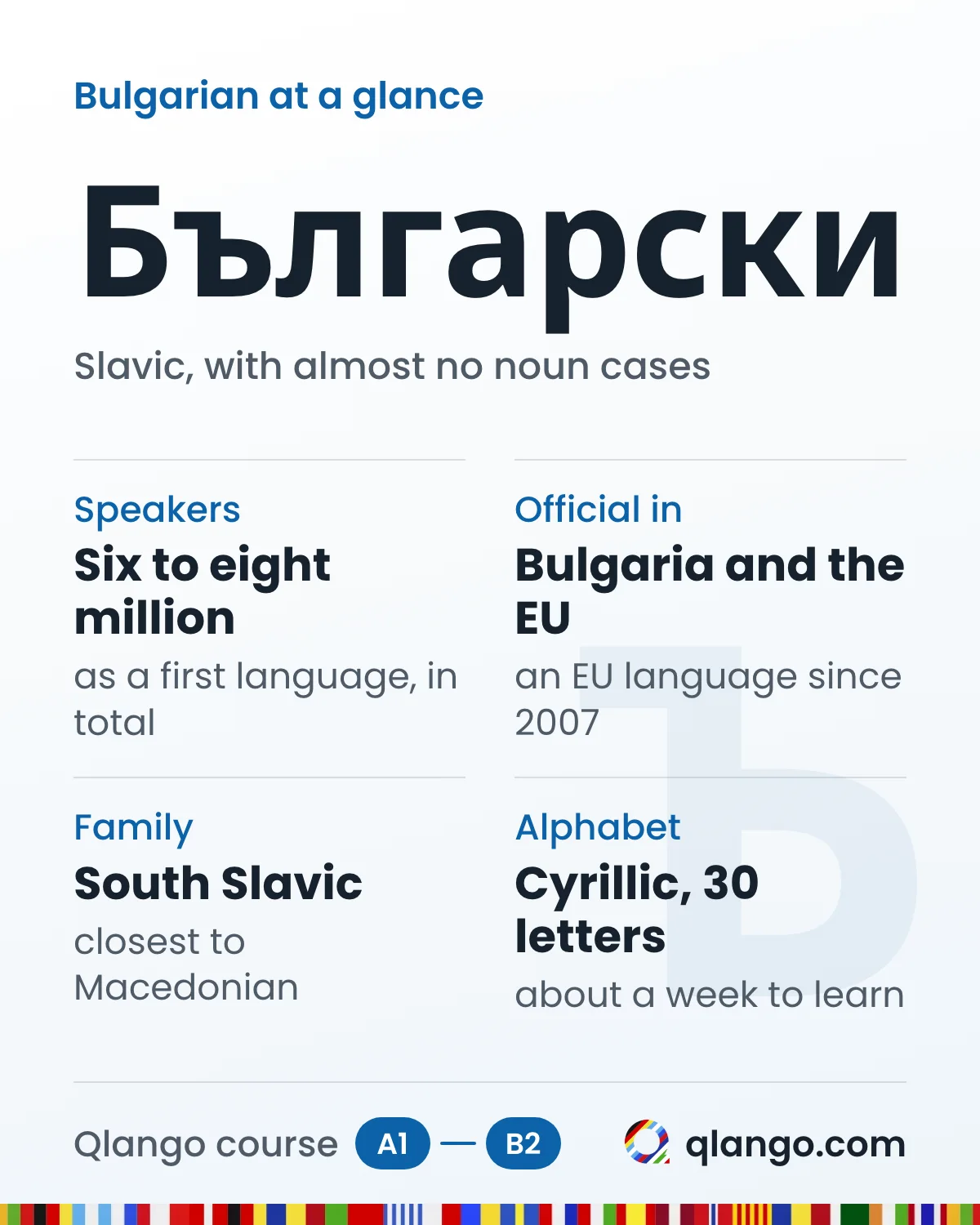
Bulgarian is the official language of Bulgaria, a country of about six and a half million people, and the mother tongue of most of them. Long-established Bulgarian communities live in Ukraine and Moldova, and a large newer diaspora has settled in Spain, Germany, the UK and elsewhere. In total, somewhere between six and eight million people speak it as a first language. It has been an official language of the European Union since 2007, which made Cyrillic the EU's third official alphabet after Latin and Greek.
Bulgarian is a South Slavic language. Its closest relative is Macedonian, and speakers of the two understand each other well; there's a separate guide on how to learn Macedonian.
Learn Bulgarian Cyrillic first
Cyrillic took shape in the First Bulgarian Empire around the turn of the tenth century, and Bulgarians are rightly proud of it: 24 May is a public holiday for the alphabet and Slavic literacy. The Bulgarian version has 30 letters. A handful look and sound like their Latin counterparts (А, Е, К, М, О, Т), several look familiar but aren't (В is v, Н is n, Р is r, С is s, У is u, Х is h), and the rest are new.
If you already read Russian Cyrillic, three things are different. Bulgarian has no ы, э or ё. The letter ъ is a full vowel, close to the sound in English "but", and it appears in the country's own name, България. And щ is "sht", not the Russian "shch": щастие (happiness) is pronounced shtastie.
A week of twenty-minute sessions is enough to read slowly. After that, read everything you can find: product labels, headlines, street names, the back of a bus ticket.
Why Bulgarian grammar is easier than it looks
Nouns without cases
A Bulgarian noun changes for number and for definiteness, and that's mostly it. Personal pronouns keep a few case forms, and you'll hear a vocative when people call each other by name, but there's no six-case table to learn for every noun.
"The" goes on the end
Bulgarian attaches the definite article to the end of the noun: жена (zhena, woman) becomes жената (the woman), and село (selo, village) becomes селото (the village). Masculine nouns have two written forms, столът and стола for "the table", depending on the noun's role in the sentence. In everyday speech they sound very alike, so this is mostly a spelling rule. Learn the article with every noun and it soon feels natural.
No infinitive
Bulgarian has no infinitive. Where English says "I want to drink coffee", Bulgarian says Искам да пия кафе (iskam da piya kafe), roughly "I want that I drink coffee". Once you've seen the pattern, you can use it everywhere, and it's far simpler than it sounds.
What genuinely takes time
The verb system
Bulgarian verbs have aspect, like all Slavic verbs, plus a full set of tenses: two simple past tenses (one for completed events, one for background and ongoing ones), several perfects and futures, and a future in the past. Grammars usually count nine tenses. You won't need most of them at A1, and the present tense is pleasantly regular.
Evidential forms
Bulgarian can mark whether you witnessed something yourself or only heard about it. News reports, gossip and fairy tales sound grammatically different from eyewitness accounts. It's a fascinating feature and a B1 problem, not a first-week problem.
Stress
Stress in Bulgarian is free, can move when a word changes form, and isn't marked in writing. Sometimes it's the only thing that separates two words: вълна stressed on the second syllable means wave, and stressed on the first it means wool. Learn the stress with each word, by ear, from the start.
Yes and no, by head
Traditionally, Bulgarians nod to mean no and shake their head to mean yes. Plenty of people who deal with foreigners switch to the international version, so you can never be quite sure which one you're watching. Listen for the words instead: да is yes, не is no.
First Bulgarian words
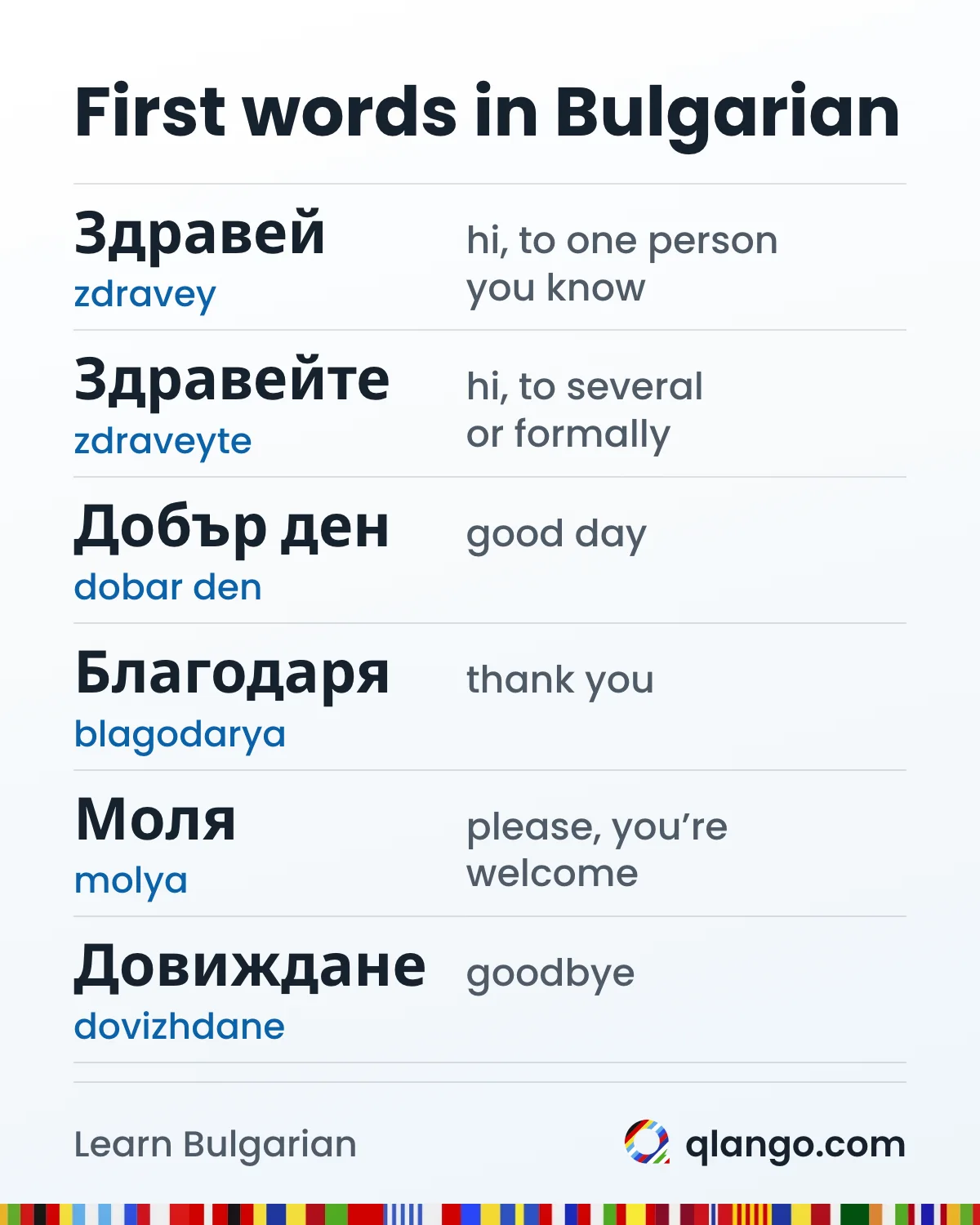
Start with здравей (zdravey), hi to one person you know, and здравейте (zdraveyte) for several people or anyone you'd address formally. Добър ден (dobar den) is good day. Благодаря (blagodarya) is thank you, though you'll hear мерси (mersi) all the time. Моля (molya) covers please and you're welcome. Извинете (izvinete) is excuse me, наздраве (nazdrave) is cheers, and довиждане (dovizhdane) is goodbye, with чао (chao) doing the job among friends.
That's enough to be polite in a shop, a taxi and a guesthouse, and to be noticed for trying.
Why it's hard to find a Bulgarian course
Type "learn Bulgarian" into a search box and one of the suggestions is "learn Bulgarian while you sleep", which tells you a fair amount about the state of the market. Serious, structured material is scarce. Much of what exists assumes you already know Russian, or is a phrasebook for the Black Sea coast. Classes outside Bulgaria are rare, and those that exist are often aimed at children from Bulgarian families. If you're an adult starting from zero, you'll be assembling your own programme, and our guide to learning a language on your own helps with the method.
A four-week starter plan
Twenty to thirty minutes a day is enough for this.
| Week | Focus | What to do each day |
|---|---|---|
| 1 | Cyrillic and sounds | Five or six letters a day, reading aloud, the greetings above |
| 2 | Nouns and the article | Thirty everyday nouns with their article, numbers to twenty, съм (I am) and имам (I have) |
| 3 | Present tense and да | Regular verbs in the present, sentences with искам да, five sentences a day about yourself |
| 4 | Past tense and first messages | The past tense of ten common verbs, short messages to a speaker or another learner |
By the end you'll be well into A1 on the CEFR scale, able to read Cyrillic aloud and to say simple things about yourself.
How Qlango teaches Bulgarian
Qlango has Bulgarian from A1 to B2, the level where you can hold a real conversation without either side straining. Lessons are short, every new word arrives with example sentences, and spaced repetition brings it back just before you'd forget it. The answer modes run from picking one of four to building sentences and typing the answer in Cyrillic, so you move from recognising the article endings to producing them. Dictation, with AI-generated speech you can slow down, trains your ear for where the stress falls. When a grammar point refuses to make sense, Premium's AI teacher will explain it as often as you ask, with fresh examples each time.
When you add the course, you choose the language you learn through. It can be your native language rather than English, and if that's another Slavic language, a good part of the grammar will feel like home. See all languages and levels and the Premium plans.
Do your first Bulgarian lesson today, through whichever language you think in. Start with the alphabet; by the weekend, България will read itself.


