In Bishkek you can spend a week without needing a word of Kyrgyz. Russian is the working language of many of the capital's offices, cafés and taxis, and plenty of people switch to it the moment they hear a foreign accent. Drive to Naryn, Talas or the villages around Issyk-Kul and the picture changes: Kyrgyz is the language of the house, the bazaar and the wedding toast. That split explains why it's worth deciding to learn Kyrgyz, and why it takes a little stubbornness.
The method itself isn't mysterious. Learn the Cyrillic alphabet with its three extra letters and its double vowels in the first week, then the plural and the personal endings, then the main cases. Move through A1 and A2 with a structured course, review vocabulary on a schedule, and create your own chances to use the language, because nobody in Bishkek will force you to.
Where Kyrgyz is spoken
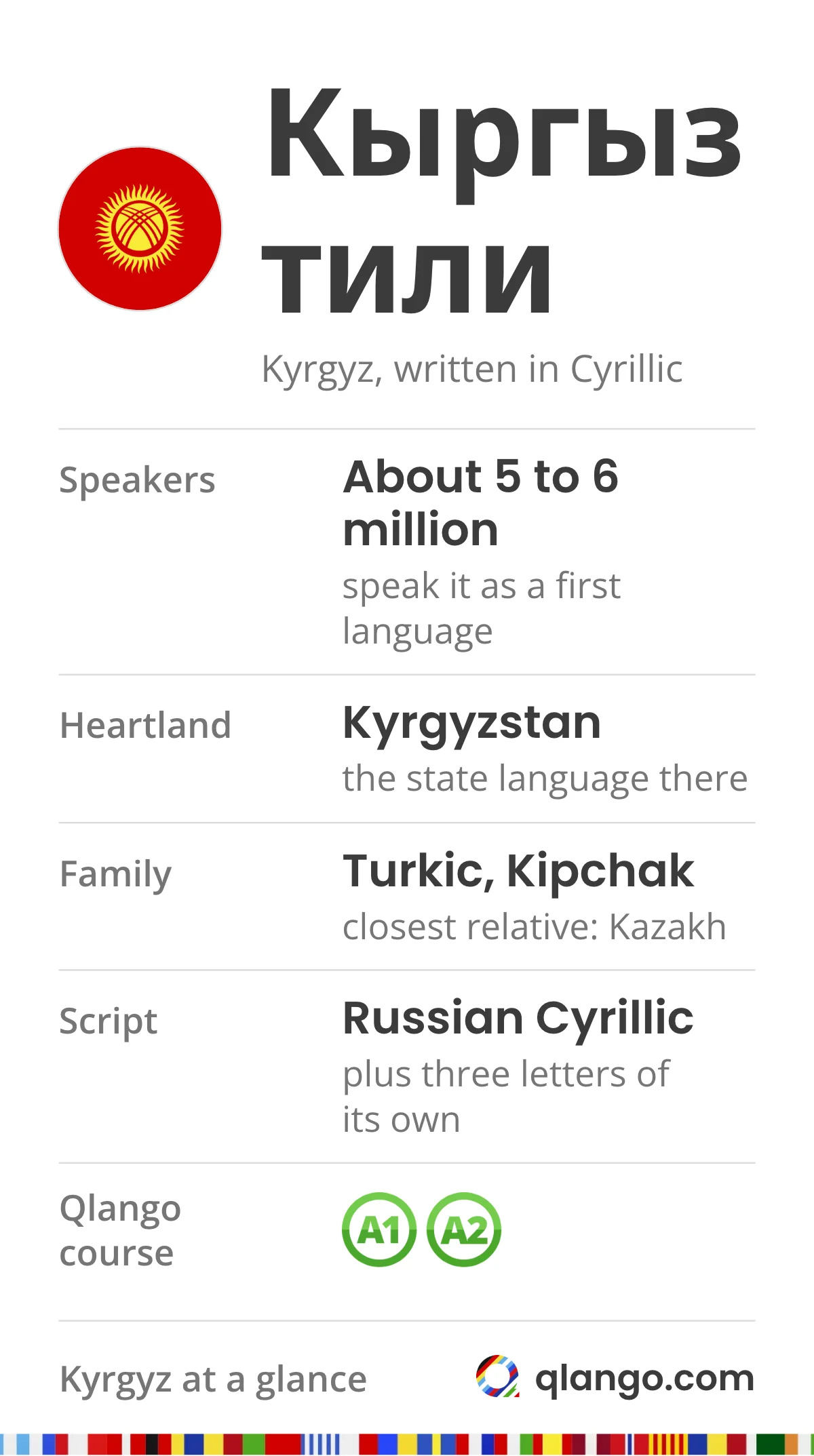
Kyrgyz is the state language of Kyrgyzstan, where Russian also has the status of an official language. Outside the country there are Kyrgyz communities in China's Xinjiang region, in the Murghab district of eastern Tajikistan, in Uzbekistan and in Afghanistan's Wakhan corridor. Altogether, something like five to six million people speak it as their first language.
It belongs to the Kipchak branch of the Turkic family, and its closest relative is Kazakh: a Kyrgyz and a Kazakh speaker can usually follow each other with some goodwill. Turkish is a more distant cousin. A Turkish speaker will recognise many roots and the logic of the suffixes, but won't follow a conversation in Osh.
Cyrillic, three extra letters and double vowels
Kyrgyz was written in Arabic script until the late 1920s, in a Latin alphabet until 1940, and in Cyrillic since then. In China it is still written in an Arabic-based script. A switch to Latin comes up for debate in Kyrgyzstan every few years, but Cyrillic remains the official script, and it's what you'll see on every sign in Bishkek.
The alphabet is Russian Cyrillic plus three letters:
- ң is the ng in sing, as in миң (thousand).
- ө is like German ö, as in төрт (four).
- ү is like German ü, as in үч (three) and үй (house).
Two more habits matter. Long vowels are written double, so суу is water and ооба is yes. And ж, which in Russian sounds like the s in pleasure, is pronounced in Kyrgyz much like the j in jam: жок, no, sounds close to jok.
Grammar: vowel harmony with a twist
Like other Turkic languages, Kyrgyz builds words by adding suffixes to a root, and the suffixes change their vowels to match the root. Kyrgyz takes this further than most, because it harmonises lip rounding as well. The plural suffix alone has twelve forms, depending on the last vowel and the last consonant of the word: китептер (books), колдор (hands), үйлөр (houses), аттар (horses).
That sounds frightening on paper. In practice your ear starts choosing the right form within a few weeks, and the system is so consistent that once a pattern clicks, it stays clicked.
The rest of the grammar is regular. No gender, no articles, six cases, personal endings on verbs, and the verb at the end of the sentence. Questions take a suffix instead of a change in word order: саламатсызбы, the polite greeting, is literally are you well, with -бы doing the asking. The cases attach just as predictably to place names: Бишкекте, Бишкекке and Бишкектен mean in, to and from Bishkek.
First Kyrgyz words
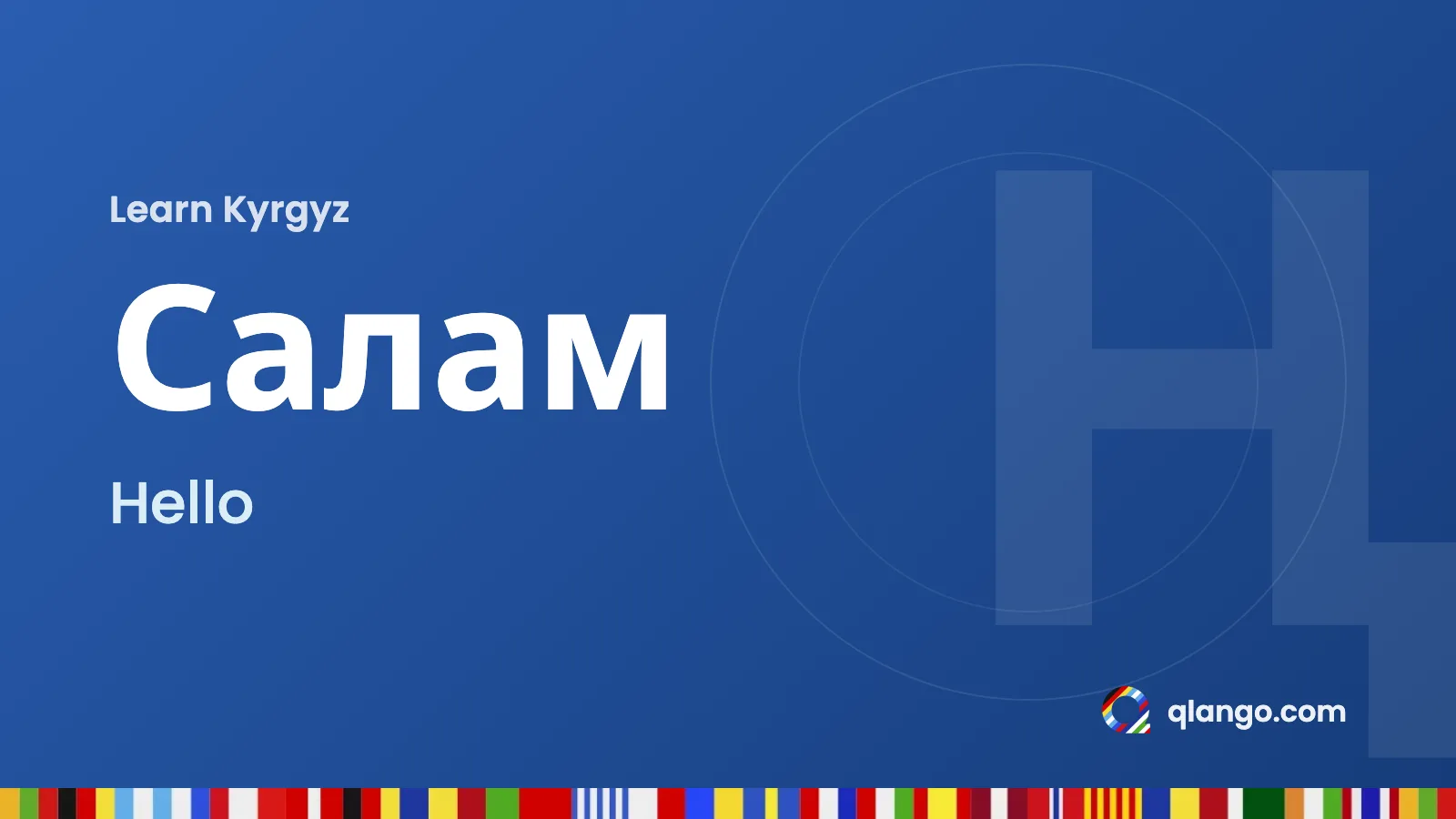
- Салам: hi
- Саламатсызбы: hello, the polite form
- Рахмат: thank you
- Ооба and жок: yes and no
- Жакшы: good
- Менин атым ...: my name is ...
- Кош келиңиз: welcome
- Бир, эки, үч, төрт, беш: one to five
- Нан, суу, чай: bread, water, tea