
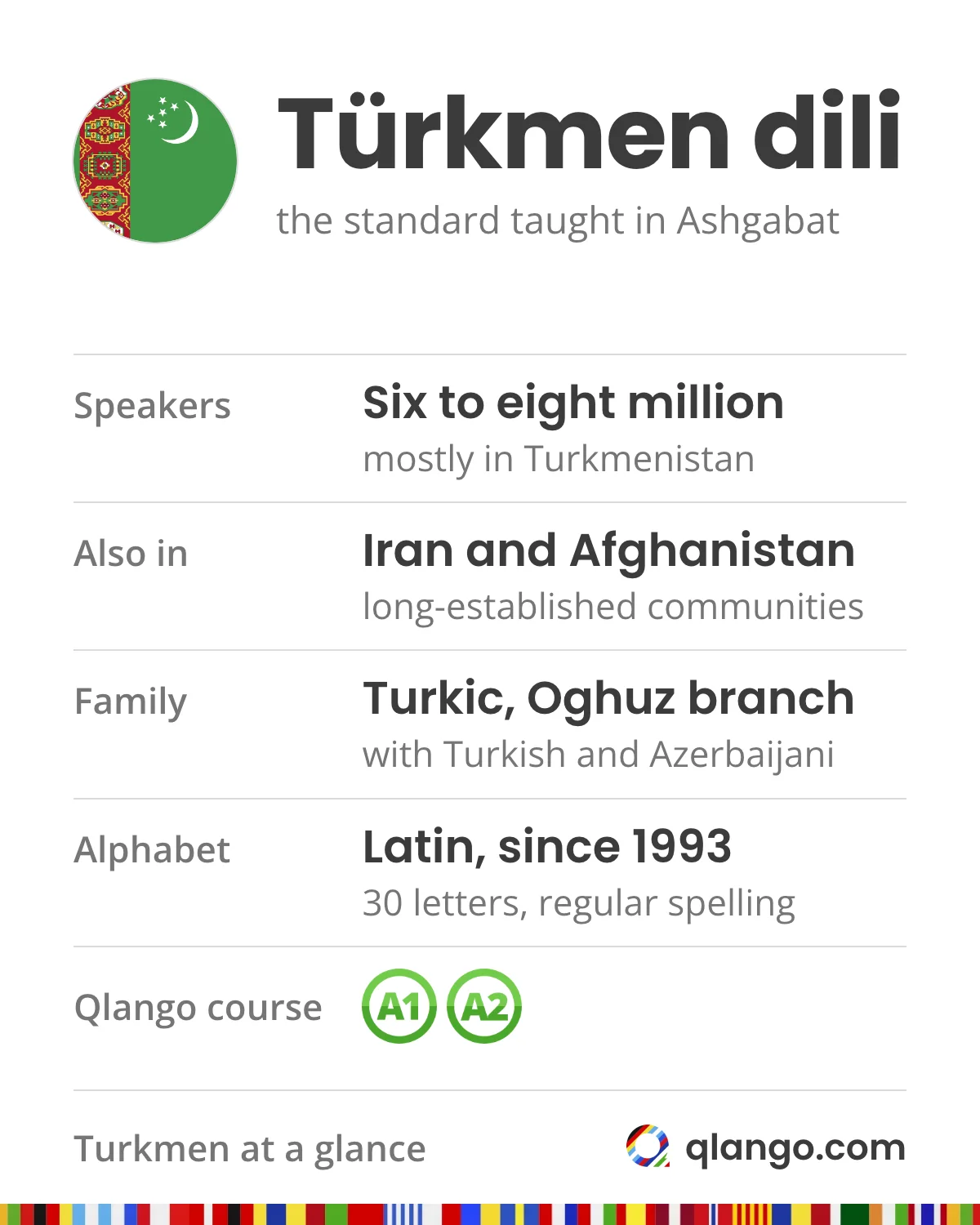
Say salam in Turkmen the way you would in Arabic or Turkish and you already have an accent. In standard Turkmen the letter s is pronounced close to the th in think, and z close to the th in this, so the greeting comes out nearer to thalam. It's one of several small surprises for anyone who decides to learn Turkmen, a Turkic language with its own Latin alphabet and somewhere between six and eight million speakers.
The short answer to how: spend the first few days on the alphabet, which goes quickly because the spelling is regular. Then build the core of the grammar, which means suffixes stacked in a fixed order, vowel harmony and the verb at the end of the sentence. Take A1 and A2 with a structured course, review vocabulary every day, and find at least one speaker to write to, because a stay in Turkmenistan is hard to arrange. The questions below cover the rest.
Where is Turkmen spoken?
Mostly in Turkmenistan, where it is the state language. There are also long-established Turkmen communities in northeastern Iran, especially in Golestan province, and in northern Afghanistan, with smaller groups in Turkey, Uzbekistan and Russia. Numbers outside Turkmenistan are uncertain, so be suspicious of anyone who gives you a precise total.
In Iran and Afghanistan Turkmen is written in the Perso-Arabic script, and the spoken varieties there differ from the standard taught in Ashgabat. Everything in this guide refers to the standard language of Turkmenistan.
Which alphabet does Turkmen use?
The Latin alphabet, officially since 1993. Before that Turkmen was written in Cyrillic, from 1940; before that, briefly, in an earlier Latin alphabet; and before that in Arabic script. Today's alphabet has 30 letters, and a few of them don't do what an English speaker expects:
| Letter | Sound | Example |
|---|---|---|
| ä | the a in cat | bäş (five) |
| ç | ch as in church | çörek (bread) |
| ň | ng as in sing | adyň (your name) |
| ş | sh | Aşgabat (Ashgabat) |
| w | somewhere between English v and w | suw (water) |
| y | a vowel like Turkish ı, an i made further back | gyz (girl) |
| ý | y as in yes | ýok (no) |
| ö, ü | as in German | dört (four), üç (three) |
The trap is y. In Turkmen it's a vowel, and the consonant is written ý. Read ýok and gyz aloud a few times and the difference sticks.
Is Turkmen hard for English speakers?
Easier than it looks in some ways, harder in others.
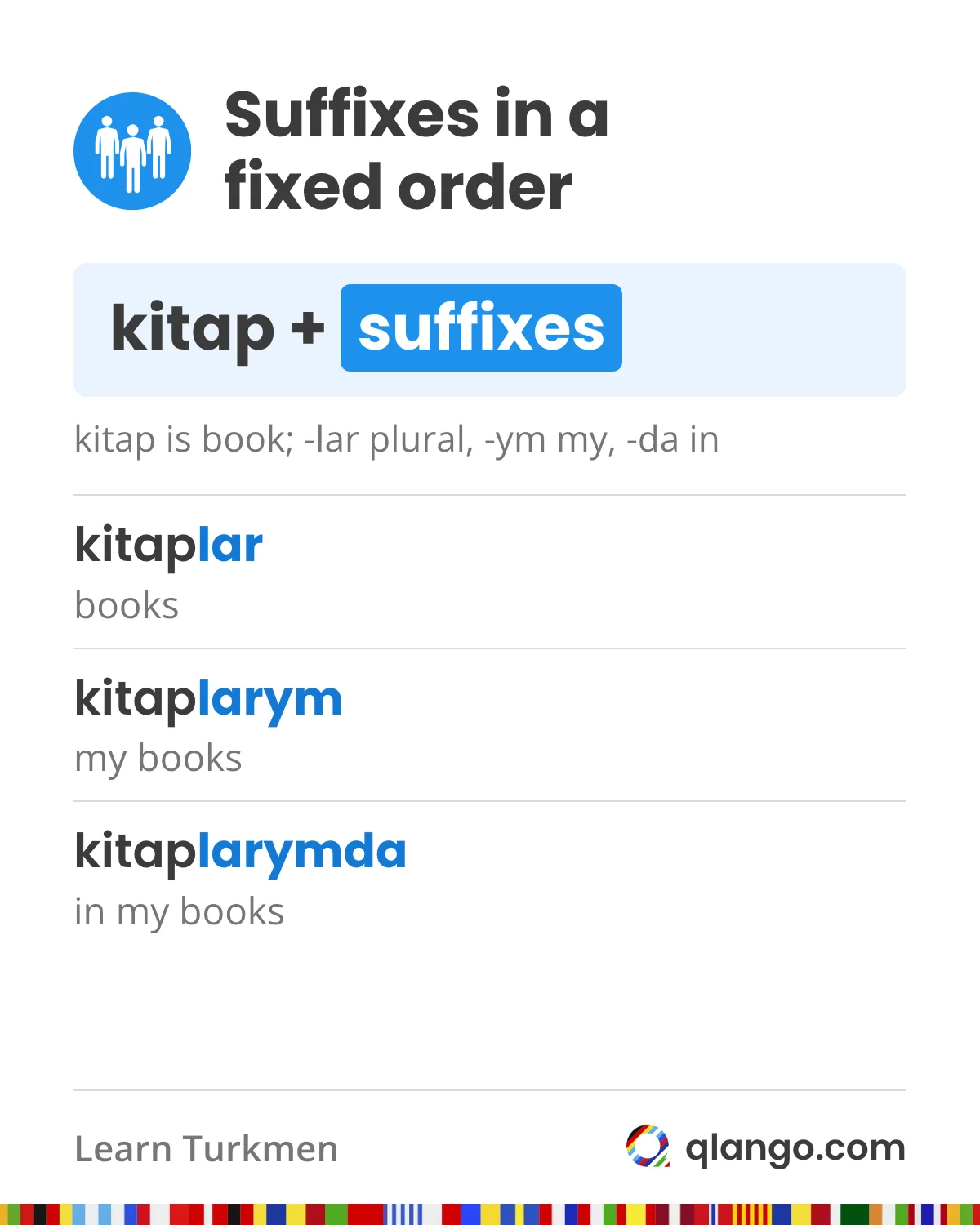
The easy part is the structure. There's no grammatical gender, no articles, and spelling matches pronunciation. A Turkmen word is a root with suffixes added in a fixed order, so kitap (book) becomes kitaplar (books), kitaplarym (my books) and kitaplarymda (in my books). Learn the suffixes and you can build words you've never seen, something English, with its went and bought, rarely lets you do.
The harder part comes from four places. Vowel harmony changes each suffix to match the vowels of the root, so the plural of kitap is kitaplar but the plural of öý, house, is öýler. There are six cases. The verb comes at the end, so in a long sentence you hold everything in your head until the last word. And Turkmen keeps long vowels that most Turkic languages lost, without marking them in spelling: the textbook pair is at, horse, with a short vowel, and at, name, with a long one. Learn words by ear as well as by eye, and don't worry if this takes months to settle.
Then there's vocabulary. Apart from loans from Arabic, Persian and Russian, almost nothing looks like English, so new words need steady review rather than one heroic evening. Our guide to learning a language on your own has practical ways to keep that going when there's no class to show up to.
Can you study Turkmen in Turkmenistan?
Rarely, in practice. Few people outside the region study Turkmen, and the country is not easy to visit. A tourist visa for Turkmenistan normally requires a letter of invitation arranged through a travel agency, so the classic plan of a summer at a language school there is out of reach for most learners. Most people start from home instead, with older textbooks and academic grammars, many of them written for Russian or Turkish speakers.
If you already know Turkish or Azerbaijani, you have a real head start. All three belong to the Oghuz branch of Turkic, and you'll recognise a good deal of written Turkmen. Compare Turkish evet with Turkmen hawa, both meaning yes, and you'll also see where the head start runs out.
What are the first Turkmen words to learn?
- Salam: hello
- Sag bol: thank you, literally be healthy
- Hawa and ýok: yes and no
- Gowy: good
- Meniň adym ...: my name is ...
- Adyň näme?: what's your name?
- Bir, iki, üç, dört, bäş: one to five
- Suw, çörek, çaý: water, bread, tea
How to learn Turkmen, one day at a time
Forget weekly milestones for a moment and think about the shape of a single day, because consistency matters more than any syllabus. Twenty-five minutes is enough:
- Five minutes of review. Go through the words due today before touching anything new. Skipping review is how learners end their first month with three hundred words they half remember.
- Ten minutes of new material. One short lesson: a handful of words and one grammar point.
- Five minutes of writing. Three sentences about your own day, using the new words. Suffix mistakes are fine; making them is how you learn where the suffixes go.
- Five minutes of reading. Anything in Turkmen: a news headline, a song lyric, a sign in a photo. Read it aloud and look up one word.
Keep that up for thirty days and you'll read the alphabet without effort, know a couple of hundred words, handle the plural, the possessive endings and a couple of cases, and introduce yourself without notes. That's well into A1.
How Qlango helps
Qlango's Turkmen course covers A1 and A2, from greetings to the everyday exchanges of A2: shopping, travel, talking about your family and your work. It fits the daily routine above. Lessons are short, words come back through spaced repetition right before you'd forget them, flashcards and find-the-pairs exercises build vocabulary, and sentence-building exercises drill the suffix order until kitaplarymda feels normal. A weekly learning plan and a streak keep the habit honest.
When you add the course, you choose the language you learn through, so it can be English or another language you'd rather use. Starting is free; Premium adds offline learning and an AI teacher you can ask why a suffix changed its vowel, as often as you need. Every course is on the languages and levels page.
Twenty-five minutes, four small parts, thirty days. A Qlango A1 lesson fits neatly into the ten minutes of new material, so tonight's session can open with salam, said with a th.


