Walk down a street in Belgrade and you'll read the same language in two alphabets: Cyrillic on the post office, Latin on the phone shop next door, sometimes both on one café menu. It's the first thing that surprises people who decide to learn Serbian, and it's less of an obstacle than it looks. The two scripts match letter for letter, and both spell words exactly as they're pronounced, so adding the second one takes days, not months.
The real work is elsewhere: seven cases, verbs that come in pairs, and a vocabulary with few English cognates beyond the international ones. In return you get a language that also lets you understand people in Croatia, Bosnia and Herzegovina and Montenegro. As deals go, that's a good one.
Where Serbian is spoken
Serbian is the official language of Serbia and one of the official languages of Bosnia and Herzegovina, and it's the most widely spoken mother tongue in Montenegro. There are Serbian communities in Kosovo and Croatia and a large diaspora in Austria, Germany, Switzerland, the US, Canada and Australia. Native speakers number in the high single-digit millions.
Linguists often describe Serbian, Croatian, Bosnian and Montenegrin as standard varieties of one language, once called Serbo-Croatian; the US Foreign Service Institute still lists it under that name, and counted together its speakers number well over fifteen million. The differences are real but modest: some vocabulary, the scripts, and the pronunciation of one old vowel. In Serbia, milk is mleko and beautiful is lepo; in Bosnia, Montenegro and Croatia they're mlijeko and lijepo. Standard Serbian accepts both, but if you're learning for Belgrade or Novi Sad, learn the "e" forms. If Croatia is where you'll use the language, there's a separate guide on how to learn Croatian.
Learn Serbian Cyrillic and Latin side by side
Each script has 30 letters, and each Cyrillic letter has exactly one Latin partner. Many are easy. These are the ones that need attention:
| Cyrillic | Latin | Sound |
|---|---|---|
| Ж ж | Ž ž | the "s" in "pleasure" |
| Ш ш | Š š | "sh" |
| Ч ч | Č č | a hard "ch", as in "church" |
| Ћ ћ | Ć ć | a softer "ch", tongue further forward |
| Џ џ | Dž dž | a hard "j", as in "jam" |
| Ђ ђ | Đ đ | a softer "j" |
| Љ љ | Lj lj | like "lli" in "million" |
| Њ њ | Nj nj | like "ny" in "canyon" |
| Ј ј | J j | "y" as in "yes" |
| Ц ц | C c | "ts" as in "cats" |
| Х х | H h | like "ch" in Scottish "loch" |
Watch the impostors in Cyrillic: Р is r, С is s, Н is n, В is v and У is u. So РЕСТОРАН is restoran, and ПИВО is pivo, beer, which most learners pick up early.
Our advice is to start with the Latin script for the first few days, since it's closer to what you know, then add Cyrillic in the second week and read everything in both. Cyrillic is the official script and the one used by the state, in schools and in many newspapers; Latin dominates advertising and the internet. You'll need both, and transcribing ten words a day from one to the other is the quickest way there.
What makes Serbian hard for English speakers
Seven cases
Nominative, genitive, dative, accusative, vocative, instrumental and locative. Take kafa, coffee: kafa je vruća (the coffee is hot), šolja kafe (a cup of coffee), pijem kafu (I'm drinking coffee). Ask for milk in it and mleko becomes mlekom: kafa sa mlekom. That's four case forms before you've finished your first café visit. The good news is that the endings repeat across many nouns, and you'll be understood with imperfect ones long before you get them right.
Verbs come in pairs
Most Serbian verbs have two forms: imperfective for actions in progress or repeated, perfective for actions completed. Kupovati is to be buying, kupiti to buy and be done with it. Pisati and napisati work the same way for writing. English expresses this with tenses and little words; Serbian builds it into the verb, so you learn two verbs for most actions. Serbian also prefers da plus the present tense where English uses an infinitive: Hoću da kupim kartu, "I want to buy a ticket".
The r that works as a vowel
In prst (finger), srce (heart) and trg (square), r does the job of a vowel. It's easier than it looks: roll the r lightly and keep going. Even the country's name, Srbija, begins this way.
Pitch and length
Serbian has a pitch accent. Stressed syllables can be long or short, rising or falling, and none of it is marked in normal writing. Learners mostly ignore it at first and are understood perfectly well. Imitate what you hear and don't let it hold you up.
First Serbian words, in both scripts
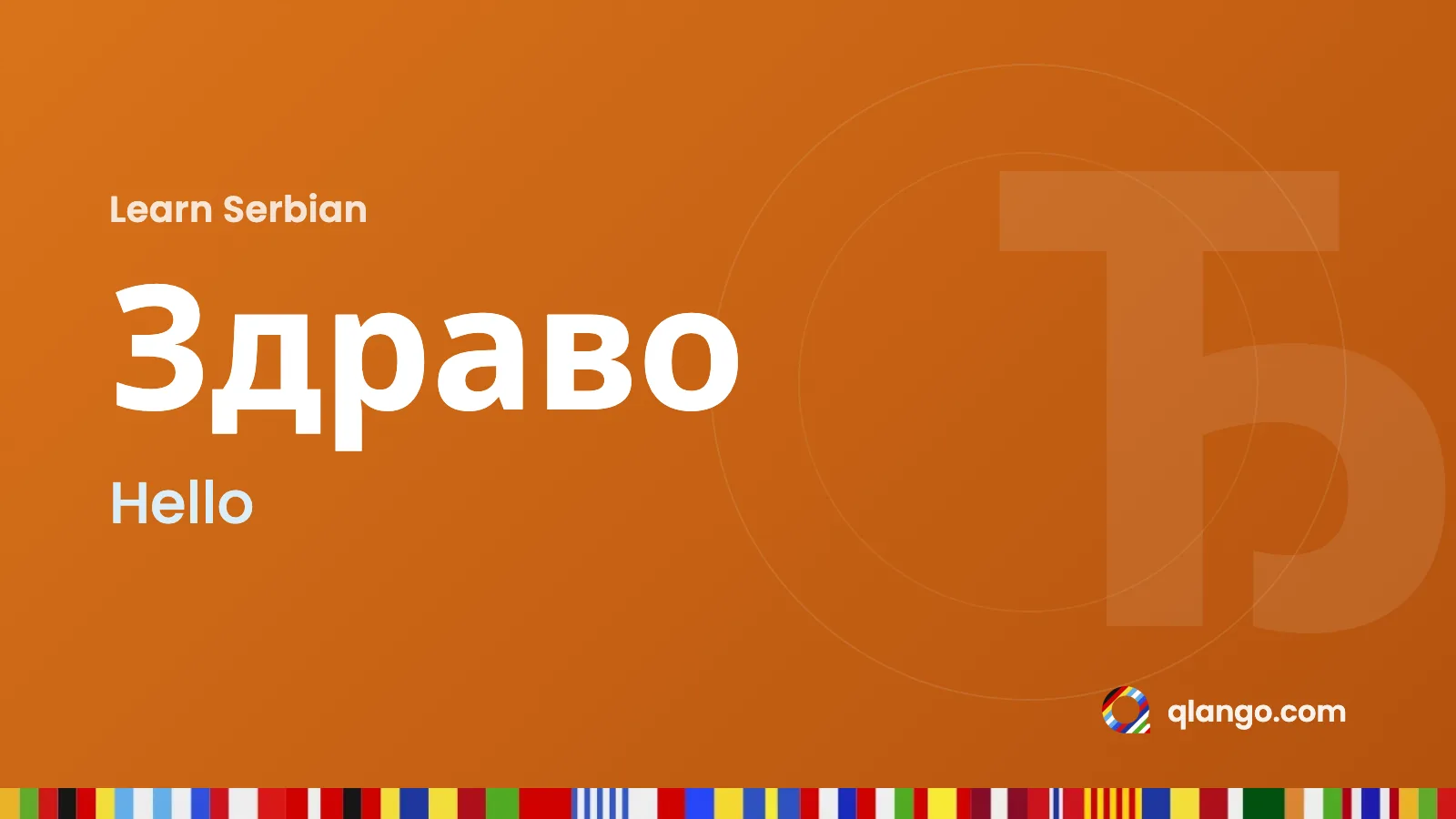
- Zdravo / Здраво: hi
- Dobar dan / Добар дан: good day
- Hvala / Хвала: thank you
- Molim / Молим: please, you're welcome, and "sorry, what?"
- Izvinite / Извините: excuse me
- Da / Да and Ne / Не: yes and no
- Može / Може: sure, fine by me
- Živeli / Живели: cheers
- Prijatno / Пријатно: enjoy your meal, and a polite goodbye
- Ćao / Ћао: hi and bye between friends
Može deserves its own note. It literally means "it can", and it's how you accept almost anything in Serbia: a coffee, a plan, a lift to the station. "Kafa?" "Može." That's a complete conversation.
Why good Serbian courses are hard to find
Search for "learn Serbian app" or "learn Serbian textbook" and you'll find people stitching together podcasts, old Serbo-Croatian grammars, phrasebooks and heritage material written for children of the diaspora. Older books often mix Serbian and Croatian vocabulary without saying which is which, and many course providers skip Serbian altogether. A course made for adults who start from zero and want to go level by level is genuinely scarce.
A first month that works
- Days 1 to 5: the Latin script and sounds. Learn the table above, the greetings and the numbers to ten. Read aloud every day.
- Days 6 to 12: Cyrillic. Learn the Cyrillic letters in three sittings. Transcribe ten words a day between scripts and read a Cyrillic headline aloud, slowly, each morning.
- Days 13 to 20: present tense and the accusative. Ja sam (I am), imam (I have), and a handful of regular verbs, used with objects: imam brata (I have a brother), pijem kafu. Write five sentences a day about your own life.
- Days 21 to 30: the past tense and verb pairs. Serbian forms the past with "to be" and a past form of the verb: bio sam u Beogradu, "I was in Belgrade" (a woman says bila sam). Learn your first ten verb pairs and start sending short messages to a speaker or another learner.
At thirty minutes a day that's around fifteen hours: a solid start on A1 and nothing more. For the bigger picture, see how long it takes to learn a language.
How Qlango teaches Serbian
Qlango has Serbian from A1 all the way to C2, so the course runs from zdravo to the level where you can follow fast, idiomatic Serbian on the radio and say exactly what you mean. If the CEFR letters are new to you, here's what each level means in practice. That full range is unusual for Serbian, and it matters if you're moving to Serbia for work or family rather than learning for a holiday.
Lessons are short, words come with example sentences, and spaced repetition brings them back before they fade. The sentence-building exercises are where cases and aspect sink in, because you have to choose kafu or kafe yourself. Dictation, with AI-generated speech you can slow down, trains your ear for č against ć. When you add the course, you choose the language you learn through, and it can be your native language rather than English. The full list of languages and levels is here, and Premium adds offline lessons and an AI teacher you can ask about any form that confuses you.
Pick Serbian, set the language you learn through, and get the first A1 lesson done today. If someone offers you a coffee afterwards, you already know the answer.