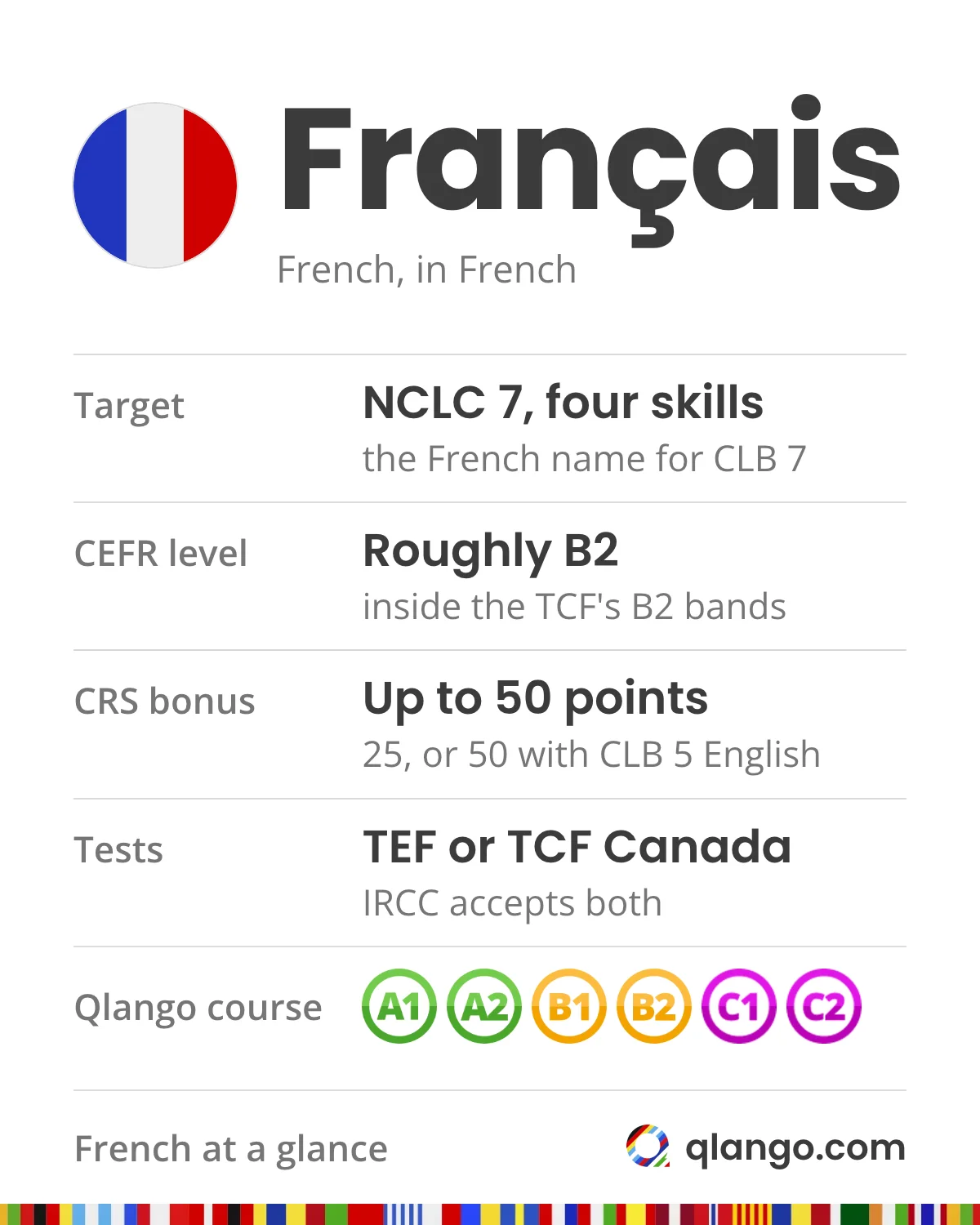
If you want to learn French for Canada PR, aim at one target: NCLC 7, the French name for CLB 7, in all four skills. That level earns up to 50 extra Express Entry points and makes you eligible for the French-language draws. In CEFR terms it is roughly B2, so for most English speakers starting from zero it's a project of well over a year, not a summer.
Everything below follows IRCC's own charts and rules as of October 2026.
Why does French matter so much for Express Entry?
French is one of the few parts of your Express Entry score you can still raise on your own. NCLC 7 or higher in all four French skills adds 25 CRS points, or 50 if you also have at least CLB 5 in all four English skills, and it makes you eligible for the French-language proficiency draws.
Those draws have been generous. IRCC's list of Express Entry rounds shows 11 French-language draws between February and mid-October 2026, with 55,500 invitations in total and cut-off scores between 382 and 435. Canadian Experience Class draws over the same months needed more than 500.
The rest of the score is changing. From November 3, 2026, IRCC brings back CRS points for job offers, now only for eligible high-wage occupations and without the need for a Labour Market Impact Assessment. Job offers and Canadian work experience move into a new Labour Market Integration factor, where you get points for one or the other, not both (IRCC: Express Entry changes). The French-language bonus of 25 or 50 points stays as it is, and it remains the lever that depends only on you.
The catch is in the words "all four". A brilliant listening score with an NCLC 6 in writing earns no bonus at all.
Is CLB 7 in French B1 or B2?
CLB 7 in French is B2, in the lower half of that level. IRCC doesn't publish a CEFR conversion, but the TCF's own scale does: France Éducation international places 400 to 499 points, and 10 to 13 out of 20 in speaking and writing, at B2. IRCC's NCLC 7 ranges for TCF Canada sit almost entirely inside those bands.
Here are IRCC's equivalency charts for the three levels that matter most, with the CEFR level the TCF bands point to.
| Level | TCF Canada: listening / reading / speaking and writing | TEF Canada: listening / reading / speaking and writing | Roughly |
|---|---|---|---|
| NCLC 5 | 369-397 / 375-405 / 6 | 181-216 / 151-180 / 226-270 | B1 |
| NCLC 7 | 458-502 / 453-498 / 10-11 | 249-279 / 207-232 / 310-348 | B2 |
| NCLC 9 | 523-548 / 524-548 / 14-15 | 298+ / 248+ / 371+ | C1 |
The last column follows the TCF's official bands, where 300 to 399 points is B1 and 500 to 599 is C1. In plain terms, B2 means following a radio discussion, arguing a point in writing and holding a conversation at work without strain. Our guide to what B2 level means has more detail, and CEFR levels explained shows the whole ladder.
TEF Canada or TCF Canada: which test should you take?
Take whichever you can book at a center near you, on a date that fits your plan. IRCC accepts both for Express Entry, both test listening, reading, writing and speaking, and your results must be less than two years old when you create your profile and when you apply for permanent residence.
TEF Canada is run by Le français des affaires, part of the Paris Île-de-France Chamber of Commerce and Industry. TCF Canada comes from France Éducation international. Their score scales differ, and so do their task formats. Try the official sample material for each and notice which format you find less stressful. That's a better tiebreaker than anything you'll read in a forum.
Book early, because test centers set their own session dates. And leave room for a second attempt in case one skill comes in at NCLC 6.
How long does it take to learn French for Canada PR?
From zero, at about an hour a day, expect well over a year to reach NCLC 7 in all four skills. The fastest route starts from a real foundation: someone who already has a solid B1 from school or university can reach NCLC 7 in a few months of focused work, which is where the "CLB 7 in six months" stories come from.
The most useful official yardstick comes from the US Foreign Service Institute, which trains American diplomats. Its timelines give French 30 weeks of full-time study, at 23 hours of class and 17 hours of self-study a week, to reach professional proficiency, level 3 on the US government's ILR scale. That's about 1,200 hours of class and homework. NCLC 7 is a lower bar, but you can't skip the slow skills: writing an organized argument and speaking under exam pressure take longer to build than reading.
Daily contact beats weekend marathons, and months of a little French beat weeks of a lot. Our piece on how long it takes to learn a language covers the general picture.
What is a realistic plan from zero to NCLC 7?
Go level by level: build an A2 base, then learn to tell stories at B1, then learn to argue at B2, and switch to test technique only in the last two or three months. Each step is a CEFR stage, not a fixed number of weeks.
- A1 to A2: the base. Present tense, passé composé, the thousand most common words, numbers, dates and everyday questions. Study daily, even for 15 minutes, and read aloud to get used to silent letters.
- B1: telling stories and giving reasons. Imparfait against passé composé, the future, the first uses of the subjunctive (il faut que je parte). Write a short paragraph three times a week.
- B2: arguing. This is where the test score lives. Learn the connectors that hold an argument together: cependant, en revanche, pourtant, d'ailleurs, c'est pourquoi. Write formal emails and opinion pieces, and listen to Canadian French news or podcasts daily until you can follow a discussion without rewinding.
- The last eight to twelve weeks: the test itself. Do full sample tests under timed conditions, learn the format of every task, record yourself on the speaking tasks and listen back, and have a qualified teacher correct your writing. Knowing the format is worth points that general practice won't give you.
- Book the test before you feel ready. A fixed date makes the last stage happen.
Vocabulary is the quiet bottleneck between B1 and B2, where texts fill up with words you recognize but can't use yet. Spaced repetition, which brings words back right before you'd forget them, makes them stick; here's how spaced repetition works.
Will Canadian French be a problem?
No. The French you learn in a course is understood everywhere in Canada, and both tests assess general French. Local words come quickly once you arrive: in Quebec, dîner is lunch and souper is dinner, and the weekend is la fin de semaine. Listening to Canadian sources during the B2 stage tunes your ear to the accent early.
How can Qlango help you learn French for Canada?
Qlango teaches French on the CEFR scale from A1 all the way to C2, so the course runs well past the B2 that NCLC 7 corresponds to. Level by level, it builds the vocabulary, grammar, reading and writing that take you from your first words to confident, independent French.
Lessons are short enough for a commute. Spaced repetition carries you through the big vocabulary jump from B1 to B2, and the answer modes, from picking one of four to building sentences and writing, make you produce French, not just recognize it. The weekly learning plan keeps your study regular, statistics show your progress over weeks and months, books and Decoding Stories add reading practice, and you can chat with other learners, with message translation and AI help to write a reply.
Premium adds offline learning and an AI teacher you can ask unlimited questions, such as why it's "bien que je sois" and never "bien que je suis". When you add French, you choose the language you learn through: English, or another language you want to strengthen.
Frequently asked questions
Is CLB 7 French B1 or B2?
B2. IRCC's NCLC 7 ranges for TCF Canada (458 to 502 in listening, 453 to 498 in reading, 10 to 11 in speaking and writing) sit almost entirely inside the TCF's official B2 bands.
Can I get CLB 7 in French in six months?
Only if you start from a genuine B1 and study seriously every day. From zero, six months isn't realistic for most working adults, so plan for well over a year.
Do I need French for Express Entry if my English is strong?
No. Express Entry works with English or French, and French is optional. But NCLC 7 in all four skills adds up to 50 points and opens the French-language draws, whose cut-offs in 2026 were far lower than those of Canadian Experience Class draws.
Every week of French you do now is a week you won't spend cramming later. Add French in Qlango, do your first A1 lesson today, and set a weekly plan you can keep.