The Korean alphabet, Hangul (한글), has 24 basic letters: 14 consonants and 10 vowels. Add 5 double consonants and 11 compound vowels and you have the 40 letters of modern Korean. Below is a Korean alphabet chart for all of them, with the official romanization and an English sound hint, followed by how letters stack into syllable blocks and a two-day plan for reading Hangul by Sunday evening.
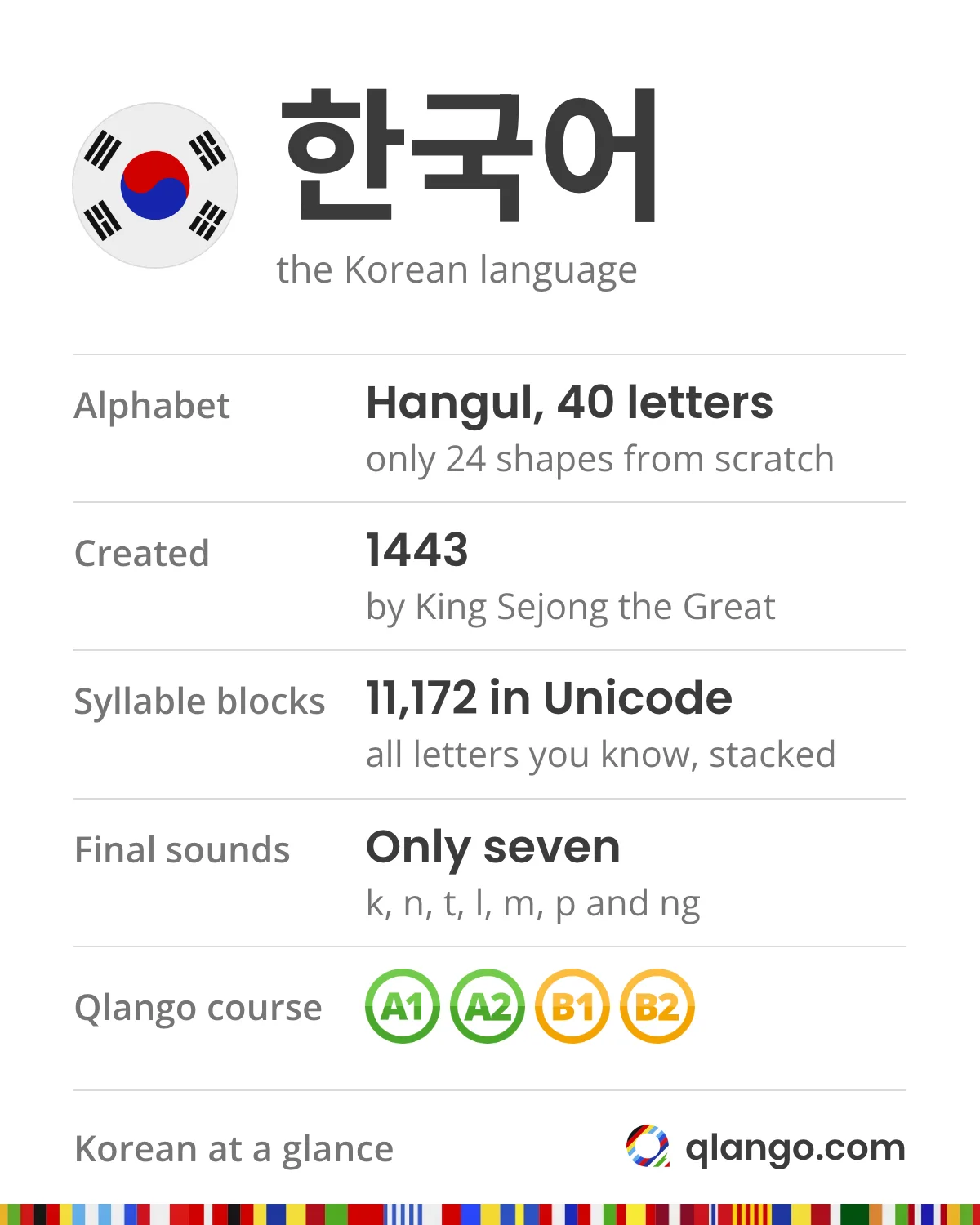
King Sejong the Great created Hangul in 1443 and promulgated it in 1446, so unlike most scripts it has a known author and date (Ministry of Culture, Sports and Tourism). The romanization below is the Revised Romanization of Korean, the official system (NIKL romanization rules).
How many letters are in the Korean alphabet?
Modern Hangul uses 40 letters: 14 basic consonants, 10 basic vowels, 5 double consonants and 11 compound vowels. The doubles and compounds are built from the basic 24, so you only learn 24 shapes from scratch; the other 16 are combinations you can work out.
Korean alphabet chart: the 14 basic consonants
Several consonants have two romanizations because the sound shifts with position. ㄱ is g before a vowel and k at the end of a syllable, and ㄹ is r before a vowel and l at the end. The sound hints are approximations, since Korean sounds don't map one to one onto English.
| Letter | Name | Romanization | Sounds like |
|---|---|---|---|
| ㄱ | 기역 (giyeok) | g / k | a soft k at the start of a word, g between vowels |
| ㄴ | 니은 (nieun) | n | n in "no" |
| ㄷ | 디귿 (digeut) | d / t | a soft t at the start of a word, d between vowels |
| ㄹ | 리을 (rieul) | r / l | a light tap, like the tt in American "butter"; l at the end |
| ㅁ | 미음 (mieum) | m | m in "me" |
| ㅂ | 비읍 (bieup) | b / p | a soft p at the start of a word, b between vowels |
| ㅅ | 시옷 (siot) | s | s in "sun"; close to sh before ㅣ |
| ㅇ | 이응 (ieung) | silent / ng | silent at the start of a syllable, ng as in "sing" at the end |
| ㅈ | 지읒 (jieut) | j | between the j in "jam" and the ch in "chip" |
| ㅊ | 치읓 (chieut) | ch | ch in "church", with a puff of air |
| ㅋ | 키읔 (kieuk) | k | k in "kite", with a strong puff of air |
| ㅌ | 티읕 (tieut) | t | t in "top", with a strong puff of air |
| ㅍ | 피읖 (pieup) | p | p in "pie", with a strong puff of air |
| ㅎ | 히읗 (hieut) | h | h in "hat" |
Hold a hand in front of your mouth: ㅋ, ㅌ, ㅍ and ㅊ should push air against your palm, while ㄱ, ㄷ, ㅂ and ㅈ barely should. That puff is the main difference between 기 and 키.
What are the 10 basic Korean vowels?
They're built from three strokes: a vertical line, a horizontal line and a short tick. Add a second tick and you add a y sound, so ㅏ is a and ㅑ is ya, ㅗ is o and ㅛ is yo. That one pattern halves the work.
| Letter | Romanization | Sounds like |
|---|---|---|
| ㅏ | a | a in "father" |
| ㅑ | ya | ya in "yard" |
| ㅓ | eo | u in "up", with the jaw a little lower |
| ㅕ | yeo | yu in "young" |
| ㅗ | o | o in "go", but short and without the glide |
| ㅛ | yo | yo in "yoga" |
| ㅜ | u | oo in "moon" |
| ㅠ | yu | the word "you" |
| ㅡ | eu | oo said with the lips spread flat, as in a smile |
| ㅣ | i | ee in "see" |
ㅓ and ㅗ are the pair English speakers mix up most. Round your lips for ㅗ and keep them relaxed and open for ㅓ. 서울 (Seoul) begins with ㅓ, which is why Koreans don't say it like "soul".
What are the double consonants and compound vowels?
Double consonants are tense versions of ㄱ, ㄷ, ㅂ, ㅅ and ㅈ: tighten your throat and release with no puff of air, like the k in "skin". Compound vowels combine two basic vowels, and in everyday speech several of them sound alike, which is good news for learners.
| Letter | Name | Romanization | Sounds like |
|---|---|---|---|
| ㄲ | 쌍기역 (ssanggiyeok) | kk | k in "skin", tense |
| ㄸ | 쌍디귿 (ssangdigeut) | tt | t in "stop", tense |
| ㅃ | 쌍비읍 (ssangbieup) | pp | p in "spin", tense |
| ㅆ | 쌍시옷 (ssangsiot) | ss | a sharp, hissing s |
| ㅉ | 쌍지읒 (ssangjieut) | jj | a tense j with no puff of air |
| Letter | Romanization | Sounds like |
|---|---|---|
| ㅐ | ae | e in "bed" |
| ㅔ | e | e in "bed"; most speakers no longer separate it from ㅐ |
| ㅒ / ㅖ | yae / ye | ye in "yes" |
| ㅘ | wa | wa in "want" |
| ㅙ / ㅚ / ㅞ | wae / oe / we | we in "wet"; the three sound almost the same |
| ㅝ | wo | wo in "won" |
| ㅟ | wi | wee in "week" |
| ㅢ | ui | eu gliding into i |
What is the Korean alphabet in order?
Dictionaries list the consonants as ㄱ ㄲ ㄴ ㄷ ㄸ ㄹ ㅁ ㅂ ㅃ ㅅ ㅆ ㅇ ㅈ ㅉ ㅊ ㅋ ㅌ ㅍ ㅎ and the vowels as ㅏ ㅐ ㅑ ㅒ ㅓ ㅔ ㅕ ㅖ ㅗ ㅘ ㅙ ㅚ ㅛ ㅜ ㅝ ㅞ ㅟ ㅠ ㅡ ㅢ ㅣ. Each double letter follows its single, and each compound vowel follows its base.
How do Hangul syllable blocks work?
Every syllable is written as one block: a consonant, then a vowel, sometimes followed by a final consonant. Vertical vowels sit to the right of the first consonant, horizontal vowels sit underneath it, and a final consonant always goes at the bottom.
- ㄱ plus ㅏ makes 가 (ga), and ㄴ plus ㅓ makes 너 (neo): vertical vowels go to the right.
- ㄱ plus ㅗ makes 고 (go), and ㄴ plus ㅜ makes 누 (nu): horizontal vowels go underneath.
- ㅎ plus ㅏ plus ㄴ makes 한 (han), and ㄱ plus ㅡ plus ㄹ makes 글 (geul). Together: 한글, hangeul.
- A syllable that starts with a vowel uses the silent ㅇ as a placeholder: 아 (a), 오 (o), 우유 (uyu, milk).
Unicode contains 11,172 ready-made Hangul syllables: 19 initial consonants times 21 vowels times 28 final options, counting "no final" as one (Unicode Hangul Syllables chart). You don't learn them one by one. Each is just letters you already know, stacked.
What is batchim in Korean?
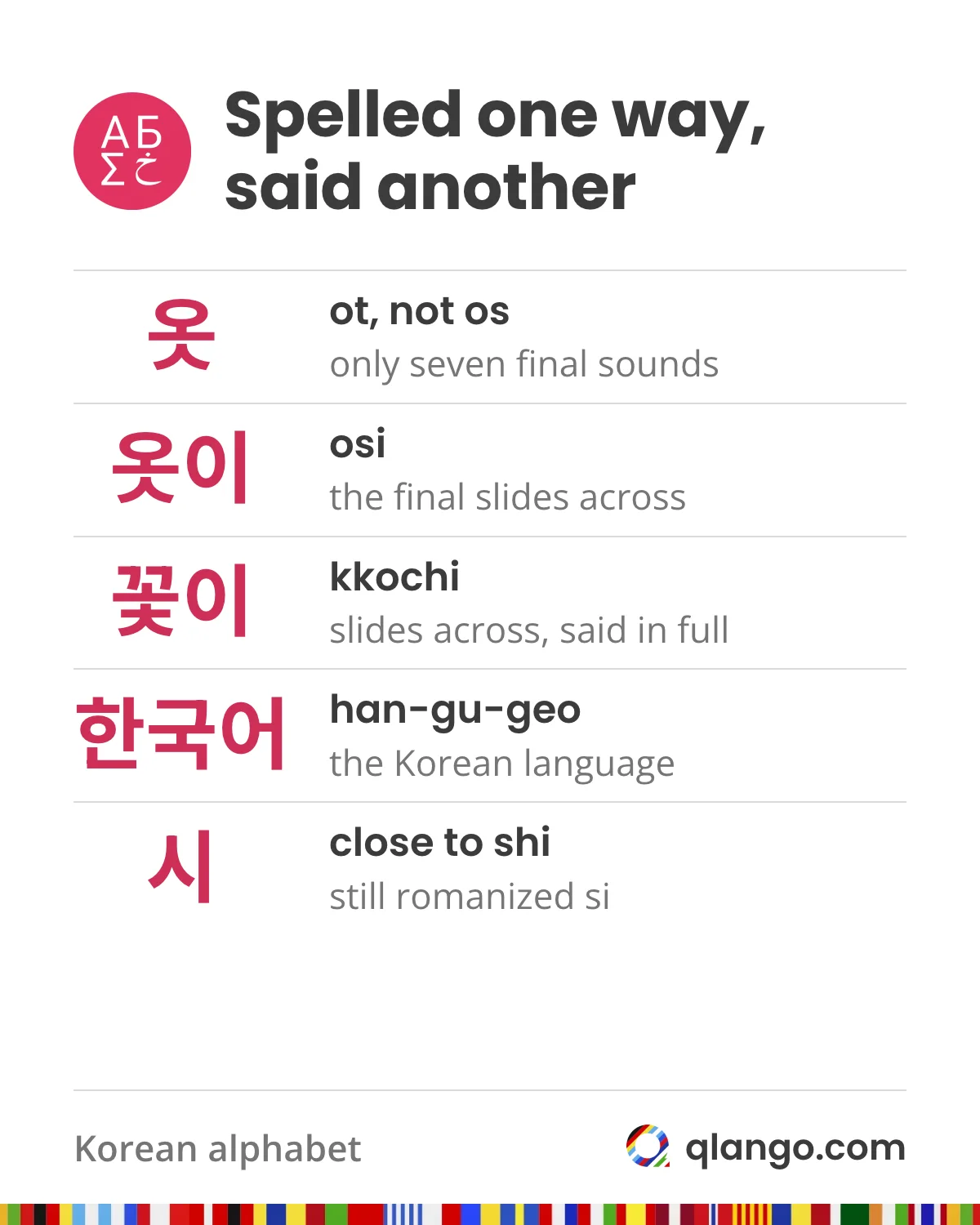
Batchim (받침) is the final consonant at the bottom of a block. Many letters can sit there, but they collapse into only seven sounds: k, n, t, l, m, p and ng. That's why 옷 (clothes) is said ot, not os.
| Final letters | Sound | Examples |
|---|---|---|
| ㄱ ㅋ ㄲ | k | 부엌 (bueok, kitchen), 밖 (bak, outside) |
| ㄴ | n | 산 (san, mountain) |
| ㄷ ㅌ ㅅ ㅆ ㅈ ㅊ | t | 옷 (ot, clothes), 꽃 (kkot, flower) |
| ㄹ | l | 물 (mul, water) |
| ㅁ | m | 밤 (bam, night) |
| ㅂ ㅍ | p | 밥 (bap, rice), 앞 (ap, front) |
| ㅇ | ng | 강 (gang, river) |
When the next syllable starts with a silent ㅇ, the final consonant slides across and is pronounced in full. 옷이 sounds like 오시 (osi), 꽃이 like 꼬치 (kkochi), and 한국어, the Korean language, sounds like han-gu-geo.
How to learn Hangul in a weekend
Two days of about two hours each is enough to read slowly. Work in short blocks, write every letter by hand and say it out loud as you write.
- Saturday morning: the 10 basic vowels. Write each one five times, saying it aloud.
- Saturday afternoon: the 14 basic consonants. Pair each with ㅏ and read the row aloud: 가 나 다 라 마 바 사 아 자 차 카 타 파 하.
- Saturday evening: loanwords. 커피 (keopi, coffee), 바나나 (banana), 택시 (taeksi, taxi), 버스 (beoseu, bus).
- Sunday morning: doubles and compound vowels. Say 가, 카 and 까 until you hear three different sounds.
- Sunday afternoon: batchim and linking. Read 옷이 and 한국어 aloud.
- Sunday evening: real words. 김치 (gimchi), 비빔밥 (bibimbap), 서울 (Seoul), 감사합니다 (gamsahamnida, thank you). Then write your name in Hangul.
Want a printable Korean alphabet chart? Print this page, or better, copy the tables into a notebook once by hand; writing a letter fixes its shape far better than looking at it. From Monday, put romanization away.
What to learn after you can read Hangul
Words, every day, in Hangul. Our guide on how to learn Korean by yourself covers what comes next. Qlango's Korean course runs from A1 to B2, with short lessons, spaced repetition and answer modes that include writing, which is where the letters really stick. Word games like Wordle and Word Search add repetition without feeling like homework.
When you add the course, you choose the language you learn through. It's free to start, and Premium adds offline learning and an AI teacher you can ask why 옷이 is pronounced osi. The languages page lists every course.
FAQ
Can you really learn Hangul in a weekend?
Yes, well enough to read slowly and correctly. Speed comes in the following weeks, through reading a little every day.
Is there a Korean alphabet A to Z?
No. Hangul doesn't map letter for letter onto English. Use the romanization as a guide to the sound, then switch to Hangul as soon as you can: romanization spells single vowels like 어 and 으 with two letters and hides how sounds change between syllables.
Why does 시 sound like "shi"?
Before the vowel ㅣ, ㅅ is pronounced close to the English sh, so 시 sounds like "shi". It's still romanized si, which trips up a lot of beginners.
Two days, forty letters, one notebook. Give Hangul this weekend, then open the Korean course in Qlango on Monday and read your first lesson in the script itself.