Mexican Spanish vs Spain Spanish is not a choice between two languages. It's a choice between two accents and two sets of everyday words, and speakers of both understand each other without trouble. The short answer: learn Mexican Spanish if you'll use it in the US or Latin America, and Spain Spanish if you're headed to Spain. Whichever you pick, adding the other later is very doable.
Mexico is by far the largest Spanish-speaking country. The Instituto Cervantes counts about 130 million native speakers there, against about 47 million in Spain (Instituto Cervantes, 2025). In the US, the Census Bureau counted 70.1 million Hispanic residents in 2025 (US Census Bureau), and in much of the country, the Southwest above all, the Spanish you hear every day is Mexican or close to it.
Mexican Spanish vs Spain Spanish: what's the difference?
The grammar is the same. The differences sit in pronunciation, the plural "you", one past-tense habit and a set of everyday words. A Spaniard says vosotros, pronounces the z in zapato like the English th, and drives a coche. A Mexican says ustedes, pronounces that z like an s, and drives a carro.
| Feature | Spain | Mexico |
|---|---|---|
| z, and c before e or i | th, as in "think": gracias sounds like gra-thee-as | s: gra-see-as |
| "You" to a group of friends | vosotros: vosotros habláis | ustedes: ustedes hablan |
| Something that happened today | Hoy he comido paella | Hoy comí tacos |
| Saying OK | vale | sale, va, órale |
| Saying cool | guay | padre, chido |
| Friend, dude | tío, tía | güey |
| Asking "pardon?" | ¿Perdona? or ¿Cómo? | ¿Mande? |
Can Mexicans and Spaniards understand each other?
Yes, easily. Think of an American watching a British series: a few words need context, the accent takes ten minutes to tune into, and nothing stops the conversation. Films, TV and music cross the Atlantic in both directions, so both sides are used to hearing the other.
Misunderstandings, when they happen, are about vocabulary, and they're usually funny rather than serious. One word deserves a warning, and it's in the vocabulary section below.
How is the pronunciation different?
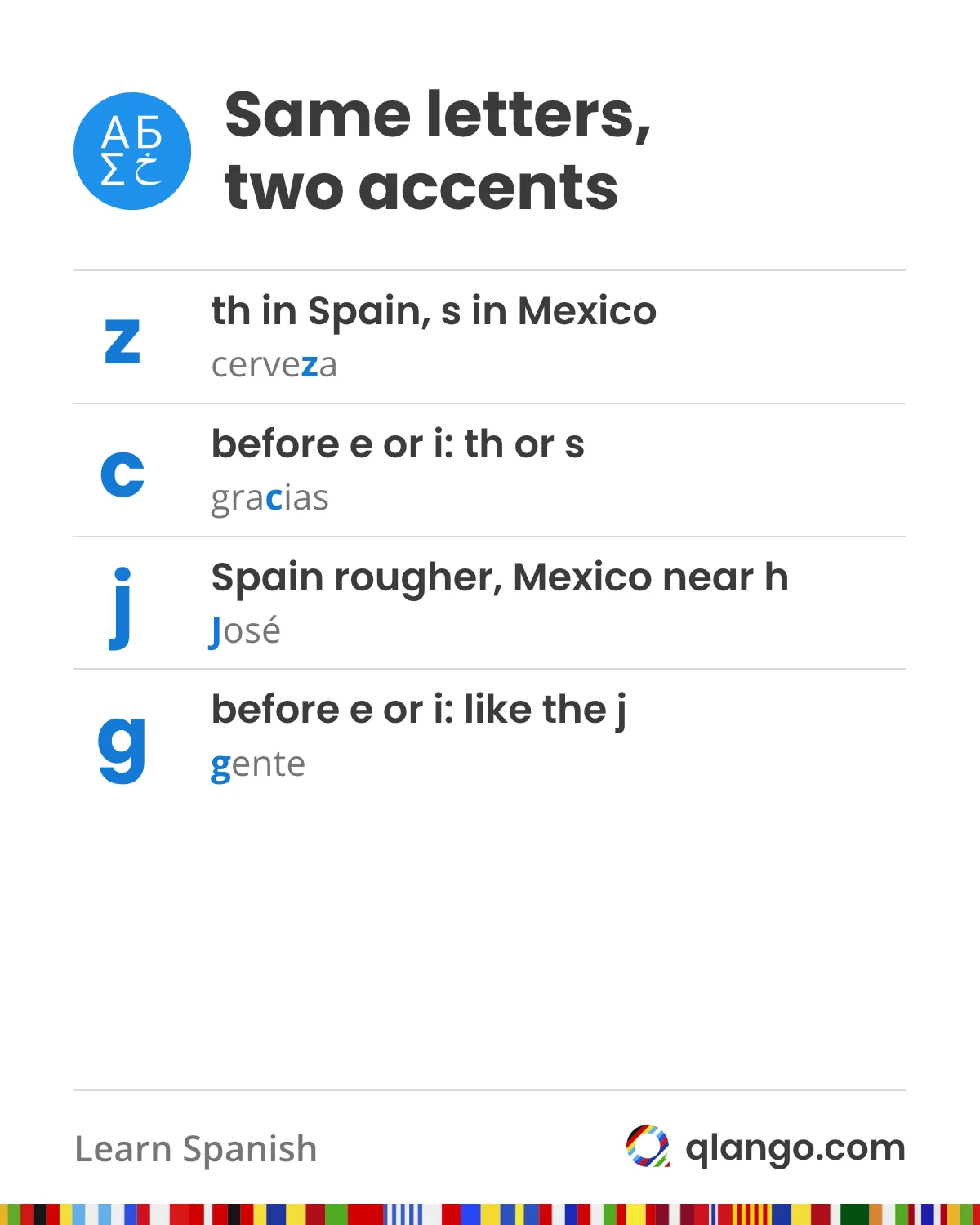
The famous difference is the th. In most of Spain, z, and c before e or i, are pronounced like the th in "think", so cerveza sounds like thair-BEH-tha. In Mexico, and in all of Latin America, they sound like s. Both are fully correct Spanish.
The Real Academia Española says so itself: its dictionary of usage describes the s pronunciation, called seseo, as general in Latin America, the Canary Islands and part of Andalusia, and fully accepted in educated speech (RAE). It's also not a lisp. In Spain, casa (house) and caza (hunt) sound different, so the th carries meaning. In Mexico, the two words sound the same, and context does the work.
The other sound to notice is the j, and the g before e or i. In Spain it's rougher, made at the back of the throat; in Mexico it's softer, closer to an English h. José and gente sound noticeably different on each side of the Atlantic, but nobody misunderstands them.
Vosotros or ustedes: what changes in the grammar?
Mainly the plural "you". Spain uses vosotros for friends and family and ustedes for formal situations. Mexico, like the rest of Latin America, uses ustedes for everyone. That removes a whole verb form from Mexican Spanish: vosotros habláis, coméis, vivís simply doesn't come up in daily life.
Spain also tends to use the present perfect for things that happened today: Hoy he desayunado tarde, I had breakfast late today. Mexico prefers the simple past: Hoy desayuné tarde. Both are understood everywhere.
And Mexican Spanish loves the diminutive. A cafecito is a friendly little coffee, and ahorita, from ahora (now), can mean right now or in a while. The tone of voice usually tells you which.
Which everyday words are different?
Quite a few, and they're words you use every day: transport, food, clothes and technology. Neither list is wrong. Each side understands the other's words, even if they'd never use them, and the table below covers the ones you'll meet first.
| English | Mexico | Spain |
|---|---|---|
| car | carro | coche |
| cell phone | celular | móvil |
| computer | computadora | ordenador |
| bus | camión | autobús |
| apartment | departamento | piso |
| ticket (bus, train) | boleto | billete |
| to drive | manejar | conducir |
| juice | jugo | zumo |
| potato | papa | patata |
| glasses | lentes | gafas |
| jacket | chamarra | chaqueta |
| swimming pool | alberca | piscina |
| straw | popote | pajita |
| waiter | mesero | camarero |
| to rent | rentar | alquilar |
| to chat | platicar | charlar |
Then there's coger. In Spain it's the everyday verb for take or catch: coger el autobús. In Mexico it's vulgar slang, and people say tomar el camión instead. If you learn one word to avoid before a trip to Mexico, make it this one.
Which one should you learn?
Learn the variety of the people you'll actually talk to. For most Americans, that means Mexican Spanish: much of the Spanish heard in US workplaces, schools and clinics has Mexican roots, and Mexico is the country next door. Choose Spain Spanish if you're moving to Spain, studying there or traveling mainly in Europe.
| Your situation | Pick |
|---|---|
| You live in the US and want to talk with coworkers, patients, customers or neighbors | Mexican Spanish |
| You're planning trips to Mexico | Mexican Spanish |
| You'll travel widely in Latin America | Mexican Spanish, which shares seseo and ustedes with the region |
| You're moving to, studying in or touring Spain | Spain Spanish |
| Your partner or family is from one of the two countries | That country's variety |
If none of these fits, pick the one whose films and music you enjoy most. You'll listen to it more, and listening is half the work. Spanish is one of the easiest languages for English speakers either way.
Can you switch from one to the other later?
Yes, and it's less work than people expect. The grammar and the core vocabulary are shared, so switching means adding or dropping vosotros, learning a list of everyday words like the one above and getting used to an accent. A few weeks of watching a series from the other country, with subtitles, takes care of the accent.
Can you learn both varieties with Qlango?
Qlango has two separate courses: Spanish (Spain), from A1 to C2, and Spanish (Mexican), from A1 to B2. B2 is the upper-intermediate level where you can talk with native speakers without strain on either side (what B2 means). Pick the course that matches your goal, and add the other whenever you like.
When you add a course, you choose the language you learn through, so translations come in a language you already know well. Lessons are short, spaced repetition brings words back right before you'd forget them, and the answer modes, picking one of four, building sentences, finding pairs and writing, get you producing Spanish from day one. Word Duel, Wordle and MinuteRush are good for drilling vocabulary like carro and coche.
It's free to start. Premium adds offline learning and an AI teacher you can ask unlimited questions, for instance when to use the present perfect in Madrid and the simple past in Mexico City. Every course and level is on the languages page.
FAQ
Is Mexican Spanish easier than Spain Spanish?
Slightly, at the very start: there's no vosotros verb form to learn and no th sound to make. After that, the difficulty is identical, because the grammar is the same.
Is Spain Spanish more correct?
No. The Real Academia Española treats Latin American pronunciation, including seseo, as fully standard. Educated Spanish in Mexico City is as correct as educated Spanish in Madrid.
Will people in Spain understand my Mexican Spanish?
Yes, without difficulty. Spaniards hear Mexican Spanish in films, series and music, and Mexicans hear Spain's Spanish the same way. Expect a few smiles at vocabulary, not confusion.
Which Spanish is spoken in the US?
Mostly Latin American varieties. Mexican Spanish is the most widespread, especially in the Southwest, while Caribbean Spanish is strong in Florida and the Northeast.
Pick the Spanish of the people you want to talk to, and start this week. Open Qlango, choose Spanish (Mexican) or Spanish (Spain), and by your first trip or your first conversation at work, you'll know whether to say vale or sale.