A hundred years ago, Kazakh was written in an Arabic-based script. Since then it has switched to a Latin alphabet, then to Cyrillic, and it is now moving, in stages, to a new Latin alphabet. Kazakhs in China still use the Arabic-based one. If you want to learn Kazakh, that history sounds like a warning. It isn't. You need one script to begin with, and for now that script is Cyrillic, because most books, newspapers and websites in Kazakhstan still use it.
After the alphabet, the main job is getting used to how Kazakh builds words: it takes a root and stacks suffixes on the end, choosing each suffix's vowel to match the word. The grammar is regular to the point of being kind. What takes time is vocabulary, the handful of sounds English doesn't have, and the fact that many people in the cities will cheerfully switch to Russian for your sake.
Where Kazakh is spoken, and by whom
Kazakh is the state language of Kazakhstan. Russian is also used officially and is still everywhere in cities like Almaty and Astana, but Kazakh has been gaining ground in schools, media and public life since independence. Outside Kazakhstan you'll find Kazakh communities in northwest China, western Mongolia, Uzbekistan and Russia. Estimates put the total number of speakers somewhere above ten million.
People who learn it usually have a concrete reason: a job in Kazakhstan, a Kazakh partner or in-laws, or simply living there and getting tired of being told that nobody needs Kazakh because everyone speaks Russian. Even a little Kazakh tends to change the mood of a conversation.
Kazakh or Russian first?
If you're moving to Almaty for a two-year contract and need to sort out rent, doctors and paperwork next month, Russian will usually get you further, faster, in the big cities. That's simply how urban Kazakhstan works. But if you're staying longer, have Kazakh family, or work outside the largest cities, Kazakh earns its place, and plenty of people end up learning both. The two compete less than you'd think. Kazakh grammar is nothing like Russian, so you won't mix them up, and the Cyrillic you learn for one serves the other. Learning Kazakh second, after some Russian, at least means the alphabet is already done.
Its family: cousins of Tatar, Kyrgyz and Uyghur
Kazakh is a Turkic language of the Kipchak branch. Its closest relative is Kyrgyz, and the branch also includes Tatar, Bashkir and Karakalpak. Uyghur and Uzbek belong to a different Turkic branch but share a lot of vocabulary. Turkish is a more distant relative: a Turkish speaker will spot many familiar words and still not follow much of a conversation without study.
The alphabet: Russian Cyrillic plus nine letters
Kazakh Cyrillic has 42 letters, the 33 of Russian and nine of its own.
| Letter | Roughly like |
|---|---|
| Ә ә | the "a" in "cat" |
| Ғ ғ | a "g" made far back in the throat, close to a French "r" |
| Қ қ | a "k" made further back than in English |
| Ң ң | the "ng" in "sing" |
| Ө ө | German "ö" |
| Ұ ұ | the "u" in "put" |
| Ү ү | German "ü" |
| Һ һ | "h", mostly in loanwords |
| І і | the "i" in "bit" |
Ы, which Russian has too, is a short, swallowed vowel in Kazakh, close to the "a" in "about". Several Russian letters, such as ц, щ and ё, turn up mostly in Russian loanwords. If you already read Russian, the alphabet is a weekend. If you don't, give it a week, and write by hand while you learn it.
What's easy and hard when you learn Kazakh
The easy part is the system. Kazakh has no grammatical gender and no articles, its verbs follow a few regular patterns, and its suffixes behave. Watch the same three endings on two different words:
- қала (city): қалада (in the city), қалаға (to the city), қаладан (from the city)
- үй (house): үйде (at home), үйге (to the house), үйден (from the house)
The endings are the same; only the sounds shift to match the word. That's vowel harmony, and after a few weeks you'll do it without thinking.
The hard part is how much is new at once. Sounds like қ, ғ and ң take practice. The verb goes at the end, so Мен үйге барамын, "I'm going home", is literally "I home-to go". Stress usually falls on the last syllable, which takes some getting used to if you know Russian, where it moves around. And Kazakh shares little vocabulary with English beyond loanwords, so every word has to be earned.
First words
| Kazakh | Transliteration | Meaning |
|---|---|---|
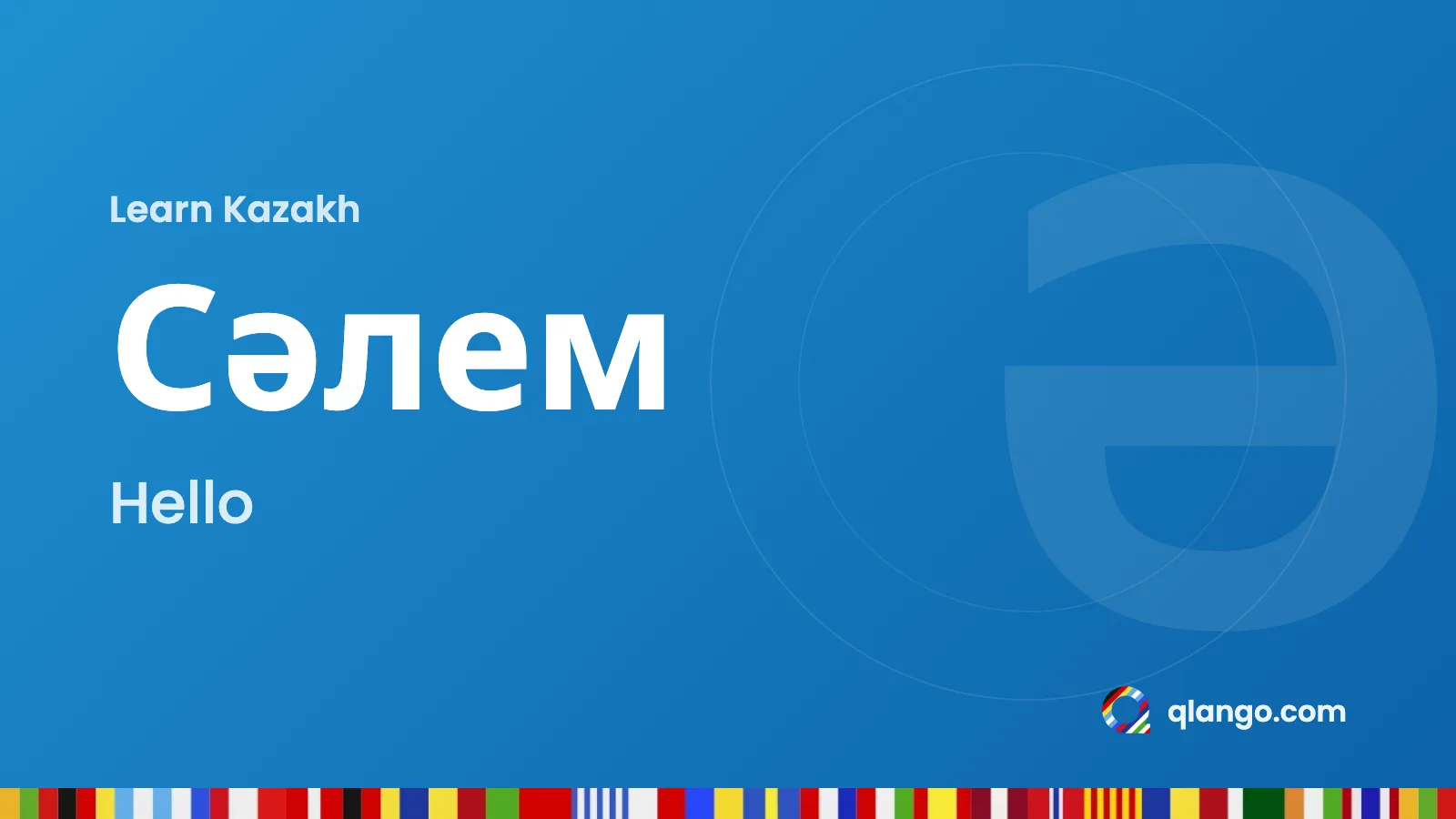
| Сәлеметсіз бе | sälemetsiz be | hello (polite) |
| Сәлем | sälem | hi |
| Рақмет | raqmet | thank you |
| Иә | iä | yes |
| Жоқ | joq | no |
| Сау болыңыз | sau bolyñyz | goodbye (polite) |
| Менің атым ... | meniñ atym ... | my name is ... |
Numbers one to ten: бір, екі, үш, төрт, бес, алты, жеті, сегіз, тоғыз, он.
A plan for the first four weeks
Twenty to thirty minutes a day is enough. If you want a fuller weekly routine you can adapt to any language, see our guide to learning a language on your own.
| Week | Focus | By the end of the week |
|---|---|---|
| 1 | Cyrillic, including the nine Kazakh letters; greetings | You can read any word slowly and greet someone politely |
| 2 | Pronouns, numbers, the endings that mean "I am", "you are" | You can say who you are and what you do |
| 3 | Location endings: in, to, from | You can say where you are, where you're going and where you've come from |
| 4 | Present tense and verb-final sentences | You can write five simple sentences about your day |
One habit saves weeks: write Cyrillic by hand from the first day. Typing lets you lean on autocorrect. A pen doesn't.
Learning Kazakh with Qlango
If you'd rather learn Kazakh online than from a textbook, Qlango covers A1 and A2. Treat that as what it is, a beginner foundation: you'll be able to introduce yourself, ask and answer simple everyday questions and read short, simple texts, but you won't be debating politics. Explanations come in the language you choose to learn through, English for most readers of this page. Lessons are short and new words return on a spaced-repetition schedule. Writing answers yourself drills the suffixes, and building sentences gets the verb to the end where it belongs. With Premium, the AI teacher will explain why it's үйге but қалаға, and the next ten questions after that. The list of all languages and levels shows the rest of the catalog.
Learn the nine extra letters this week, then do your first A1 Kazakh lesson. Сау болыңыз, and good luck with қ.