
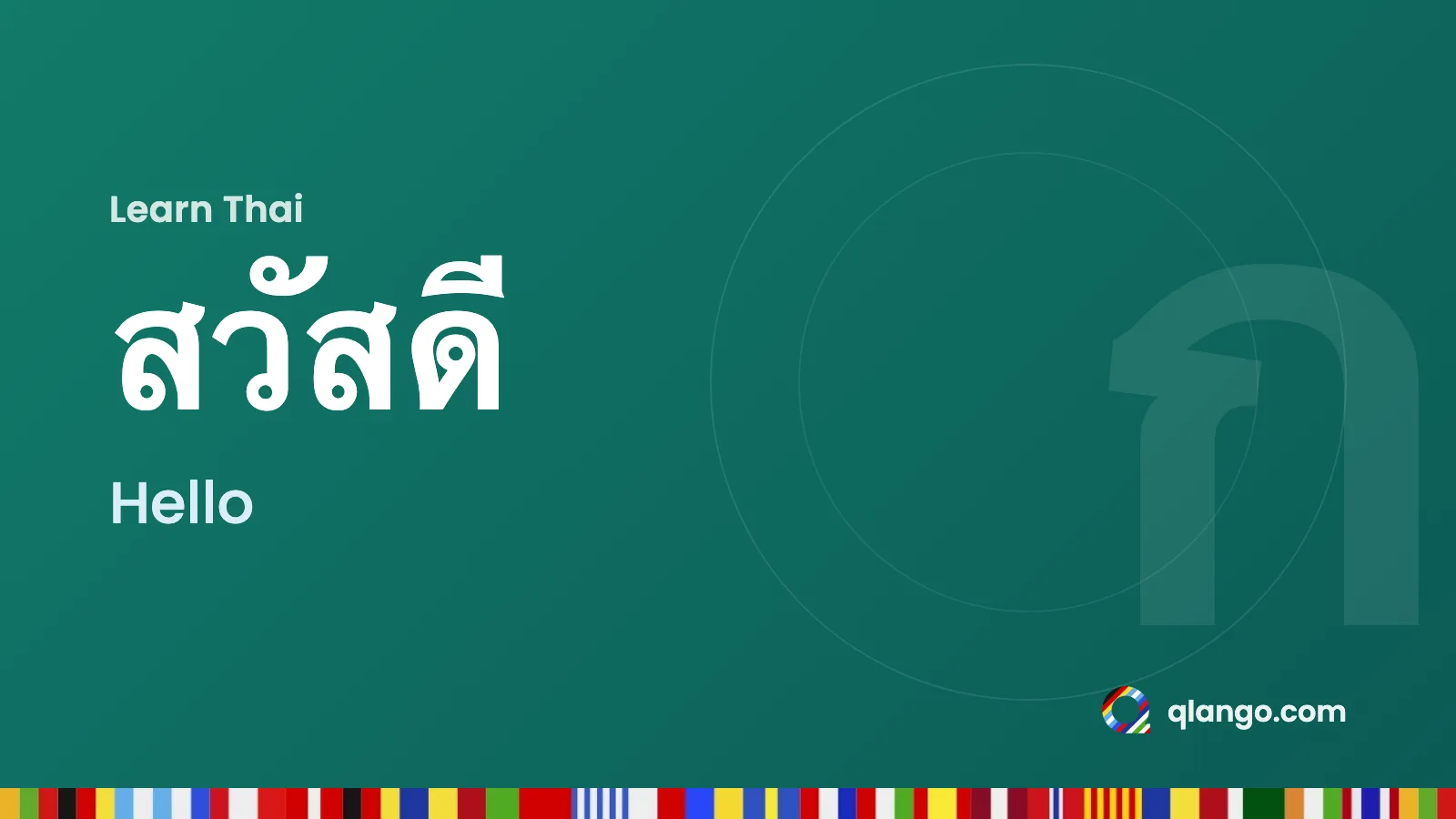
The th in Thai is a t, and the ph in Phuket is a p. In romanized Thai, the Latin-letter spelling you see on maps and menus, ph and th stand for p and t sounds released with a small puff of air, not for the sounds English gives them. Most visitors work this out for Thailand and never for Phuket.
If you want to learn Thai, that's the most useful thing to know before you begin. Romanization is a crutch that wobbles. No single system is used by everyone, the official one leaves out tones and vowel length, and the same word turns up spelled three different ways on three different signs. So learn the Thai script in your first month. It looks like a wall of loops at first, and it's the fastest route to pronouncing Thai correctly. Then put tones and polite particles to work in short everyday sentences; the grammar itself is light.
Where Thai is spoken
Standard Thai, based on the speech of Bangkok and the central plains, is the official language of Thailand, a country of around 70 million people. Many Thais also grow up with a regional language: Isan in the northeast, which is very close to Lao, Northern Thai around Chiang Mai, or Southern Thai. The standard is the one to learn.
Thai belongs to the Tai branch of the Kra-Dai family, with Lao and Shan as close relatives. Like Vietnamese, it's tonal with very light grammar, though the two languages aren't related.
The Thai script in brief
Thai is written in its own alphabet, descended from an old Khmer script. Strictly speaking it's an abugida: consonants form the backbone, and vowels attach to them.
- 44 consonant letters, two of them no longer used. Several letters share a sound, partly because of the script's Sanskrit and Pali heritage and partly because the letter helps decide the tone.
- Three consonant classes: high, middle and low. A consonant's class, the length of the vowel and any tone mark together decide a syllable's tone.
- Vowel signs that sit before, after, above or below the consonant, or around it. In เขา, "he" or "she", the vowel is written partly before the ข and partly after it, and pronounced after it.
- Four tone marks, written above the consonant.
- No spaces between words. Spaces mark the ends of phrases and sentences.
In practice, a few weeks of daily work gets you reading slowly, and slow reading is all you need to start pronouncing words properly.
How to learn Thai tones and vowel length
Thai has five tones: mid, low, falling, high and rising. Vowel length matters too, since a long vowel and a short one can make different words. Here's what an untrained ear hears as "khao":
- ข้าว: rice (long vowel, falling tone)
- ขาว: white (long vowel, rising tone)
- ข่าว: news (long vowel, low tone)
- เขา: he, she (short vowel, rising tone)
- เข่า: knee (short vowel, low tone)
Romanization can't keep those five apart; the script can.
Thai also has three p-type and three t-type sounds where English has two of each. ป is a p with no puff of air, as in "spin"; พ is the p of "pin"; บ is a b. The same goes for ต, ท and ด. That's why romanized Thai needs ph and th, and why Phuket isn't "Foo-ket".
The easy part: grammar
There are no verb endings, no tenses, no plurals, no articles and no gender. Time comes from context or from small words such as แล้ว (laeo, already) and จะ (ja, will). Word order is subject, verb, object, as in English, with adjectives after the noun: ข้าวผัด, khao phat, is fried rice, literally "rice stir-fry". You'll need classifiers when counting, like คน (khon) for people and ตัว (tua) for animals and clothes.
Polite particles and pronouns
Polite Thai sentences end with a particle: ครับ (khrap) if you're a man, ค่ะ (kha) if you're a woman. It depends on the speaker, not the listener, so a man says สวัสดีครับ and a woman says สวัสดีค่ะ to anyone. Pronouns follow the same logic: ผม (phom) is "I" for men, while women use ดิฉัน (dichan) in formal speech and ฉัน (chan) in everyday talk. Often the pronoun is simply dropped.
First Thai words
| Thai | Roughly | Meaning |
|---|---|---|
| สวัสดี | sawatdi | hello, goodbye |
| ขอบคุณ | khop khun | thank you |
| ครับ, ค่ะ | khrap, kha | polite endings (male, female speaker) |
| ใช่ | chai | yes, that's right |
| ไม่ | mai | not, no |
| ไม่เป็นไร | mai pen rai | never mind, no problem |
| ขอโทษ | kho thot | sorry, excuse me |
| ไม่เข้าใจ | mai khao jai | I don't understand |
| เท่าไร | thao rai | how much? |
| อร่อย | aroi | delicious |
| น้ำ | nam | water |
You'll hear mai pen rai constantly. It covers forgiveness, reassurance and a general refusal to make a fuss.
Built for the hotel, not the menu
A lot of Thai material is built for holidays. Phrase lists in romanization get you a hotel room and a bowl of noodles, and leave you unable to read a menu or work out why your khao keeps coming out as the wrong word. The script is postponed "for later", and later never arrives. Vowel length is barely taught at all. The first test of any material is simple: does it teach you to read Thai?
Your first month
Give it thirty minutes a day if you can.
- Week 1: the middle-class consonants and the most common vowels. Read simple syllables aloud. Learn สวัสดี and ขอบคุณ with your particle.
- Week 2: high- and low-class consonants, and the tone rules for syllables without tone marks. Numbers one to ten.
- Week 3: the four tone marks, the khao set above, and a hundred core words in Thai script.
- Week 4: short sentences, a real menu, street signs, messages.
Thai is a language most people learn largely by themselves; our guide to learning a language on your own covers the routine that keeps it going.
Learning Thai with Qlango
Qlango teaches Thai from A1 to B2, from your first สวัสดี to the level where you can follow the main points of conversations and articles on familiar topics and discuss them with some ease. Lessons use Thai script, so reading practice is built into every one. Spaced repetition brings words back just before they'd slip, which suits a language where five different khao words have to stay apart. With Premium, an AI teacher explains grammar, vocabulary and example sentences, such as when to add แล้ว, as often as you ask, and lessons work offline. See every language and level Qlango teaches.
Quick answers
Is Thai harder than Vietnamese? Not by much. For English speakers, the FSI puts both in Category III, at about 44 weeks of full-time study. Thai's script takes longer to learn; Vietnamese uses a Latin alphabet but has six tones in the north to Thai's five.
What does it cost? The Qlango course is free to start, and Premium adds offline learning and an unlimited AI teacher, monthly, yearly or as a one-time Forever plan. The FAQ explains how adding a course works, including choosing the language you learn through.
Do I need the script if I only want to speak? Yes, if you want your tones right. Tones and vowel length are written in the script and nowhere else.
Thai children begin with ก, gor gai, the chicken. It's a middle-class consonant, so it belongs to week one of the plan above as well. Open Qlango's A1 course today and watch the wall of loops start turning into letters.


