Brazilian vs European Portuguese is a choice between two standards of one language, and speakers of each understand the other. The differences that matter to learners are pronunciation, the everyday word for "you", a set of common words and a few grammar habits. Choose by where you'll use it: European Portuguese for life in Portugal, Brazilian Portuguese for Brazil and for most of the music, series and online content you'll come across.
Qlango teaches both, Portuguese (Brazilian) and Portuguese (European), each from A1 to B2, so you can start with the one that fits your plans.
Are Brazilian and European Portuguese the same language?
Yes. They share the grammar, most of the vocabulary and, since the 1990 Orthographic Agreement, most of the spelling. The gap is a bit like British and American English with a stronger accent difference: obvious from the first sentence, rarely a barrier once your ear adjusts.
Size is the other big difference. Brazil had about 203 million people at its 2022 census (IBGE), while Portugal had about 11.4 million at the end of 2025 (INE). That imbalance shapes what you'll find: look for Portuguese podcasts, series or music and you'll run into Brazilian Portuguese far more often.
How is the pronunciation different?
Pronunciation is the biggest difference. European Portuguese reduces or drops unstressed vowels, so words sound shorter and full of consonants, while Brazilian Portuguese keeps its vowels fuller and more open. For most learners Brazilian is easier to understand at first, and European takes more listening practice.
| Feature | Brazil | Portugal |
|---|---|---|
| Unstressed vowels | Clear: telefone has four audible syllables | Reduced: telefone can sound like "tlfon" |
| s at the end of a syllable | Like s in most regions | Like sh: festas sounds like "feshtash" |
| t and d before an i sound | Often like English ch and j: tia, dia | Plain t and d |
| l at the end of a syllable | Like w: Brasil sounds like "Brasiu" | A dark l, as in English "full" |
Rio de Janeiro also uses the sh sound, so you'll hear it in Brazil too. Some spellings still differ because the pronunciation does: económico in Portugal, econômico in Brazil. In Portugal facto is a fact and fato is a suit; in Brazil fato is a fact.
Do they use different words?
Yes, for a set of everyday words, many of them about transport, food, phones and the home. You'll understand both sets quickly, but it's best to use the one that matches the country you're in.
| English | Brazil | Portugal |
|---|---|---|
| bus | ônibus | autocarro |
| train | trem | comboio |
| breakfast | café da manhã | pequeno-almoço |
| cell phone | celular | telemóvel |
| fridge | geladeira | frigorífico |
| bathroom | banheiro | casa de banho |
| juice | suco | sumo |
| ice cream | sorvete | gelado |
| cup | xícara | chávena |
| team | time | equipa |
| screen | tela | ecrã |
| girl | menina, moça | rapariga |
One warning: rapariga is a neutral word for "girl" in Portugal, but in parts of Brazil it's an insult. Say menina or moça there.
How do grammar and "você" differ?
The grammar is one system with different habits. The three you'll notice first are how people say "you", how they say "I'm doing something", and where they put pronouns such as me and te.
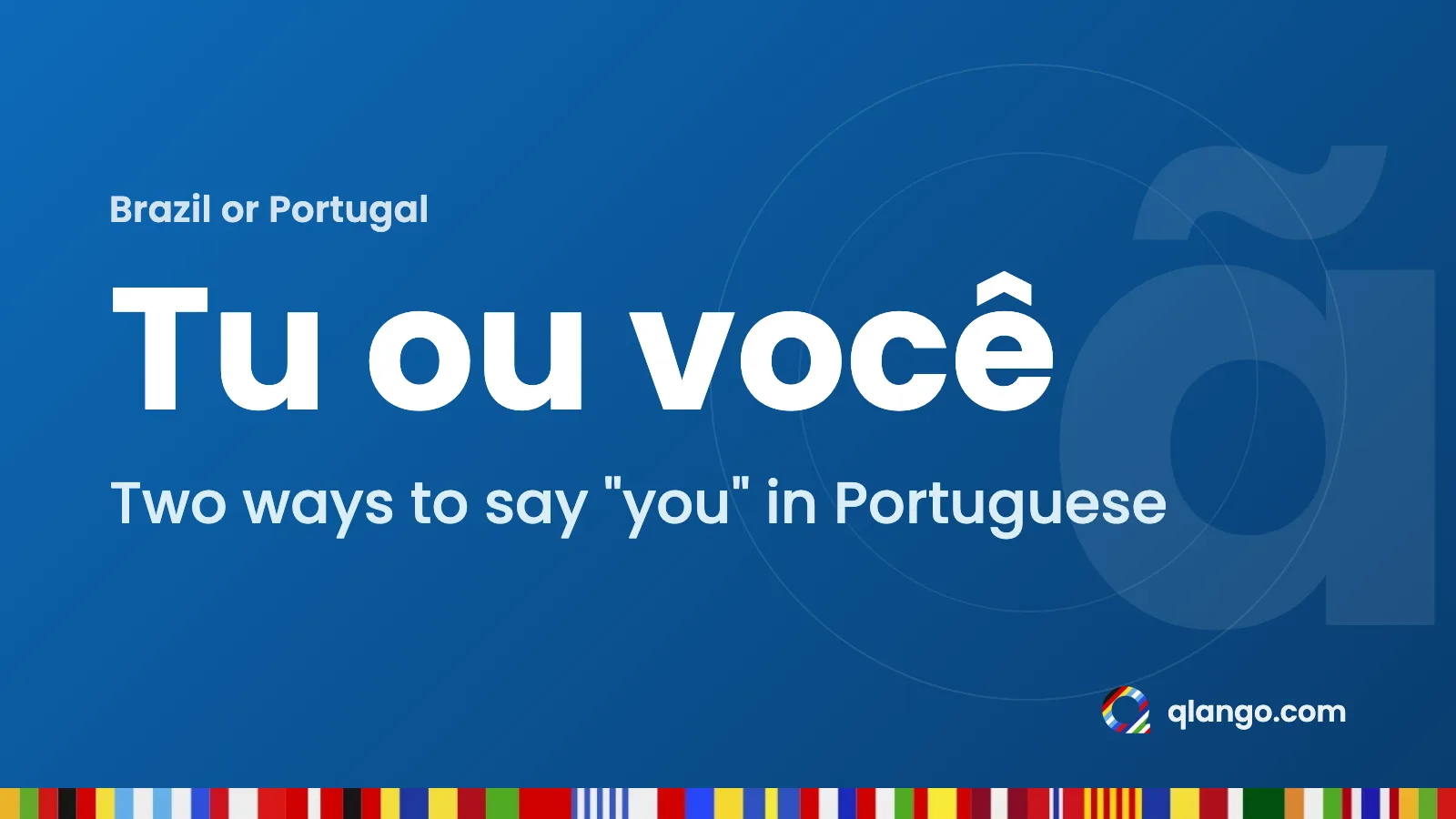
- You. In Brazil, você is the everyday "you", with a third-person verb: você fala. In Portugal, friends and family use tu with its own verb form: tu falas. There, você can sound distant or even rude, so people often use the person's name or o senhor and a senhora instead. Tu is also common in some regions of Brazil, often with the você verb form.
- Ongoing actions. Brazil uses the gerund: estou falando. Portugal prefers a plus the infinitive: estou a falar. Both mean "I'm speaking".
- Pronoun placement. Brazilians usually put the pronoun before the verb: me chamo Ana, eu te amo. In Portugal it normally goes after, with a hyphen: chamo-me Ana, amo-te.
Is Brazilian or European Portuguese closer to Spanish?
For listening, Brazilian Portuguese is closer to Spanish, because its vowels are clearer and easier to catch. For grammar, European Portuguese has one familiar habit: tu with its own verb form, so tu falas lines up with Spanish tú hablas. On balance, Spanish speakers tend to find Brazilian easier at the start.
Our guide to learning Portuguese as a Spanish speaker covers the false friends and sound patterns that matter for either variety.
Do you need Portuguese for Portuguese citizenship?
Yes. Portugal's revised nationality law, Organic Law 1/2026, in force since May 19, 2026, requires applicants for naturalization to prove, by test or certificate, sufficient knowledge of the Portuguese language and culture, history and national symbols. It also raised the residence requirement to seven years for citizens of Portuguese-speaking countries and the EU, and ten years for everyone else.
For the language part, Portugal's migration agency states that a certificate at A2 or higher proves knowledge of Portuguese for a nationality application (AIMA). Common routes are the CIPLE, the A2 exam of CAPLE at the University of Lisbon, and state-recognized Português Língua de Acolhimento courses. The same law presumes that nationals of Portuguese-speaking countries meet the language part of the requirement, unless an applicant's lack of Portuguese is plain to see (article 6, paragraph 10 of the amended law). This is the situation as of October 2026, and procedures change, so check with the registry office (IRN) before you apply. A2 is an elementary level; our guide to CEFR levels shows what it involves.
Brazilian vs European Portuguese: which should you learn?
Learn the variety spoken where you'll live, work or have family. If no particular place pulls you, Brazilian gives you the most listening material, and preferring the sound of one over the other is a perfectly good reason too.
| Your situation | Choose |
|---|---|
| Moving to Portugal or applying for Portuguese citizenship | European |
| Studying or working in Portugal | European |
| Travel, work or family in Brazil | Brazilian |
| Mainly music, series and social media | Brazilian |
| No particular place, just curious | Whichever sound you like |
Switching later isn't starting over. Once you know one variety well, the other is a matter of ear training and a list of word swaps.
Does Qlango teach Brazilian or European Portuguese?
Both. Qlango has Portuguese (Brazilian) and Portuguese (European), each from A1 to B2, and you choose the language you learn through: English, Spanish or another language you know. Short lessons and spaced repetition build your vocabulary, with words coming back right before you'd forget them. The answer modes (pick one of four, build sentences, write, find pairs) make you produce the forms, not just recognize them.
Games such as Word Duel and MinuteRush keep review light, and books and Decoding Stories give you reading practice. You can also chat with other learners, with message translation and AI help to write a reply. Premium adds offline learning and an AI teacher you can ask unlimited questions, for example why people in Lisbon say estou a falar. Every course is in the table of languages.
Frequently asked questions
Can Brazilians and Portuguese people understand each other?
Yes. It's the same language, and they understand each other, though Brazilians sometimes need a moment to tune in to the reduced vowels of European Portuguese. Learners go through the same adjustment.
Is European Portuguese harder than Brazilian Portuguese?
For listening, usually yes, because of the vowel reduction. Grammar and vocabulary are about equally demanding. Once you're used to the sound, the difficulty evens out.
Should I learn Brazilian or European Portuguese for Portugal?
European. You'll be understood with Brazilian Portuguese, but European Portuguese matches what you hear every day, the forms of address people expect, and the words on signs and menus.
Can I learn both varieties?
Yes, one after the other. Get one variety to a comfortable level first, then add the second. The switch takes weeks of listening, not a fresh start.
Decide where your Portuguese is going to live, then start there. Pick Brazilian or European in Qlango, choose the language you learn through, and do your first A1 lesson today.