Learn Portuguese as a Spanish Speaker: What Changes
How to learn Portuguese as a Spanish speaker: what carries over, the false friends and sounds that trip you up, and how to stop slipping into portuñol.
Author: QlangoPublished: 7 min read
If you speak Spanish, you already understand a surprising amount of written Portuguese, and you can learn Portuguese as a Spanish speaker much faster than someone starting from English. The hard parts are the sounds, a handful of treacherous false friends and some grammar Spanish doesn't have. The best method is to learn Portuguese through Spanish and spend your time on what's different, not on relearning what you already know.
It's written for anyone with strong Spanish: heritage speakers who grew up with it at home, and people who learned it at school or at work. Below is what transfers, what doesn't, and how to keep the two languages apart.
Is Portuguese easy for Spanish speakers?
Reading Portuguese is easy for Spanish speakers almost from the first day; speaking it well takes longer. The grammar skeleton is the same, most vocabulary is related, and the spelling follows patterns you can learn in an afternoon. Pronunciation and listening are slower, because Portuguese sounds much less like it looks than Spanish does.
That gap explains a familiar experience: a Spanish speaker reads a Brazilian news site with little trouble, then can't follow two people chatting in a café. Universities have noticed. The University of Texas at Austin, for example, runs a separate Portuguese for Spanish Speakers track, a sign that these students need a different course from everyone else.
What carries over from Spanish?
Almost all of the grammar carries over, and so does most of the vocabulary once you know the sound patterns that link the two languages. Gender, articles, ser and estar, the preterite and the imperfect, the subjunctive: all of it works roughly the way you expect. Many words change in regular, predictable ways.
Spanish
Portuguese
Pattern
llamar, lleno, llave
chamar, cheio, chave
ll- becomes ch-
puerta, tiempo, nuevo
porta, tempo, novo
no ue or ie diphthong
hijo, hacer, hablar
filho, fazer, falar
h- becomes f-
luna, salir, tener
lua, sair, ter
l or n between vowels drops out
mujer, trabajo, ojo
mulher, trabalho, olho
j often becomes lh
nación, ciudad
nação, cidade
-ción becomes -ção, -dad becomes -dade
España, señor
Espanha, senhor
ñ is written nh
Learn these and you can predict a good share of everyday words. Not all of them, though, and the exceptions bite.
Which false friends trip Spanish speakers up?
The dangerous ones look identical, or nearly, and mean something else entirely: exquisito, embarazada, polvo, oficina and largo are the classics. Most are harmless on a flashcard and embarrassing in conversation, so learn the common ones early, before they slip out in front of someone.
Word
In Spanish
In Portuguese
exquisito / esquisito
delicious, exquisite
strange, odd
embarazada / embaraçada
pregnant
embarrassed
polvo
dust
octopus
oficina
office
workshop, repair shop
largo
long
wide
cena
dinner
scene
todavía / todavia
still, yet
however
acordar
to agree
to wake up
rato
a while
mouse, rat
presunto
alleged
ham
Pregnant in Portuguese is grávida. And a guest who praises the food as "exquisita" has, to Brazilian ears, just called it weird.
What makes Portuguese pronunciation hard for Spanish speakers?
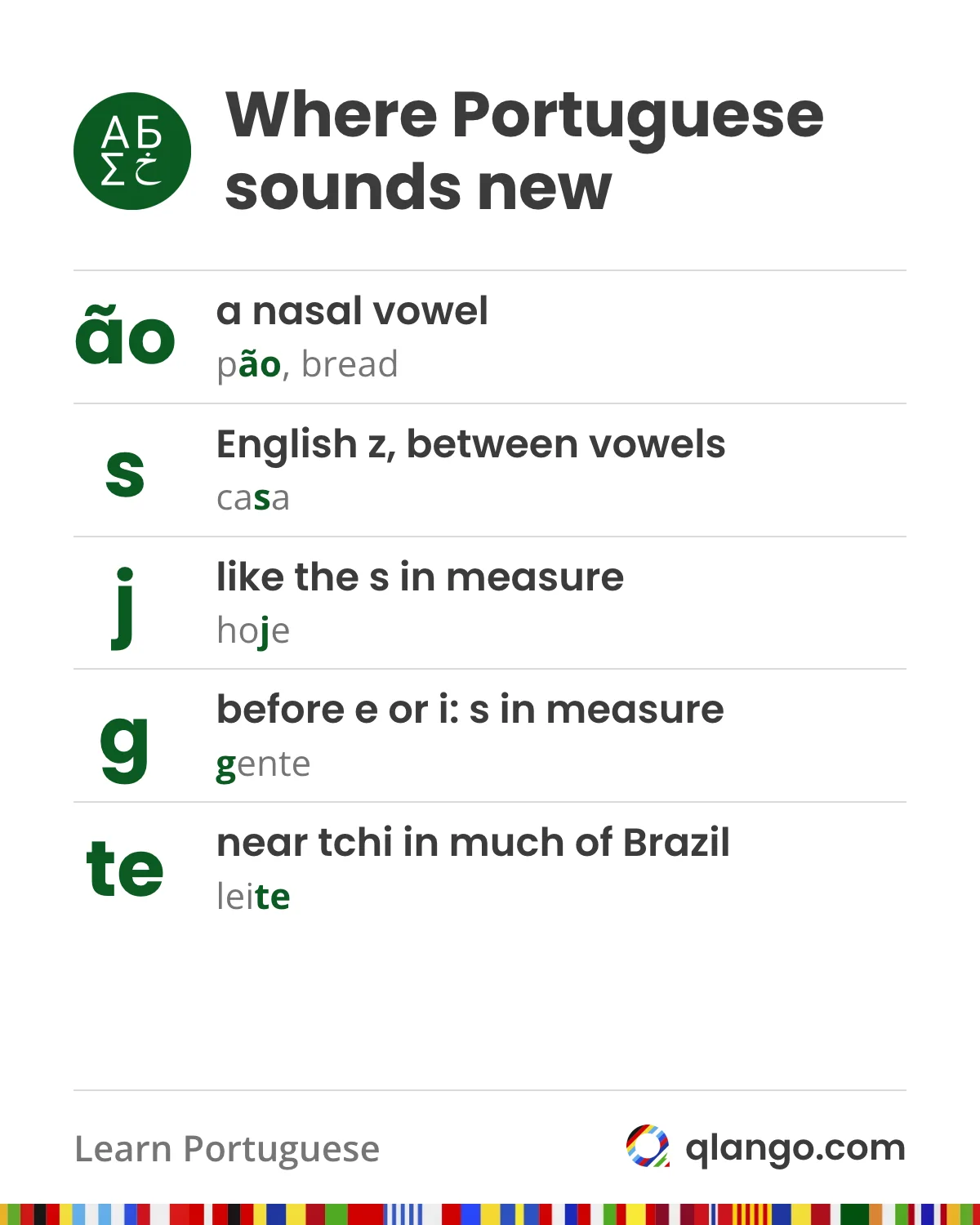
Portuguese has more vowels than Spanish and nasalizes many of them, which is the biggest adjustment: on top of the five clean vowels you know, it adds open and closed versions of e and o, plus nasal vowels like those in pão (bread), mãe (mother), bom (good) and sim (yes).
The open and closed vowels change meaning: avó is grandmother, avô is grandfather. Unstressed vowels shift too. In much of Brazil a final -e sounds like i and a final -o like u, and t before that i turns into a "ch" sound, so leite comes out close to "leitchi". In Portugal, unstressed vowels shrink so much that whole syllables seem to disappear. That's the main reason Brazilian Portuguese is usually easier on Spanish ears at first. Our comparison of Brazilian vs European Portuguese goes through the differences in detail.
Two more sounds need attention. A single s between vowels is pronounced like an English z, as in casa, and j and g before e or i sound like the s in "measure": hoje, gente. Most varieties of Spanish don't have either sound.
Which Portuguese grammar is new for Spanish speakers?
A few structures have no everyday Spanish equivalent, and they're worth learning on purpose instead of waiting to absorb them. The main ones are the personal infinitive, the future subjunctive and the contractions of prepositions with articles.
Personal infinitive. Portuguese can conjugate an infinitive: é melhor vocês saírem cedo, "it's better for you all to leave early". Spanish needs que plus the subjunctive.
Future subjunctive. Quando eu tiver tempo, eu ligo, "when I have time, I'll call", where Spanish says cuando tenga. It's also behind se você quiser, "if you want".
Contractions. Spanish has only al and del. Portuguese merges all the time: do, da, no, na, pelo, num.
Ter and ficar. Ter does the work of tener and often of haber. Ficar covers location and change: onde fica o banco? ele ficou triste.
The compound past. Tenho comido doesn't mean he comido; it means "I've been eating (lately)". For "I've eaten", Portuguese uses the simple past: já comi.
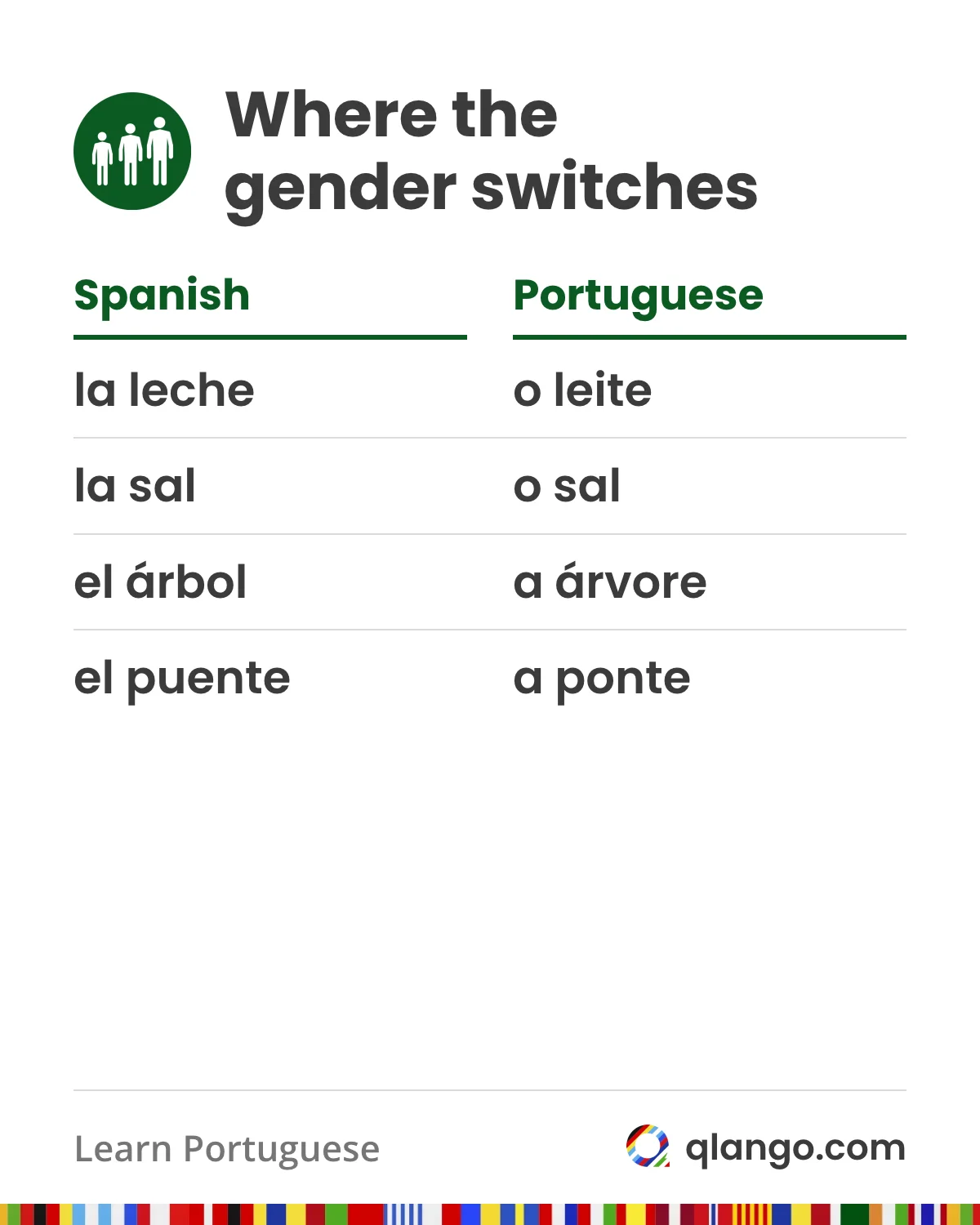
Gender switches. O leite, o sal, a árvore, a ponte: the opposite of Spanish la leche, la sal, el árbol, el puente.
How do you stop mixing Spanish and Portuguese?
You stop slipping into portuñol by learning the differences deliberately and listening to a lot of real Portuguese, not by trying to forget your Spanish. Mixing happens because your Spanish is fast and automatic, so it fills every gap. The fix is to make the Portuguese version just as automatic.
Keep a collision list. Every time Spanish sneaks in, write down both versions: pero and mas, también and também, muy and muito, y and e, hay and há or tem.
Listen before you speak much. A few weeks of daily listening tunes your ear to Portuguese vowels before habits harden.
Learn whole phrases. Tudo bem, pode ser, com licença, não tem problema: chunks like these come out in one language.
Distrust identical words in speech. If a word is spelled the same in both languages, check how it's said. It's rarely said the Spanish way.
Use your Spanish on purpose. Learning through Spanish turns your first language into a tool for explaining the new one instead of a source of interference.
How long does it take to learn Portuguese as a Spanish speaker?
Much less time than starting from scratch, though the speed differs by skill. Reading comes almost at once, everyday conversation within months of regular study, and Portuguese without Spanish creeping in takes longest of all.
The typical pattern is a quick climb through A1 and A2, because so much is familiar, then a slower stretch around B1 where the differences start to matter more than the similarities. That slowdown is normal, and the learners who keep going are the ones who expected it. For the wider picture, see how long it takes to learn a language.
Can you learn Portuguese through Spanish in Qlango?
Yes. In Qlango you choose the language you learn through, so you can take Portuguese from Spanish instead of from English. Translations then come in Spanish, so you link chave to llave rather than to "key", and the patterns above show up in every lesson.
Both varieties are available, Portuguese (Brazilian) and Portuguese (European), each from A1 to B2. Lessons are short, and spaced repetition brings words back right before you'd forget them, which is exactly what false friends need. The answer modes (pick one of four, build sentences, write, find pairs) make you produce Portuguese, not just recognize it. Games such as Word Duel and MinuteRush, books and Decoding Stories, and chat with other learners round it out.
Premium adds offline learning and an AI teacher you can ask unlimited questions, for example when to use the personal infinitive. Prices are on the Premium page, and every course is listed in the table of languages.
Frequently asked questions
Can Spanish speakers understand Portuguese?
Written Portuguese, mostly yes. Spoken Portuguese is harder, especially from Portugal, because vowels are reduced and nasalized. Understanding improves quickly with a few weeks of regular listening.
Is Brazilian or European Portuguese easier for Spanish speakers?
Brazilian Portuguese is usually easier at first, because its vowels are fuller and clearer. European Portuguese shares some habits with Spanish, such as tu with its own verb form (tu falas, like tú hablas). Pick the variety you'll actually use.
Should I learn Portuguese through Spanish or through English?
If Spanish is your stronger language, learn through Spanish. You'll connect Portuguese words to the Spanish words they're related to, which is faster and makes every difference stand out.
You already have most of the Portuguese you'll need; much of it is just spelled and pronounced differently. Choose Spanish as your learning language in Qlango, pick Brazil or Portugal, and do your first lesson today.