Yes, you can learn Korean on your own, and the start is easier than its reputation. Spend the first week on Hangul, the alphabet. Then learn how particles and polite verb endings work, and only after that start mining K-dramas and songs for words. This guide shows how to learn Korean by yourself in that order, with an honest timeline and a 12-week plan you can start tonight.
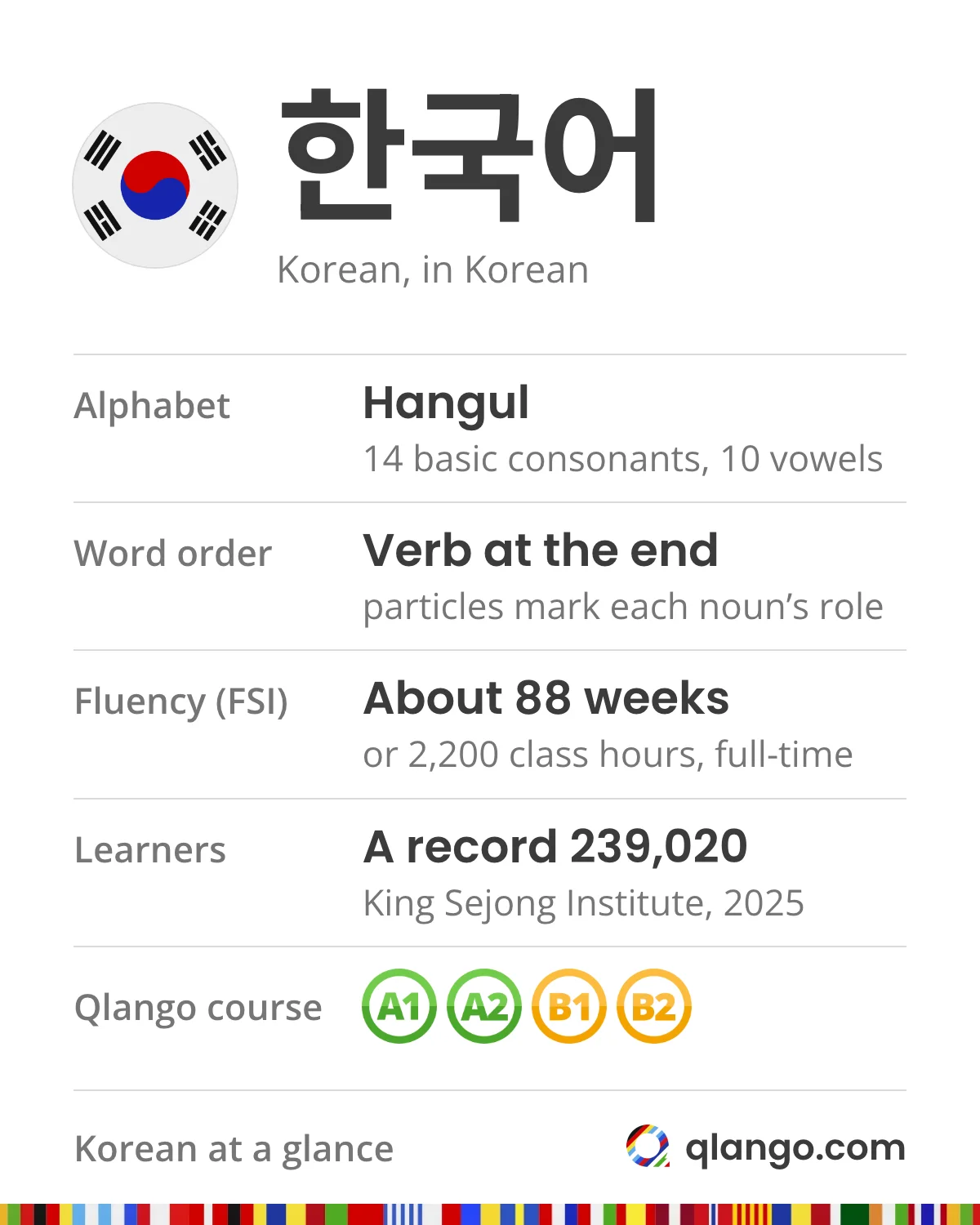
Plenty of people are trying. The King Sejong Institute Foundation, which runs Korea's government-funded language schools abroad, counted a record 239,020 learners in 2025. Korea itself welcomed a record 15.05 million visitors from January to August 2026, 21.6% more than a year earlier (Ministry of Culture, Sports and Tourism).
Can you learn Korean by yourself?
Yes. Korean has an alphabet you can learn in days, fairly regular grammar and an endless supply of listening material in dramas, variety shows and music. Make speaking and writing part of the routine from the start: read every new phrase out loud, and write short messages to other learners.
Avoid two traps: staying on romanization for months, and trying to learn grammar from dramas alone, which leaves you with a head full of phrases you can't adapt. The order below avoids both.
Is Korean hard for English speakers?
It takes time, but the difficulty isn't where beginners expect it. Reading comes quickly. The long road is grammar that runs in a different order from English, vocabulary with few English relatives, and speech levels that change your verbs depending on who you're talking to.
The US Foreign Service Institute puts Korean in its hardest category, estimating about 88 weeks of full-time classes, or 2,200 class hours, for its diplomats to reach professional working proficiency (FSI language categories). That's the price of fluency, not of being useful in Korean.
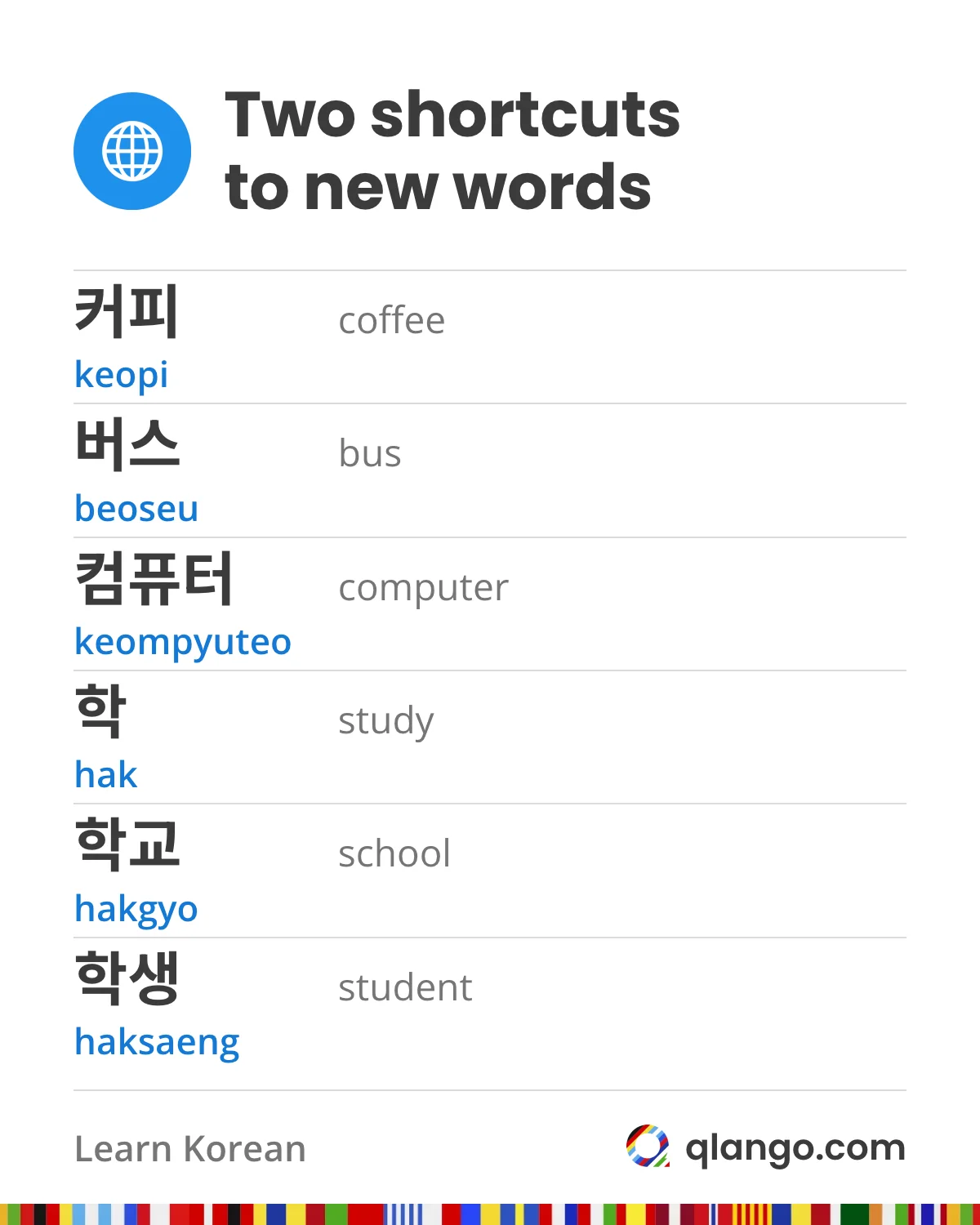
There are shortcuts. English loanwords written in Hangul are everywhere: 커피 (keopi, coffee), 버스 (beoseu, bus), 컴퓨터 (keompyuteo, computer). And a large share of vocabulary is built from roots of Chinese origin, so once you know 학 (hak, study), the words 학교 (hakgyo, school) and 학생 (haksaeng, student) fall into place.
Should you learn Hangul first?
Yes, and don't lean on romanization for long. Hangul has 14 basic consonants and 10 basic vowels, which stack into syllable blocks: ㅎ plus ㅏ plus ㄴ makes 한 (han). Two or three focused evenings get you reading slowly, and a week of daily practice makes it reliable.
Romanization is a crutch that breaks quickly. It spells single vowels such as 어 and 으 with two letters, eo and eu, which nudges English speakers toward the wrong sounds, and it hides how syllables run together in speech. Our Korean alphabet chart has every letter with its romanization, a sound hint and a two-day practice plan.
Which Korean grammar should you learn first?
Three things: word order, particles and polite verb endings. Korean puts the verb at the end, marks the role of each noun with a small particle attached to it, and changes the verb ending to show politeness. With those three, you can build your own sentences instead of memorizing other people's.
저는 커피를 마셔요 (jeoneun keopireul masyeoyo) means "I drink coffee". It's 저 (I) with the topic particle 는, then 커피 (coffee) with the object particle 를, then the verb 마셔요 at the end. The particles do the job English does with word order, which is why Korean can move words around without losing the meaning.
Then come the speech levels. The verb 먹다 (meokda, to eat) changes like this:
| Level | Form | Where you'll use or hear it |
|---|---|---|
| Formal polite | 먹습니다 (meokseumnida) | news, announcements, presentations, job interviews |
| Polite | 먹어요 (meogeoyo) | strangers, shop staff, colleagues: your default |
| Casual (banmal) | 먹어 (meogeo) | close friends, younger siblings, couples in dramas |
Learn the polite -yo form first and use it everywhere. It's never wrong with adults you don't know well, and casual speech can come later.
How do you learn Korean from K-dramas and K-pop?
Use them for listening and vocabulary, not as your textbook. Pick one show, rewatch short scenes with Korean subtitles and collect the lines you hear again and again. Most drama dialogue is casual speech between people who know each other well, so notice who is talking to whom before you borrow a line.
These come up in almost every series:
| Korean | Romanization | Meaning |
|---|---|---|
| 괜찮아요? | gwaenchanayo? | are you OK? / it's fine |
| 진짜? | jinjja? | really? |
| 대박 | daebak | amazing, huge |
| 어떡해 | eotteokae | what do I do? oh no |
| 잠깐만 | jamkkanman | wait a second |
| 보고 싶어 | bogo sipeo | I miss you |
| 밥 먹었어? | bap meogeosseo? | have you eaten? (a friendly hello) |
| 오빠 / 언니 | oppa / eonni | older brother / older sister, as a woman says it |
| 선배 | seonbae | someone senior to you at school or work |
| 화이팅 | hwaiting | you can do it (from English "fighting") |
Songs work the same way. If you're here because you searched "learn Korean with BTS", take one song you already love, find the Korean lyrics and work through a verse at a time: look up each word, say the line slowly, then sing along. Lyrics bend grammar to fit the rhythm, so treat songs as vocabulary and listening practice. Our guide to learning with films and series has more on making screen time count.
Which Korean phrases help on a trip to Seoul?
The seven polite phrases below cover most shops, cafés and taxis in Seoul. Say them with the -yo or -nida endings shown; casual drama Korean sounds odd, even rude, when aimed at a shop assistant you've never met.
| Korean | Romanization | Meaning |
|---|---|---|
| 안녕하세요 | annyeonghaseyo | hello |
| 감사합니다 | gamsahamnida | thank you |
| 이거 주세요 | igeo juseyo | this one, please |
| 얼마예요? | eolmayeyo? | how much is it? |
| 화장실 어디예요? | hwajangsil eodiyeyo? | where is the restroom? |
| 계산해 주세요 | gyesanhae juseyo | the check, please |
| 천천히 말해 주세요 | cheoncheonhi malhae juseyo | please speak slowly |
How long does it take to learn Korean by yourself?
Plan in years for fluency and in months for usefulness. With daily study, A2 is a fair first-year target: simple conversations about yourself, shopping, directions and plans. Korea's official proficiency test, TOPIK, has two parts, TOPIK I for levels 1 and 2 and TOPIK II for levels 3 to 6, and its levels make useful milestones (TOPIK).
Your pace depends on hours, not months, as our piece on how long it takes to learn a language explains, and twenty minutes every day beats two hours on Sunday.
How to learn Korean by yourself: a 12-week plan
Twenty minutes a day for twelve weeks takes you from the alphabet to simple conversations about yourself, a solid base for the rest of A1 and A2. Each block builds on the one before, so keep the order.
- Week 1: Hangul. All 24 basic letters, then the double consonants and compound vowels. Read every sign, menu and title card you can find.
- Weeks 2 and 3: introductions. The polite -yo ending, 저는 ...이에요 (I am ...), 있어요 and 없어요 (there is, there isn't) and numbers.
- Weeks 4 to 6: particles. 은/는, 이/가, 을/를, 에 and 에서, with the present tense of thirty common verbs.
- Weeks 7 to 9: the past and real Korean. The past tense, questions and the travel phrases above. Start one drama with Korean subtitles, ten minutes a day.
- Weeks 10 to 12: longer sentences. Wanting with -고 싶어요, the future with -ㄹ 거예요, and linking ideas with -고 and -지만. Write five sentences a day, and use them in messages to other learners.
How can Qlango help you learn Korean?
Qlango's Korean course runs from A1 to B2, so it can take you from your first 안녕하세요 to the upper-intermediate level where you can talk with native speakers without strain on either side. Lessons are short, spaced repetition brings each word back right before you'd forget it, and flashcards keep vocabulary in rotation. Writing your answers yourself is where particles stop being theory.
You can chat with other learners in the app, with message translation and AI help to write a reply, which is low-pressure writing practice. Streaks and statistics over weeks, months and years show the habit building. When you add the course, you choose the language you learn through. It's free to start, and Premium adds offline learning and an AI teacher you can ask unlimited questions, such as when to use 은 instead of 이. Every course and level is listed on the languages page.
FAQ
Can I learn Korean by myself for free?
You can get a long way for free with Hangul charts, Korean subtitles and music. Qlango is free to start, so you can build the habit first and decide about Premium later.
How long does it take to learn Hangul?
Two or three focused sessions are enough to read slowly and correctly. A week of daily reading makes it reliable, and speed keeps improving for months.
Can I learn Korean just from K-dramas?
Not on their own. Dramas give you listening practice and natural phrases, but without structured lessons you'll collect phrases you can't adapt, along with casual speech you can't use with strangers. Combine the two.
Is Korean harder than Japanese?
The FSI puts both in its hardest group. Korean gets you reading faster thanks to Hangul; after that, the grammar of the two languages is surprisingly similar, so choose the one you'll actually use.
Learn the letters this week. Add Korean in Qlango, choose the language you learn through, and the next time an episode starts, try reading the title before the subtitles do it for you.