Almost every Tatar textbook, course and grammar explanation assumes you already speak Russian. Many people who decide to learn Tatar find this out within an hour of looking, whether they're heritage learners who grew up hearing a grandmother speak it, linguists drawn to Turkic languages, or people who married into a family from Kazan.
If you don't read Russian, here is how to learn Tatar anyway. Spend your first week on the Cyrillic alphabet and its six extra letters. Use a course that explains the language in English. Then build up in short daily sessions: greetings, numbers, the case endings that say where things are, and sentences with the verb at the end. Tatar is a Turkic language with very regular grammar, so steady effort pays off more than talent does.
Which Tatar is this?
Tatar, sometimes called Kazan Tatar or Volga Tatar, is the language of Tatarstan, a republic of the Russian Federation on the Volga, where it's an official language alongside Russian. Tatars are Russia's second-largest ethnic group, so you'll also find speakers in neighboring Bashkortostan, in Moscow, the Urals and Siberia, in Central Asia and in small communities abroad. The number of speakers is in the low millions, and many of them use Russian at least as much as Tatar in daily life.
Crimean Tatar is a different language. It's also Turkic, and related, but it comes from Crimea, has its own literary tradition and is usually written in Latin letters. If that's the one you're after, this guide and Qlango's Tatar course are about the other one.
Family, script and a trick for Turkish speakers
Tatar belongs to the Kipchak branch of the Turkic family. Its closest relative is Bashkir, and it's a cousin of Kazakh. Speakers of Turkish recognize a lot of Tatar, with a twist: at some point in its history Tatar shifted several vowels. Turkish et (meat) is ит in Tatar, göl (lake) is күл, and gel (come) is кил. Once you see the pattern, a lot of words fall into place.
Tatar was written in an Arabic-based script for centuries, briefly in Latin letters from the late 1920s, and in Cyrillic since 1939. Today's alphabet is the Russian one plus six letters: ә (like the "a" in "cat"), ө and ү (like German ö and ü), җ (a soft "j"), ң (the "ng" in "sing") and һ ("h"). If you already read Russian, that's two or three days of work. If you don't, give it a week.
What will feel easy, and what won't
There's no grammatical gender, so ул means "he", "she" and "it". There are no articles. Verbs follow regular patterns, and the suffixes behave predictably. Here are three of Tatar's six cases on one word:
- Казанда: in Kazan
- Казанга: to Kazan
- Казаннан: from Kazan
What takes longer is vowel harmony, which changes a suffix's vowel to match the word it's attached to; the verb-at-the-end word order; and long words built from several suffixes, which you have to take apart before you can understand them. If you know Russian, the many Russian loanwords help. If you don't, they're simply more words to learn.
The other difficulty isn't grammar at all. In Kazan you'll hear plenty of Russian, and many Tatars move between the two languages mid-sentence. You may have to go looking for Tatar conversation rather than wait for it to find you.
Why Tatar courses in English are scarce
Most Tatar teaching material is produced in Tatarstan for Russian speakers, and a good share of the people looking for Tatar lessons online are searching in Russian, often asking specifically for explanations in Russian. English-language material comes down to some university courses and older grammars. The people who want to learn Tatar from English, meanwhile, are a scattered group, and nobody builds a big publishing program for a scattered group. Search for a way to learn Tatar online in English and you'll find alphabet charts, a few PDFs and not much else.
If you grew up hearing Tatar
Heritage learners usually understand more than they think, especially the words for food, family and scolding. Don't skip the beginner material because it feels too easy. Your gaps are usually in reading, in the endings you've heard but never had to produce, and in speaking at all, and a structured course fills those faster than another year of nodding along at family dinners.
A first month that works
Twenty minutes a day, split the same way each time: five minutes of review, ten of new material, and five of writing sentences or saying them out loud.
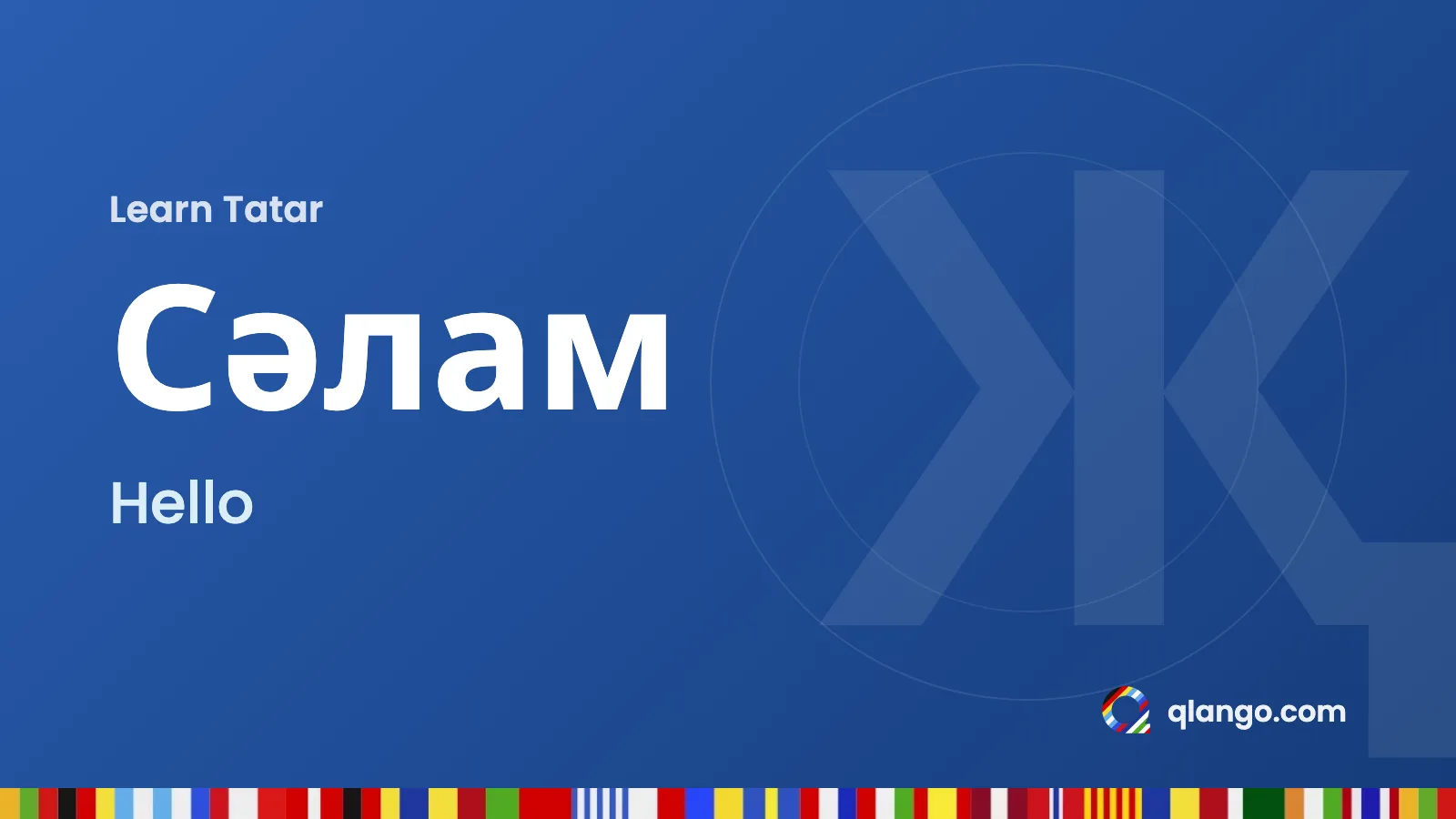
- Week 1. The alphabet and greetings: Исәнмесез (hello, polite), Сәлам (hi), Рәхмәт (thank you), Әйе (yes), Юк (no), Сау булыгыз (goodbye, polite).
- Week 2. Pronouns, мин, син, ул, без, сез, алар (I, you, he or she, we, you plural or polite, they), and numbers one to ten: бер, ике, өч, дүрт, биш, алты, җиде, сигез, тугыз, ун.
- Week 3. Location endings, with places you care about: in, to, from.
- Week 4. Present-tense verbs and short sentences with the verb at the end. Write five a day.
Review is what makes this stick. Words you've met once fade within days unless they come back at the right moment, which is the idea behind most of the techniques in our comparison of vocabulary learning methods.
How Qlango helps you learn Tatar
The main obstacle for an English speaker is that most explanations of Tatar grammar assume Russian. In Qlango you choose the language you learn through, so the course explains Tatar in English. It covers A1 and A2, which is a beginner foundation: greetings, introductions, everyday vocabulary, simple sentences and short texts, not fluency. Lessons are short, spaced repetition brings words back before you lose them, and writing answers yourself makes you produce the suffixes rather than just recognize them. With Premium, you can ask the AI teacher to explain any grammar point in plain English, which is precisely what most Tatar textbooks can't do for you. The table of languages and levels shows what's available, and the FAQ explains how adding a course works.
Add Tatar with English as the language you learn through, and do the first A1 lesson today. By next week, Исәнмесез should be easier to say than it looks.