Ask a chatbot why German says ich habe gegessen but ich bin gegangen and you'll get a clear, patient answer in about four seconds, at midnight, with five extra examples you didn't ask for. No textbook ever did that. You can learn a language with AI faster than with most of the tools that came before it. You can also spend six months feeling very productive while learning remarkably little. The difference comes down to who does the work.
The short version: use AI as a tutor that explains and quizzes you, not as a ghostwriter, and check anything important against a second source. I've watched every language-learning fad of the last twenty years arrive with great fanfare, and this one is more useful than most. It's also easier to misuse.
What AI is genuinely good at
Explanations on demand, at your level
A grammar book explains the subjunctive once, in whatever way its author found clearest. A chatbot will explain it ten different ways until one sticks: with a table, with a story, "as if I'm A2", or by comparison with French if you already speak French. And you can ask the follow-up a tired teacher might sigh at: "But then why is it por here and not para?"
Example sentences, as many as you want
This is the most underrated use. Ask for ten sentences with the Italian verb fare and you'll see why it's so hard to translate: fare la spesa (do the grocery shopping), fare colazione (have breakfast), fa freddo (it's cold). Ask for sentences ordered from easy to hard, or using only words you already know, or in the voice of a grumpy taxi driver. Words stick in context, and AI produces context on tap.
A patient practice partner
Role-play is where AI shines for nervous learners. Order at a pharmacy in Lisbon, complain to a noisy neighbor, haggle over a used bike. The chatbot doesn't get bored or judge you, and it will run the same scene fifteen times. Tell it to stay at your level and to use the vocabulary you studied this week.
Quick feedback on writing
Paste a paragraph and you get corrections with reasons in seconds. Used well, that's a writing teacher who never runs out of red ink. Used badly, it's the trap described further down.
What AI is bad at
Being right when it sounds right
A language model sounds exactly as confident when it's correct as when it's inventing a rule to explain an exception. Errors are rarer in big languages like Spanish or German, where there's a mountain of text to learn from, and more frequent in smaller ones like Latvian or Shona. Typical slips: mixing European and Brazilian Portuguese in one paragraph, using vosotros while pretending to be from Mexico City, or offering a word that's in the dictionary but hasn't been said aloud in decades.
Knowing what people actually say
AI leans toward tidy, polite written language. Real speech is messier and full of fillers and half-sentences. A chatbot will happily teach you a perfectly correct sentence that no Parisian under seventy would ever say out loud.
Hearing you
A text chatbot can't hear your pronunciation at all, and voice modes are generous, inconsistent judges of the sounds you get wrong. For pronunciation, recordings of native speakers and your own recorded voice are still the reference.
Remembering for you
The brilliant explanation you got on Tuesday is gone by Friday unless you review it. A chatbot doesn't schedule reviews, doesn't know which words you're about to forget, and won't nudge you on Thursday. Memory is still your job, or your course's.
The trap: feeling fluent while the machine does the talking
Reading a perfectly corrected version of your paragraph feels like learning. Mostly it isn't. You recognize the fixes, nod, and make the same mistakes next week, because recognizing is easy and producing is hard. The same goes for asking AI to write your messages. Plenty of chat tools make it tempting to tap and send, ours included: Qlango's chat with other learners has AI help to write a reply. Use that help to check what you wrote, not to write it for you.
A simple test after any AI session: close the window and produce three things you learned, from memory. If you can't, you were watching, not learning.
How to learn a language with AI without fooling yourself
- Try first, ask second. Write the sentence, attempt the translation, guess the rule. Then ask.
- Ask for hints, not fixes. "Don't rewrite my text. Mark the three most serious mistakes and give me a hint for each, not the answer."
- Make it quiz you. "Give me ten English sentences to translate into Italian using the passato prossimo with essere. One at a time. Wait for my answer before the next one."
- Pin down the variety. "Mexican Spanish only." "European Portuguese, informal." Otherwise you'll get a blend nobody actually speaks.
- Be suspicious of "always" and "never". When an explanation rests on a sweeping rule, or something just seems odd, check it in a grammar reference or with a native speaker.
- Move the good stuff into your reviews. Copy useful sentences into flashcards or a spaced repetition system, or they'll evaporate. Our overview of vocabulary learning methods compares the options.
- Talk to humans, too. AI is rehearsal for conversation, not a replacement for it.
Where Qlango's AI teacher fits
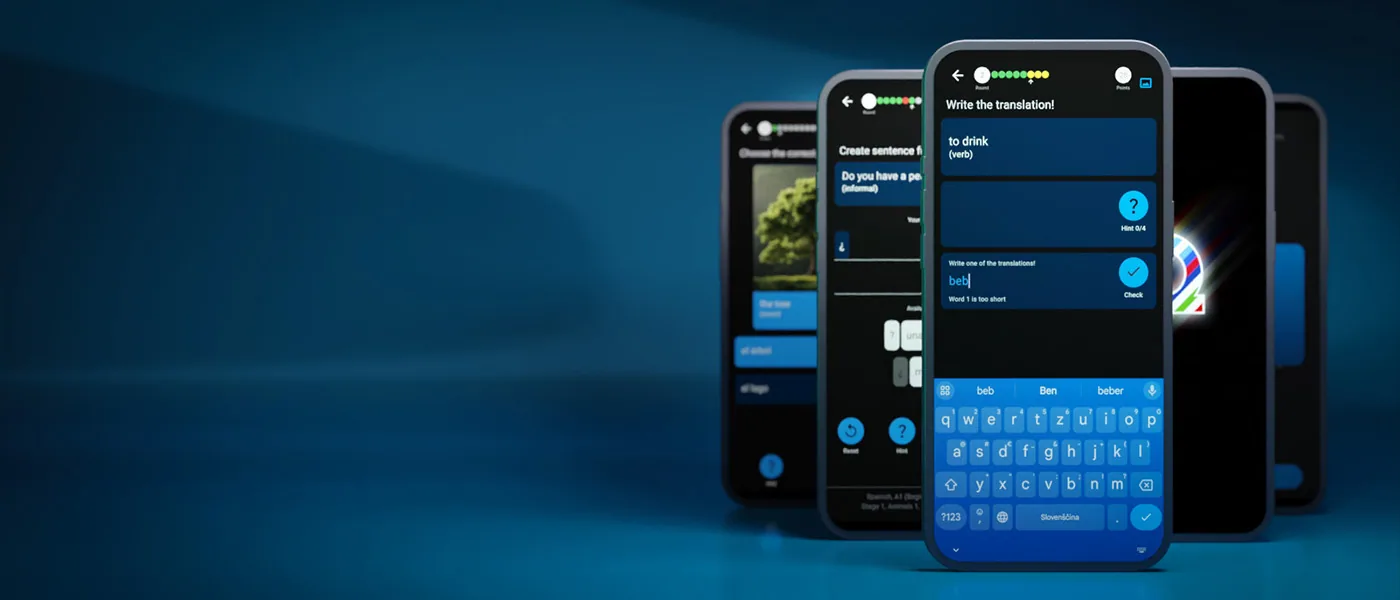
Qlango's AI teacher is there for the "why" questions. You can ask it unlimited questions about grammar, vocabulary, example sentences and pronunciation: why a word changes form, five more examples with a tricky verb, whether two near-synonyms really mean the same thing. The rest of the app covers the jobs AI is bad at. Spaced repetition brings words back right before you'd forget them, dictation makes you produce the language instead of just recognizing it, and every word and sentence comes with audio you can replay as often as you need. The AI teacher is part of Premium, together with offline learning and everything else.
Do you need a language learning app without AI?
Some learners want language learning apps that don't use AI at all, and that's a reasonable position, especially if accuracy worries you or you know you'd lean on it too hard. The core of learning a language hasn't changed in fifty years: plenty of input, regular review, speaking early and being corrected by people. None of it requires a chatbot. In Qlango the AI teacher is something you open when you have a question; the lessons, the reviews and the word games all work without it.
Tonight, write five sentences about your day in the language you're learning, with no help at all. Then ask an AI for hints rather than corrections, fix the sentences yourself, and put the best one into your review deck. That's a real lesson, and it takes about fifteen minutes.