You can get around Japan without a word of Japanese. People do it every day, pointing at plastic food models and holding up fingers to order. But if you learn Japanese for travel, even a little, the trip changes: you can ask which platform the Osaka train leaves from, tell a convenience store clerk you don't need a bag, and thank the owner of your inn properly. Below are the phrases worth learning, the scripts that help with signs, the manners that matter and an eight-week plan at 15 to 20 minutes a day.
You'll have company. The Japan National Tourism Organization (JNTO) counted about 42.7 million visitor arrivals in 2025, a record, and 3.3 million of them came from the United States, 21% more than the year before (JNTO figures for 2025).
How much Japanese do you need to travel in Japan?
Less than you fear, and more than zero. Station names on the main lines are written in English letters, and big-city hotels manage fine in English. What a few dozen phrases buy you is everything outside that bubble: small family restaurants, rural buses, a ryokan in the mountains, and the moment something goes wrong.
Aim for three layers: survival phrases, katakana for menus, and a dozen kanji for signs. Grammar can wait until after the trip.
Should you learn hiragana and katakana before your trip?
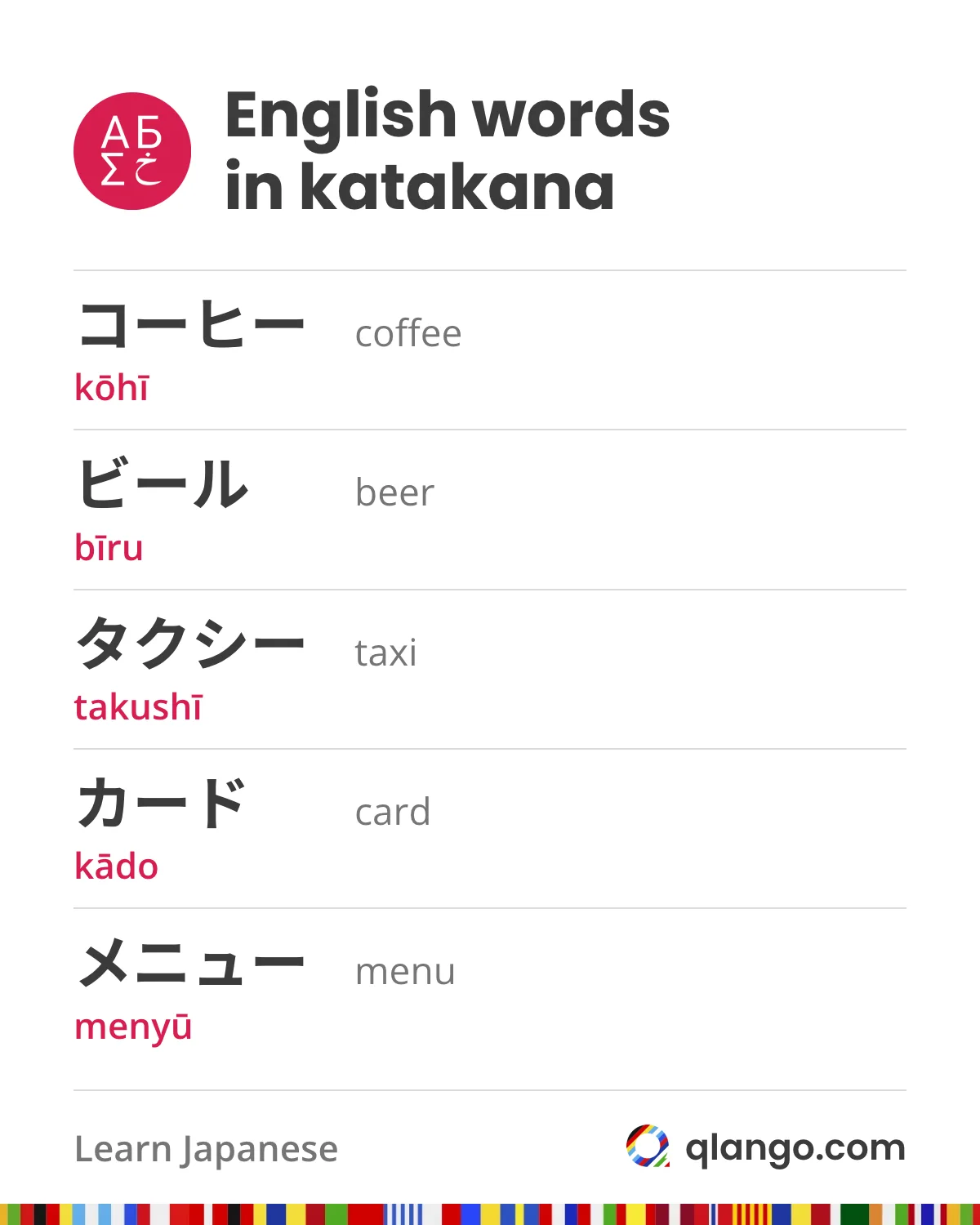
Learn katakana first. It's the script Japan uses for foreign words, so menus, drinks and shop signs turn into English you already know: コーヒー is kōhī, coffee, ビール is bīru, beer, and タクシー is takushī, taxi. Hiragana comes second, and kanji only as a short list of signs.
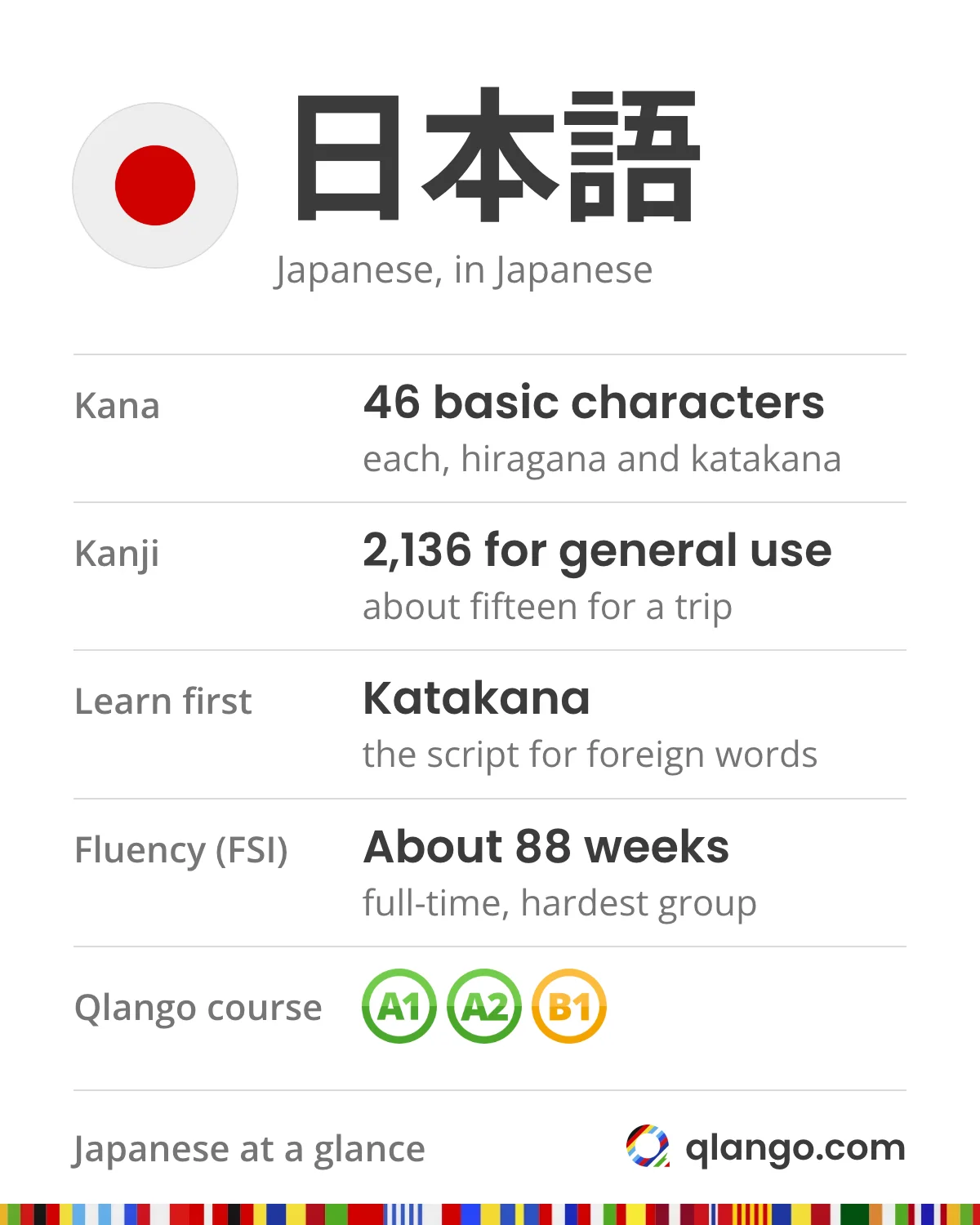
Hiragana and katakana each have 46 basic characters, and a week of daily practice is enough to read katakana slowly. Kanji is on another scale: Japan's official list of kanji for general use has 2,136 characters. For a trip you need about fifteen.
| Sign | Reading | Meaning |
|---|---|---|
| 入口 / 出口 | iriguchi / deguchi | entrance / exit |
| 駅 | eki | station |
| 改札 | kaisatsu | ticket gates |
| 乗り換え | norikae | transfer |
| 東口 / 西口 | higashi-guchi / nishi-guchi | east exit / west exit |
| 男 / 女 | otoko / onna | men / women |
| お手洗い | otearai | restrooms |
| 営業中 / 準備中 | eigyōchū / junbichū | open / not open yet |
| 禁煙 | kin'en | no smoking |
| 押 / 引 | osu / hiku | push / pull |
| 円 | en | yen |
Exits matter: big stations have many, often named by direction, and the wrong one can cost you twenty minutes.
Which Japanese phrases do travelers need most?
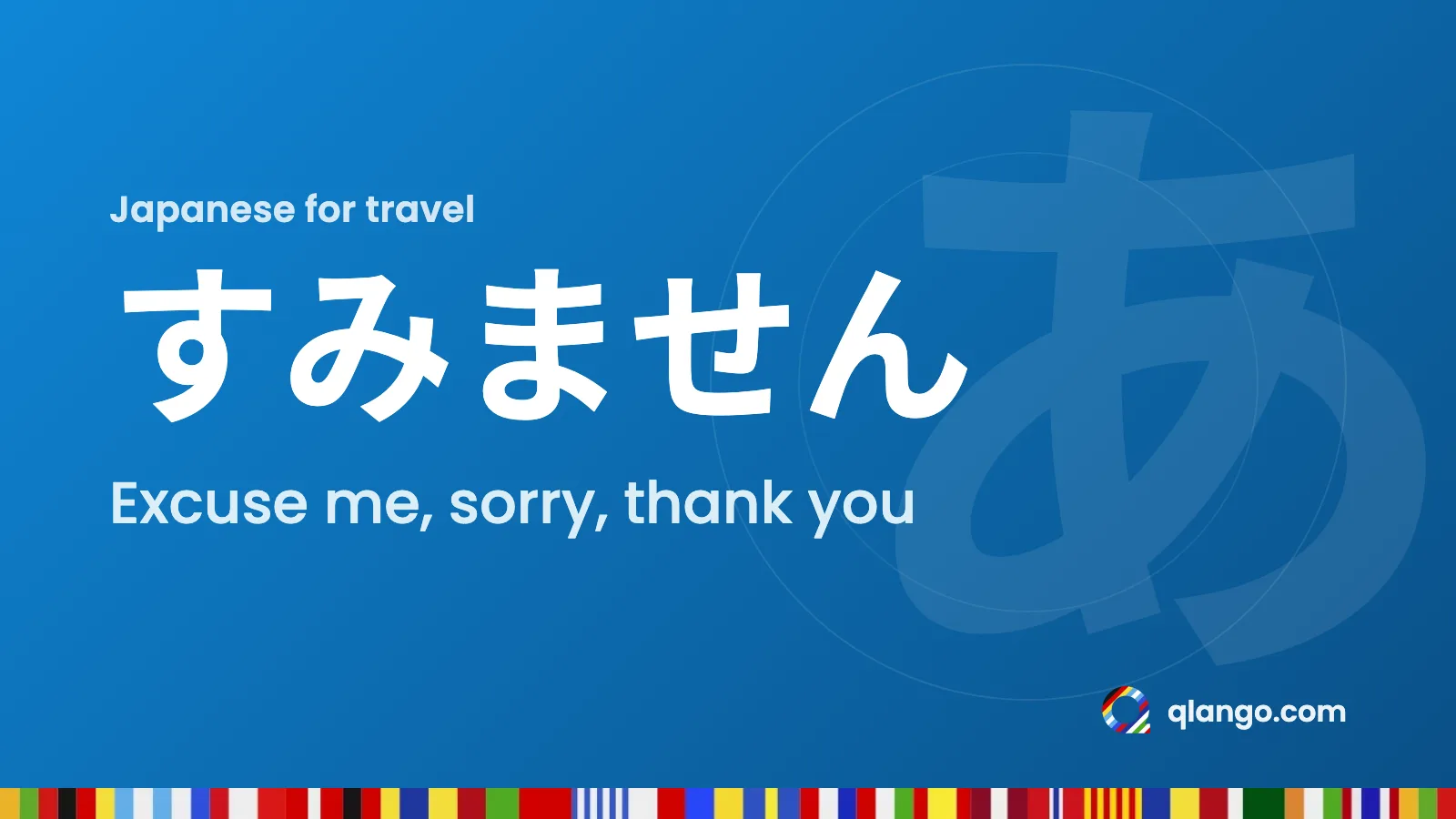
About thirty, grouped by situation. Learn the basics until they come out on their own, then add one situation a week. すみません (sumimasen) does more work than any other word here: it means excuse me and sorry, it calls a waiter, and it thanks a stranger for the trouble of helping you.
The basics
| Japanese | Romaji | Meaning |
|---|---|---|
| すみません | sumimasen | excuse me, sorry |
| ありがとうございます | arigatō gozaimasu | thank you |
| お願いします | onegaishimasu | please (when asking for something) |
| はい / いいえ | hai / iie | yes / no |
| 大丈夫です | daijōbu desu | I'm fine, no thank you |
| わかりません | wakarimasen | I don't understand |
| ゆっくり話してください | yukkuri hanashite kudasai | please speak slowly |
| トイレはどこですか | toire wa doko desu ka? | where is the restroom? |
| いくらですか | ikura desu ka? | how much is it? |
Trains, taxis and shops
| Japanese | Romaji | Meaning |
|---|---|---|
| この電車は京都に止まりますか | kono densha wa Kyōto ni tomarimasu ka? | does this train stop at Kyoto? |
| 大阪行きは何番線ですか | Ōsaka-yuki wa nanban-sen desu ka? | which platform for Osaka? |
| ここまでお願いします | koko made onegaishimasu | to here, please (showing a map to a taxi driver) |
| これを二つください | kore o futatsu kudasai | two of these, please |
| カードで払えますか | kādo de haraemasu ka? | can I pay by card? |
At a convenience store, the clerk will ask you things too. 温めますか (atatamemasu ka?) means "shall I heat it up?", 袋はご利用ですか (fukuro wa go-riyō desu ka?) means "do you need a bag?" and ポイントカードはお持ちですか (pointo kādo wa o-mochi desu ka?) means "do you have a points card?". 大丈夫です (no, thanks) answers all three, and お願いします (yes, please) answers the first two.
Restaurants and hotels
| Japanese | Romaji | Meaning |
|---|---|---|
| 二人です | futari desu | two people (the answer to 何名様ですか, how many?) |
| 英語のメニューはありますか | eigo no menyū wa arimasu ka? | is there an English menu? |
| おすすめは何ですか | osusume wa nan desu ka? | what do you recommend? |
| 卵アレルギーがあります | tamago arerugī ga arimasu | I'm allergic to eggs |
| 肉は食べられません | niku wa taberaremasen | I can't eat meat |
| お会計お願いします | o-kaikei onegaishimasu | the check, please |
| いただきます / ごちそうさまでした | itadakimasu / gochisōsama deshita | said before / after a meal |
| 予約しています | yoyaku shite imasu | I have a reservation |
| 荷物を預かってもらえますか | nimotsu o azukatte moraemasu ka? | could you keep my luggage? |
Emergencies
| Japanese | Romaji | Meaning |
|---|---|---|
| 助けて | tasukete | help |
| 救急車を呼んでください | kyūkyūsha o yonde kudasai | please call an ambulance |
| 財布をなくしました | saifu o nakushimashita | I lost my wallet |
| 英語を話せる人はいますか | eigo o hanaseru hito wa imasu ka? | is there anyone who speaks English? |
Save two numbers in your phone as well: 110 for the police and 119 for an ambulance or the fire service. JNTO also runs the Japan Visitor Hotline, +81-50-3816-2787, which answers in English, Chinese and Korean around the clock (JNTO Visitor Hotline).
How polite do you need to be in Japan?
Polite, not perfect. Use the desu and masu forms, as most phrases above do, start requests with sumimasen, and you'll come across as courteous. Nobody expects a visitor to master honorific grammar, and a small nod of the head works as a bow.
A few habits matter more than words. Don't tip: JNTO points out that tipping isn't common in restaurants, taxis or hotels. Take your shoes off where you see a step up and a row of slippers. Keep your voice down on trains. And never add -san to your own name; it's a courtesy for other people.
Can you learn Japanese by yourself before a trip?
Yes, for travel purposes. A survival kit of phrases, katakana and sign kanji is well within reach of self-study in a couple of months. Fluency is another matter: the US Foreign Service Institute puts Japanese in its hardest group, with about 88 weeks of full-time classes for its diplomats to reach professional level (FSI language categories).
That gap is why travel Japanese works best as a narrow project. Three habits make the difference when you study alone. Say every phrase out loud, because your mouth needs practice your eyes can't give it. Learn numbers early, since prices, platforms, times and room numbers are all numbers: ichi, ni, san, yon, go, roku, nana, hachi, kyū, jū. And learn the other side of the conversation: the clerk's questions above are what you'll actually hear.
How to learn Japanese for travel in eight weeks
One situation a week, 15 to 20 minutes a day, everything said out loud. That covers katakana, hiragana, the sign kanji and the phrases above in seven weeks, with the eighth left for rehearsal. Flying for next spring's cherry blossoms? Count back eight weeks from your departure.
- Week 1: katakana. Ten characters a day, then read every drink can and menu photo you can find.
- Week 2: the basics. The first table, numbers one to ten and prices in yen.
- Week 3: shops. The clerk's three questions, your two answers, and ordering two of something.
- Week 4: trains and taxis. Platform questions and the sign kanji for exits and transfers.
- Week 5: restaurants. Ordering, recommendations, allergies and paying.
- Week 6: hiragana. It makes the particles in your phrases visible and helps with smaller signs.
- Week 7: hotels and emergencies. Learn the emergency lines even if you hope never to need them.
- Week 8: rehearse. Play out whole scenes aloud: arriving at the station, buying lunch, checking in.
How can Qlango help you prepare for the trip?
Qlango's Japanese course runs from A1 to B1. B1 is the level at which, in the Council of Europe's description, you can deal with most situations likely to arise while traveling where the language is spoken (what each CEFR level means).
Lessons are short, which suits a daily pre-trip habit, and spaced repetition brings each word back just before you'd forget it (why that works). The answer modes, picking one of four, building sentences, finding pairs and writing, make you produce Japanese instead of just recognizing it. A weekly learning plan and streaks hold you to your departure date, and games such as Word Duel and MinuteRush turn spare minutes into review.
When you add the course, you choose the language you learn through: your native language, or another one you want to strengthen. It's free to start. Premium adds offline learning, handy on a long-haul flight, and an AI teacher you can ask, as often as you like, why it's kore o kudasai and not kore wa kudasai. Every course is on the languages page.
FAQ
How long does it take to learn basic Japanese for travel?
About eight weeks at 15 to 20 minutes a day covers katakana, survival phrases and the common signs. That won't carry a conversation, but it handles ordering, shopping and trains.
Do I need to learn kanji to travel in Japan?
Only a dozen or so signs, such as 入口 (entrance), 出口 (exit) and 駅 (station). Katakana is more useful for a visitor, because menus and shop signs use it for words borrowed from English.
Is Japanese hard for English speakers?
Fluency takes years: the FSI rates Japanese among its hardest languages. Travel Japanese is a much smaller task: the sounds are manageable for English speakers, and polite phrases are fixed formulas you learn whole.
Your flight date is the best deadline a learner can get. Add Japanese in Qlango, start katakana this week, and by the time you land, すみません will be out before you've had time to think.