Arabic script usually leaves out short vowels and trusts the reader to know them. The Uyghur version of the script writes every one. That single design choice shapes how you learn Uyghur: the alphabet looks forbidding for a week or two, then turns into one of the most reliable parts of the language, because once you can read the letters you can sound out almost any word you see.
In practice, that means giving the script your first two weeks, properly, before anything else. Then move on to how Uyghur builds words, with suffixes stacked on a root and vowels that adjust to fit, and to vocabulary, which mixes Turkic roots with Persian and Arabic loanwords and a layer of Russian and Chinese ones. At twenty to thirty minutes a day, you can expect to read simple words by the end of week two and write short sentences by the end of the month.
Where Uyghur is spoken
Uyghur is spoken mainly in the Xinjiang Uyghur Autonomous Region in northwest China, in cities like Ürümqi, Kashgar, Hotan and Turpan, and by Uyghur communities in Kazakhstan, Kyrgyzstan and Uzbekistan. There's a diaspora in Turkey, Europe and North America as well. Estimates put the number of speakers at around ten million or more.
It's a Turkic language of the Karluk branch, and its closest relative is Uzbek; both descend from Chagatai, the old literary language of Central Asia. Kazakh and Tatar are cousins from another branch, with plenty of shared words and rather different sound systems. Speakers of Turkish will recognize a good deal of basic vocabulary.
Three scripts, one standard
In China, Uyghur is written in an Arabic-based alphabet of 32 letters, read right to left. That's the script of books, newspapers and most teaching material. A Latin transcription is widely used for typing and online, and Uyghurs in Kazakhstan and Kyrgyzstan have used Cyrillic. If you're starting from zero, learn the Arabic-based script. It's what you'll need to read anything substantial, and putting it off only makes it harder later.
How to learn Uyghur's alphabet
The mechanics are the same as in Arabic: letters join, and most have different shapes depending on whether they stand alone or sit at the start, middle or end of a word. What's different is the vowels. Uyghur has eight, and each has its own letter:
| Letter | Latin | Sound |
|---|---|---|
| ا | a | as in "father" |
| ە | e | an open "e", close to the "a" in "cat" |
| ې | é | as in "they", without the glide |
| ى | i | as in "machine" |
| و | o | as in "port" |
| ۇ | u | as in "rule" |
| ۆ | ö | like German ö |
| ۈ | ü | like German ü |
A word can't begin with a bare vowel letter; it takes a small carrier, ئ, first. You can see it at the start of the language's own name, ئۇيغۇر. There are also letters for sounds Arabic lacks, such as پ (p), چ (ch), ژ (zh), گ (g) and ڭ (ng). If you already read Arabic or Persian, the shapes will look familiar and only the vowels are new. If you don't, two weeks of daily practice will get you reading slowly, and slow is fine.
First words
| Uyghur | Latin | Meaning |
|---|---|---|
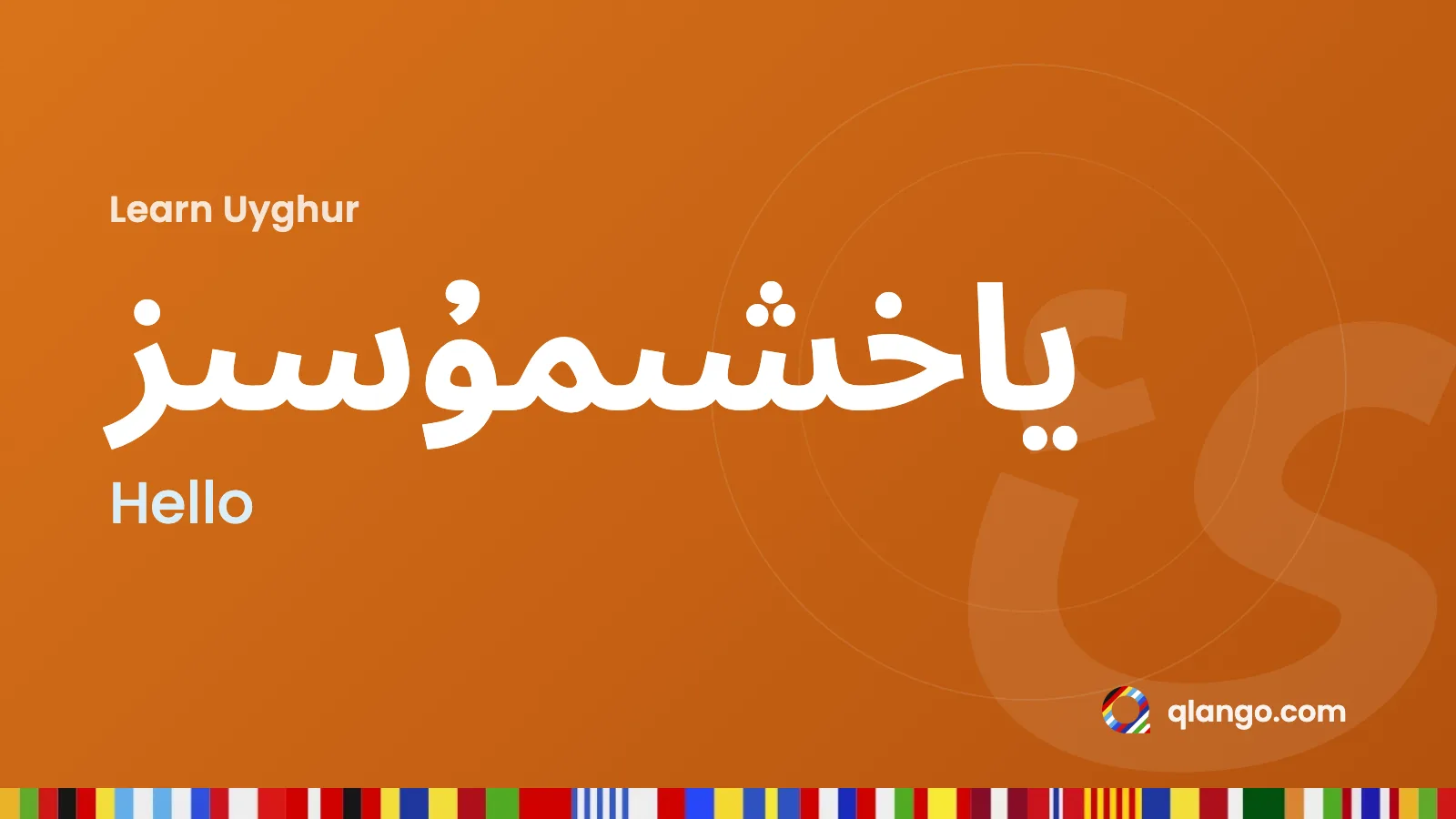
| ياخشىمۇسىز | yaxshimusiz | hello, how are you (polite) |
| رەھمەت | rehmet | thank you |
| ياق | yaq | no |
| خەير خوش | xeyr-xosh | goodbye |
| كىتاب | kitab | book |
What's easy and hard about the grammar
The grammar is regular, with no grammatical gender and no articles. Words grow by adding suffixes, and the suffix vowel usually follows the word: kitab (book) becomes kitablar (books), but öy (house) becomes öyler (houses). The verb comes at the end of the sentence, and the little words English puts before a noun, like "in" or "from", come after it in Uyghur, as endings or separate words.
What's hard is the volume of new things at once: a new script, vowel harmony, and vowels inside a word that sometimes shift when suffixes are added, so a word can look different from its dictionary form. Vocabulary arrives from several sources at once. And the throat sounds written ق and غ take practice.
Why Uyghur courses are hard to find
Most Uyghur teaching material was written for Chinese or Russian speakers, or for linguists, and very little of it explains the language in plain English. Studying in the region itself isn't a realistic option for most learners today. Much of the teaching that does happen takes place in diaspora families and community classes, which is why many heritage learners can understand their grandparents and still can't read a page of Uyghur. A search for ways to learn Uyghur online mostly turns up alphabet charts and old PDFs.
A four-week plan
| Week | Focus | Goal for the week |
|---|---|---|
| 1 | The eight vowel letters and the most common consonants | Read short words letter by letter |
| 2 | The remaining letters, joined forms, the first words above | Read and copy the first-words table without help |
| 3 | Pronouns, numbers, plurals with -lar and -ler | Introduce yourself in writing |
| 4 | Common case endings, present tense, verb-final sentences | Write five sentences about your day |
Write by hand during the first two weeks. Your hand learns the joined shapes faster than your eyes do.
How Qlango teaches Uyghur
Qlango teaches Uyghur at A1 and A2: a beginner foundation, in the sense explained in our guide to what the CEFR levels mean. By the end you can greet people, introduce yourself, handle simple everyday situations and read short, simple texts. The course is taught through the language you pick, English for most people reading this. Lessons are short, and flashcards with spaced repetition bring words back when you're about to forget them. Picking one of four and finding pairs let you get used to a word before you have to write it, which is a sensible order for anyone facing a new script. With Premium, the AI teacher answers grammar and vocabulary questions, such as why a vowel changed when you added a suffix. The languages page shows every course and level.
Questions people ask
Is Uyghur hard to learn?
For an English speaker, the first month is slower than with a Latin-script language, because of the alphabet. After that, the regular grammar helps a lot. Vocabulary is the long-term work.
Is Uyghur the same as Uzbek?
No, but they're close relatives from the same branch of Turkic, with a lot of shared vocabulary. Uzbek is written mainly in Latin letters today, while standard Uyghur uses the Arabic-based script, so even shared words look different on the page.
Can I learn Uyghur online for free?
You can start for free. Qlango is free to begin, and Premium opens the whole app, including offline learning and the AI teacher, on a monthly, yearly or one-time Forever plan. Alphabet charts and online dictionaries are useful free extras once you can read the script.
Learn the eight vowel letters this week, then do the first A1 lesson. Once you can read ئۇيغۇر without counting letters, the hardest part of month one is behind you.